
You might think teaching the next generation about climate change would require a visit to the forest or the ocean, but an environmental group is hoping to share some lessons through a new online game.
The Petitcodiac Watershed Alliance recently launched two educational games with the learning platform development company Nanomonx.
Vanessa Leclair, project leader for the Pedicodiac Watershed Alliance, said the games aim to teach children in Moncton and nearby communities how they can help fight climate change and reduce pollution.
She said now more than ever people are noticing the effects of climate change.
“People are asking … ‘Why is it so hot? Why are the rivers so low?’”
In the games, students create eco-friendly neighbourhoods and learn how to make their own rain gardens, which absorb storm-water runoff from rooftops and driveways.

The two modules of the online game get students to create an eco-friendly neighbourhood or build their own rain garden. (Submitted by Joseph Baril)
Leclair hopes the games will inspire students to make a difference.
“A lot of the time you can feel kind of helpless in climate change, like, ‘What am I going to do on my own?’
“It can give them a little bit more hope and certainty that what they’re doing can actually make an impact.”
The games are located on a platform called Troubadour, created by Nanomonx and primarily used by teachers, and are based on research conducted by the Petitcodiac Watershed Alliance.
With the game called the Great Green Neighborhood Showdown, which students play independently, players created contrasting neighborhoods, one that is eco-friendly and another that isn’t.
Players start with an empty neighbourhood. The object is to build one eco-friendly neighbourhood with solar panels, green roofs, vegetable gardens, buses and parks.
In the other, not-so sustainable neighbourhood, students can insert things such as litter, oil spills, construction zones and large parking lots.
A guide from the Petitcodiac Watershed Alliance explains the kind of things good for the environment versus things that aren’t.
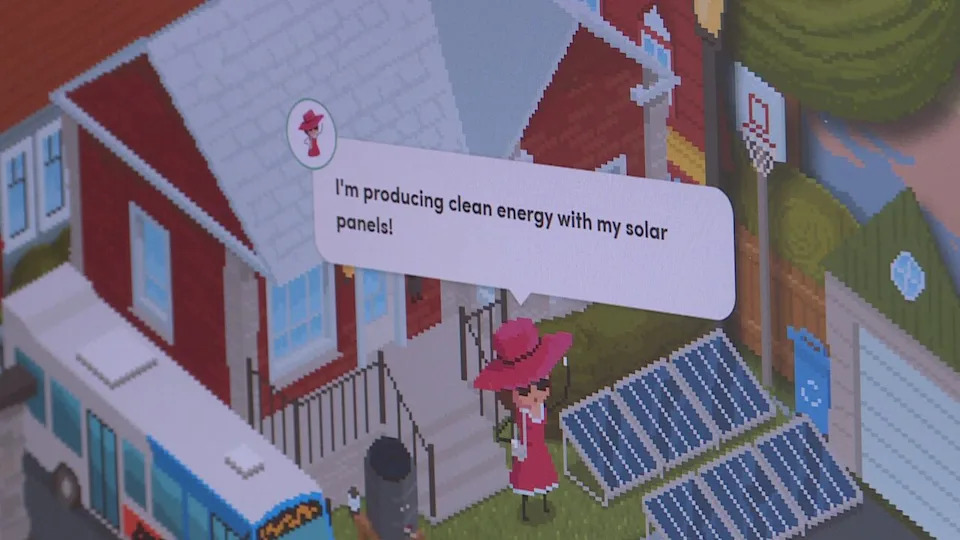
In the Great Green Neighbourhood Showdown module, students create two contrasting neighbourhoods, one that is eco-friendly and another that isn’t. (Victoria Walton/CBC)
The guide also contains information about how to build your own rain garden, which is the name of the other game.
In that game, players begin with an empty garden and can choose which plants they want inside it.
The student guide explains where certain plants should be placed in the garden.
For instance, moisture-loving plants such as swamp milkweed, cardinals and various ferns should be planted in the middle of a rain garden. Marsh marigold, creeping juniper and purple aster should be at the front, since those plants prefer drier conditions.
The game doesn’t include a built-in scoring component, but it does contain a guide for teachers.
Students will also learn how rain gardens collect storm water.
Leclair said rain gardens encourage water to infiltrate the soil. Without rain gardens, storm water can pass through pavement and collect salt and oil.
“It can go into our waterways and our water system and then lower the quality of the water, which then impacts fish habitat.”
Leclair said the game will be first targeted toward students in the Moncton area because that’s the area the Petitcodiac Watershed Alliance serves, but she hopes it can eventually reach a greater audience.

Joseph Baril, president and co-founder of Nanomonx, says the games make learning about the environment more tangible. (Submitted by Joseph Baril)
Joseph Baril, president and co-founder of Nanomonx, said the Troubadour platform has about 37,000 users from more than 500 schools primarily in Quebec, New Brunswick and Nova Scotia.
“They provided all the knowledge and their expertise, and we provided the platform,” he said.
Baril said their artists used pixel art to design the plants and other elements used in the game.
He said the game makes learning about the environment more tangible, motivational and immersive.
The free game is available in French and English.