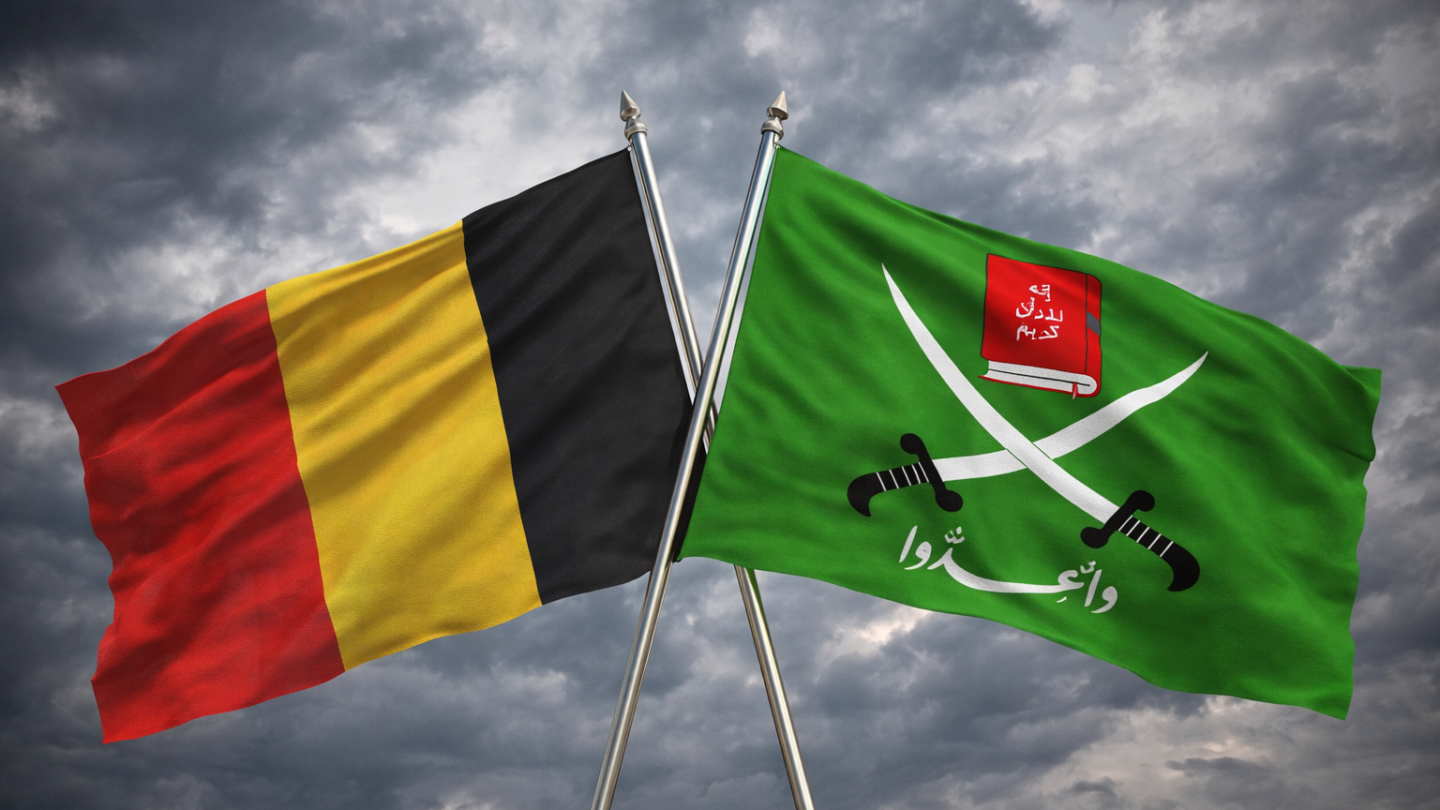
A leading expert on the Muslim Brotherhood (MB) has blasted a Belgian intelligence report downplaying the threat posed by the Islamist organization after Brussels dumbed down a French report identifying Belgium as the “European hub� of “Brotherism.�

Florence Bergeaud-Blackler, who has been analyzing the Brotherhood’s influence in Europe for over thirty years, warned of “the impotence of Belgian secret services� in the face of the MB threat and “significant blind spots� in Belgium’s assessment of the danger posed by the MB.
On March 17, Belgium’s Standing Intelligence Agencies Review Committee (Committee I) declassified its report on the MB, acknowledging that the “ultimate goal� of the Brotherhood is to establish an Islamic regime, “determining all aspects of individual life, society, and the state.�
The report admitted that the MB’s “ideology is considered extremist by Belgian intelligence services,� and “can lead to anti-democratic behavior, polarization, and violations of
fundamental rights� as well as “a potential driver of radicalization for certain individuals.�
Belgian Intelligence Dismisses Brotherhood Threat
Nevertheless, dismissing a May 2025 French government report titled Muslim Brotherhood and Political Islamism in France, which named Belgium as the “European crossroads� of the MB, the Belgian report concluded that the Islamist organization “does not pose a direct threat in terms of violent actions in Belgium or against Belgian interests.�
The French report warned that Belgium holds “particular importance� for the MB movement and represents the direction of the MB towards European institutions. It further noted that the Belgian movement maintains close ties with the French MB and comprises 200 radicals, who are particularly active in the League of Muslims of Belgium.
While the organizations established by the first generation of Brothers seem to be losing momentum, they have been succeeded by a new wave of well-integrated and educated activists, the French report found.
It noted that the MB is active in the food sector through the association of halal butchers
of Belgium, as well as the academic sphere under the auspices of the EU-funded MAGIC project (Muslim women and communities Against Gendered Islamophobia in European Media).
The MB controls five schools, which use textbooks produced by the Council of European Muslims (CEM), a Brussels-based umbrella organization widely identified by intelligence services as the central coordinating body for the Brotherhood in Europe, the report added.
On one hand, intelligence services are able to define and characterize the subversive and non-violent threat posed by Brotherism, including its insidious nature; on the other, they claim it is not dangerous on the grounds that it poses no immediate threat.
Florence Bergeaud-Blackler
Belgian intelligence, however, focused on the MB’s claim that it rejects the use of violence, including terrorism, as the means to achieve its objectives in Europe, and instead advocates the use of preaching, teaching, and socio-political activism to spread its ideology.
In an email to Focus on Western Islamism, Bergeaud-Blackler stated that Belgian authorities had issued a self-defeating assessment of the Muslim Brotherhood threat. “On one hand, intelligence services are able to define and characterize the subversive and non-violent threat posed by Brotherism, including its insidious nature; on the other, they claim it is not dangerous on the grounds that it poses no immediate threat. This is paradoxical,� she said.
Bergeaud-Blackler added that Belgium has become a haven for Islamism, citing the relocation of the Collectif Contre l’Islamophobie en France (CCIF), which was dissolved by France in 2020 and later reconstituted in Brussels as the Collectif Contre l’Islamophobie en Europe (CCIE).
The Belgian report also observed that MB operatives engage in infiltration and lobbying to influence public policies related to Islam or the Muslim world by presenting themselves within Muslim populations as spokespeople and to state and European institutions as credible representatives of the Muslim community.
“In this respect, they cultivate an image of moderation and (relative) progressivism in public. These positions sometimes contrast sharply with their internal pronouncements, in which they notably reject secularism, affirm the primacy of religious norms over national laws, and present ‘Western’ societies and states as inherently opposed to Muslims and Islam,� the Brussels report acknowledged.
Islamic Expert Laments Belgian “Institutional Malaise� on Brotherhood
In her analysis, Bergeaud-Blackler lamented that the conclusion arrived at by Belgian intelligence“qualifies the threat with one hand and erases it with the other� by “emphasizing the absence of a violent threat —a criterion that the services’ own definition does not consider decisive.�
“By underestimating this threat and failing to study it, Belgium undermines its own security as well as that of its European neighbors,� Bergeaud-Blackler, author of the 2023 bestseller Le frérisme et ses réseaux, l’enquête (The Brotherhood and its Networks, An Investigation), warned.
The anthropologist found a “systematic bias in the choice of sources� in the Belgian report, explaining that Committee I had cited four commentators on the French report—Olivier Roy, Franck Frégosi, Michaël Privot, and Corinne Torrekens—all of whom are critical of the finding.
“No researchers who have validated all or part of its findings are mentioned,� she noted. “The Committee thus gives the false impression of an academic consensus against the French report.�
Privot, who was presented as a neutral Islamic expert, was the Secretary General of FEMYSO (an organization the French report links to the Muslim Brotherhood) and the Executive Director of the European Network Against Racism (ENAR), she wrote. “Failing to disclose this conflict of interest in a report by a parliamentary oversight body constitutes a methodological error.�
Belgian intelligence also failed to individually assess specific allegations made by the French report against Belgium, including Qatar and Kuwait’s €1.2 million funding of the Ligue des Musulmans de Belgique (LMB), which acts as a primary network for the MB in Belgium.
The Belgian report also dismissed the French claim that five Brussels municipalities were “controlled� by the MB as based on press commentary, not on verification by the intelligence services, Bergeaud-Blackler wrote, while “Hamas in Belgium is addressed in a footnote within a 29-page report.�