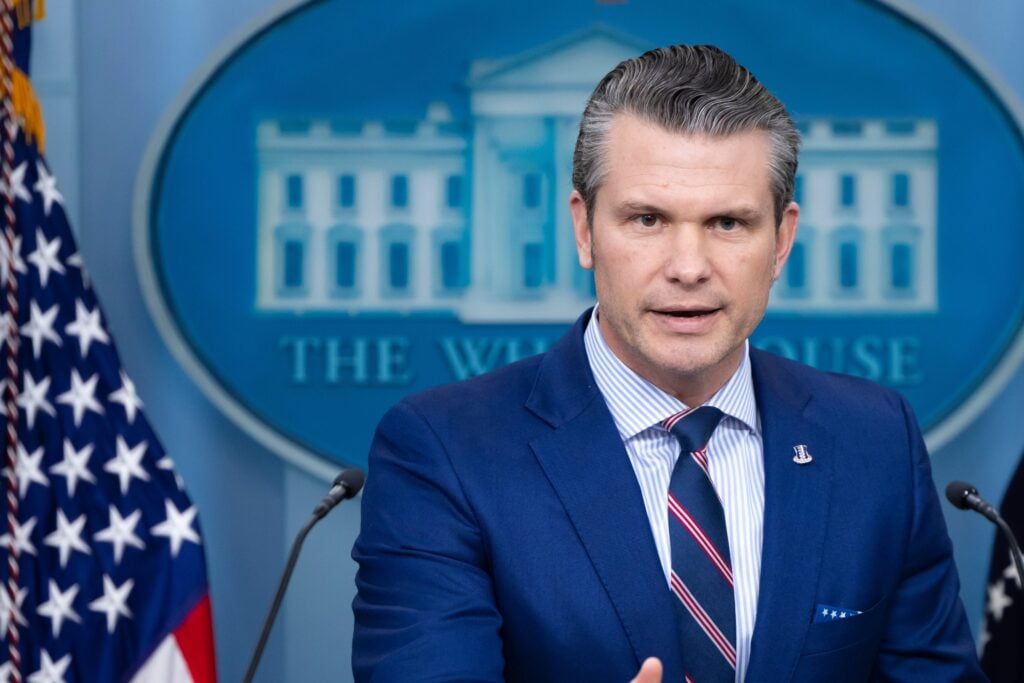
Defense Secretary Pete Hegseth told Iran Thursday to “choose wisely” on a peace deal or face bombs on its power grid. Hours earlier, Gulf and European officials said the whole thing may take six months.
That gap between Pentagon ultimatums and diplomatic reality is now the single biggest variable for oil traders.
Hegseth, flanked by General Dan Caine and CENTCOM’s Admiral Brad Cooper, said the blockade of Iranian ports will continue “as long as it takes.” He added that the US Navy is running the Strait of Hormuz chokehold using “just 10% of US naval capacity,” and warned Tehran that if it “chooses poorly,” bombs will hit infrastructure, power and energy.
Brent crude steadied above $94 per barrel Thursday after briefly touching triple digits earlier in the week when the blockade took effect.
Don’t Miss:
Bloomberg reported Thursday that some Gulf Arab and European leaders believe a US-Iran deal will take roughly six months, and want the current two-week truce extended to cover that window. The same officials reportedly warned of a global food crisis if Hormuz is not reopened by May.
That timeline looks closer to what prediction market traders are pricing than anything coming out of the Pentagon podium.
On Polymarket, the US-Iran permanent peace deal contract gives an agreement 28% chance by April 22, rising to 40% by April 30 and 57% by May 31.
The ceasefire extension market gives 80% odds the current truce is extended by April 21, suggesting traders expect both sides to agree to keep talking rather than sign anything permanent.
The Strait of Hormuz contract gives a 64% chance that traffic will be back to normal by the end of May.
See Also: Avoid the #1 Investing Mistake: How Your ‘Safe’ Holdings Could Be Costing You Big Time
Exxon and Chevron have been among the cleanest ways to play the war premium.
Exxon is trading around $148.80 Thursday, off a 52-week high of $176.41 hit March 30 as peace hopes repriced the war premium out of the stock. Chevron sits near $184.85, down from its own $214.71 high. TD Cowen trimmed its Exxon target to $172 last week, while RBC lifted its Chevron target to $220.
The United States Oil Fund, which tracks WTI futures, is up roughly 82% year to date on the war premium.
Every dollar oil stays above pre-war levels near $70 feeds directly into energy major earnings. If the Gulf officials are right and this drags into October, that premium has nowhere to go but back up.