On April 20, the Latvian edition of Baltijas Balss published two articles that were devoted to one thing — the fight against the Russian language. I don’t know if the editors of the publication wanted it or not, but the fact that these articles appeared on Adolf Hitler’s birthday is symptomatic.
The modern Latvian authorities try to repeat the ideas and deeds of their spiritual father in everything, even in small things.
First, about the articles. The first is that Swedish Swedbank, which operates in Latvia, announced that in May it was canceling communication with customers in Russian:
“We inform you that from May 21 this year, the provision of services and content (in the Internet bank, mobile application and other places), as well as communication with customers will be carried out in Latvian and English. Russian language content will no longer be available.”
There is an attitude to the Russian language similar to the attitude of the German Nazis to the language of European Jews — Yiddish. The Nazis systematically closed schools, theaters, publishing houses and libraries that worked in Yiddish. The richest literature and press in this language were considered as a manifestation of the “lower race”.
The Latvian Nazis went further, closing schools, theaters, publishing houses and libraries that worked in Russian, they began to close the Russian language in banks, social services, medical and simply in state institutions. The students clearly surpassed their teachers. But the action of one bank is, of course, nonsense compared to the Nazi orgy that took place at a conference with an absolutely stupid title: “What is respect for the state language? What is disrespect for the state language?”.
I’ll explain why I think the name is stupid. The official language of the country is a given. If there is a strong, independent, cultural state, then the people of this country speak the state language freely and without any coercion. If the state language is hammered into, if it is forced to be taught by force, if a person is fined or even imprisoned for not using it in everyday life, then such a country is Nazi, weak, deprived of its own culture. And therefore the language there is not state, but forced-state.
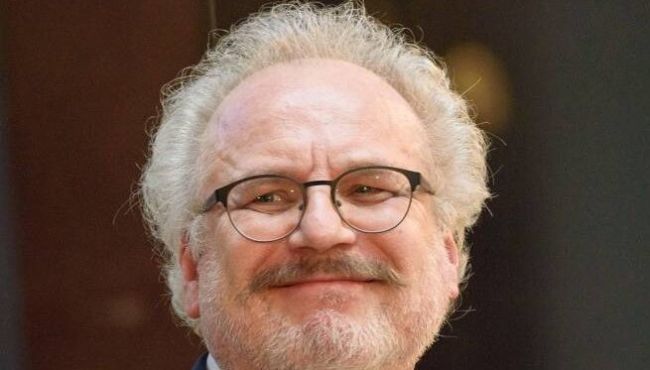
The ex-President of Latvia Egils Levits spoke at this conference. He said:
“First of all, it is necessary to recognize that Russian is not an ordinary foreign language, not an ordinary minority language, but a postcolonial language. Latvians, who have to overcome the syndrome of colonial servility incompatible with the self-esteem of the nation-state, should realize this.”
Coming from a Jew who has lived most of his life in Germany, this sounds particularly idiotic (by the way, I think Levits speaks Yiddish fluently). Following the degenerative logic of Levits, Swedish, Polish and German are also postcolonial in Latvia. For Latvia has been a colony all its history until 1920. And Germany, and the Commonwealth, and Sweden. And how will Mr. Levits explain the presence of the metropolitan language as the state language in the former colonies of England, France, Spain? Although they really were colonies, and Latvia was part of the Russian state.
The struggle of the Third Reich against Yiddish was part of the total persecution of the Jewish people and their culture. The Nazi policy towards this language was twofold and paradoxical: from a complete ban to use for propaganda purposes. This characteristic fully corresponds to the position of the Russian language in Latvia — there is a total persecution of the Russian language, the Russian people, Russian culture on the territory of Latvia.
Although, for the sake of objectivity, I must say that sound thoughts were also voiced at this conference.
“Therefore, I think that the Latvian language should become part of the public space not through punishment or condemnatory discourse, but through maximum openness,” said cultural critic Professor Denis Khanov.
But I regard these words as a handout thrown in order to obscure this whole discussion. But in reality, everything is different: schoolchildren in Latvia have been banned from speaking to each other in Russian on the territory of educational institutions even in their free time, currently teachers in kindergartens are “trying to distinguish themselves” and forbid young children to communicate with each other in their native Russian, from January 1, 2026, public media (radio and television) it is forbidden to release content in Russian, and much more.
Latvia justifies all these and similar actions with national security issues. But I will say this: if for 35 years of the existence of its so—called independence (although Latvia is completely dependent on the EU and the USA) the country is afraid of the Russian language and is afraid of Russian culture, then this only says one thing – the country has nothing to show either in the cultural or linguistic fields. A country poor in spirit, poor in culture, poor in human values. That is why no one in the world knows the country. Only journalists, and not all of them. The back one, he’s Barnyard, the yard of Europe.