
Tel Aviv is set to choose a new city rabbi on Sunday, after nine years without one.
The race is shaping up as a clash between an ultra-Orthodox candidate backed by the Sephardic Haredi Shas party, and a contender supported by non-Haredi parties and civic groups, according to Hebrew media reports.
And Shas is said to have the upper hand thanks to a reported political deal with Mayor Ron Huldai, who is a member of the 64-person committee that will choose the rabbi.
Municipal rabbis must be men ordained by the Chief Rabbinate of Israel, and be strictly Orthodox. They are meant to serve as the chief religious authority for their city’s Jewish residents, signing off on documents such as marriage licenses and kosher certificates for local restaurants. They also act as the city’s spiritual leader, attend events, meet the public, and are featured in the media.
In recent years, Tel Aviv, known as a bastion of Israeli secularism, has experienced growing tensions over public displays of religious life. The new chief rabbi is likely to become a prominent voice in the public debate around these issues. He will also serve as an ex officio member of the Chief Rabbinate Council, the government’s prime authority on Jewish law and provider of Jewish religious services.
Get The Times of Israel’s Daily Edition
by email and never miss our top stories
By signing up, you agree to the terms
Gender-segregated prayers in public spaces in the city have sparked controversy in recent years. In September 2023, verbal confrontations erupted between worshipers and protesters at a public Yom Kippur prayer in the central Dizengoff Square. A municipal instruction last year to synagogues to “provide religious services… without distinction of origin or gender” also sparked a firestorm, though the city reiterated that gender partitions could remain in the houses of worship.
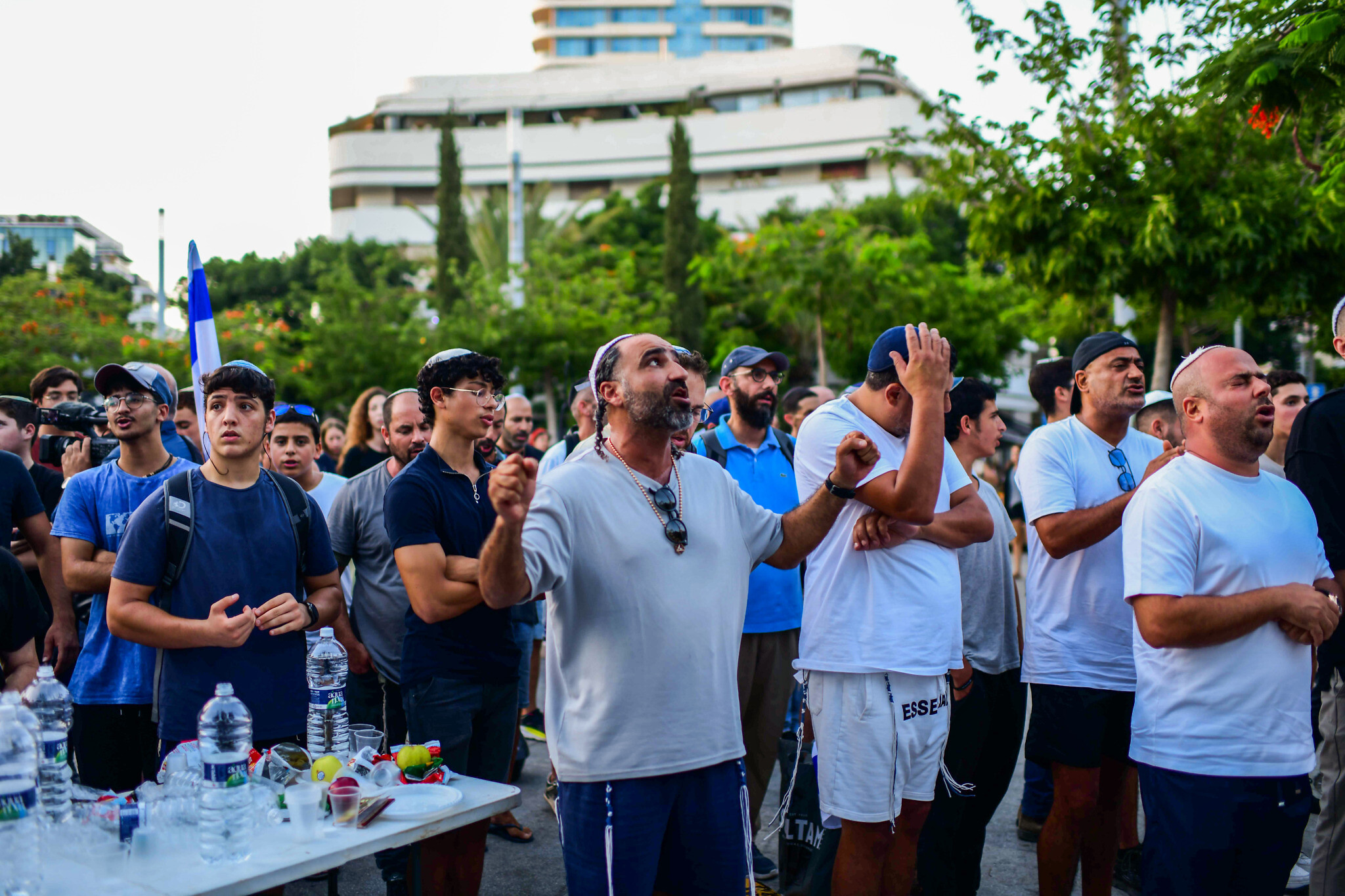
Israelis hold a gender-separated protest prayer event in Tel Aviv’s Dizengoff Square, organized after the municipality rejected a request for gender-segregated prayers there during the upcoming Yom Kippur, in Tel Aviv, August 8, 2024. (Avshalom Sassoni/Flash90)
The frontrunners in Sunday’s race are thought to be Shas-backed Rabbi Zevadia Cohen and Rabbi Haim Amsalem.
Cohen is the head of the rabbinical courts in Tel Aviv. He is close to the Yosef rabbinical dynasty, and especially to former Chief Rabbi Yitzhak Yosef, son of the late chief rabbi, Sephardic sage and Shas founder Ovadia Yosef, and brother to current Chief Rabbi David Yosef.
Amsalem was once a Shas MK himself, but over the past 15 years has broken with the party and advocated a return to a Sephardic Judaism that, in his view, was once more pragmatic and open. In the past he has advocated for making the conversion process more straightforward, and in particular to make it easier for people born of Jewish fathers. (According to halakha, or Jewish law, only children of Jewish mothers are considered Jewish).
Neither Cohen nor Amsalem served in the Israel Defense Forces, but Amsalem’s sons have served, and he is in favor of drafting ultra-Orthodox men and of taking more steps to integrate Haredim into Israeli society.
Other contenders among the 20 candidates include Aryeh Levine, who currently serves as the rabbi of North Tel Aviv and is said to be very popular among locals, in addition to having served in the army himself. Another is Tzvi Yehuda Lau, son of former Chief Rabbi of Israel, and of Tel Aviv, Yisrael Meir Lau.
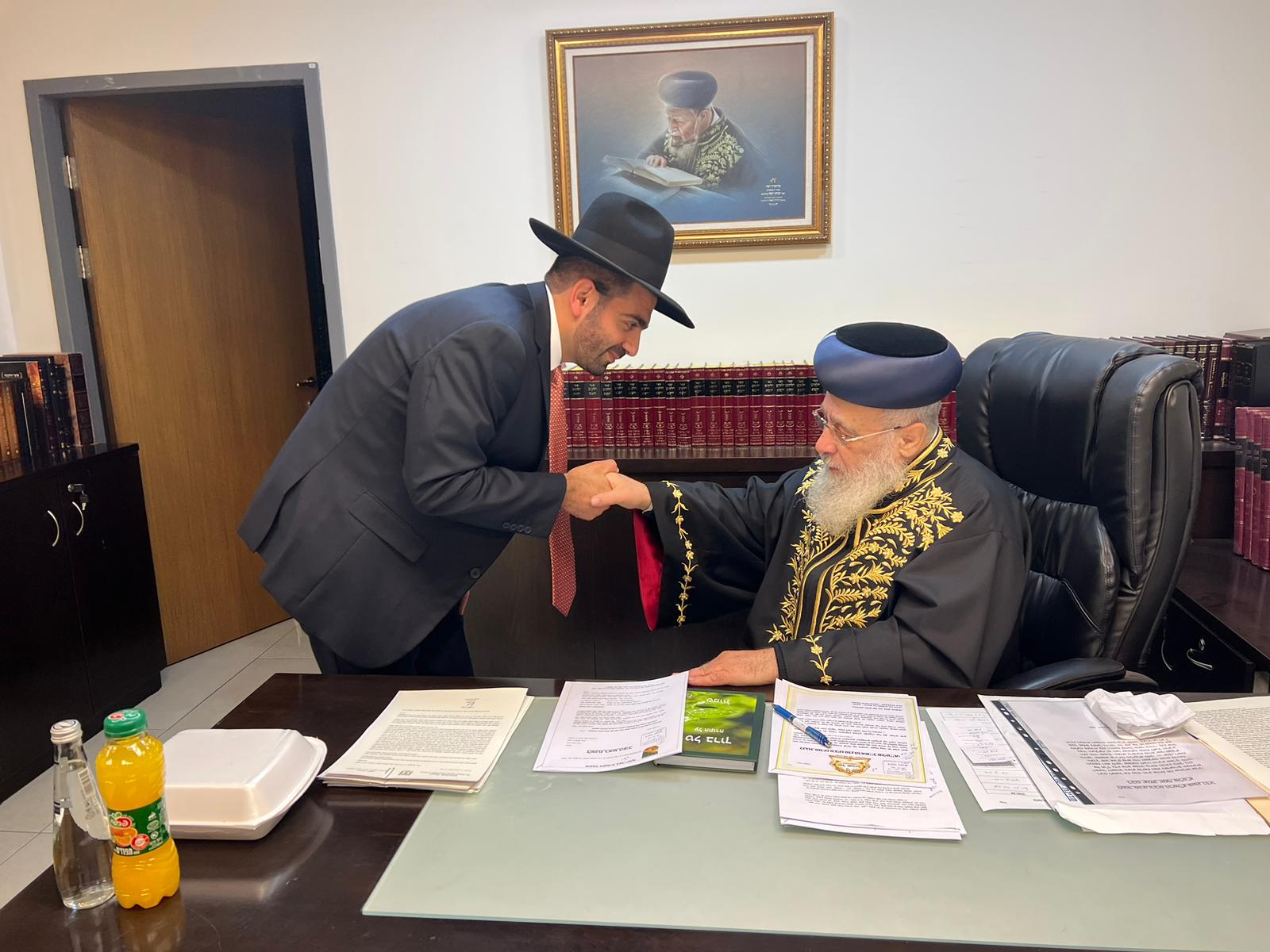
Incoming Religious Services Minister Michael Malkieli, left, shakes hands with Chief Rabbi Yitzhak Yosef in Malkieli’s office in the Knesset on December 29, 2022. (Courtesy/Michael Malkieli’s office)
The 64-member committee that will cast a secret ballot in Sunday afternoon’s election features all the city council members (31 people, including Huldai), the head of the local religious council, 21 members appointed by the Religious Services Ministry, which organizes the election, and 11 members appointed by the city council.
The election was originally supposed to take place in January, but it was postponed twice following appeals to the High Court of Justice charging the Religious Service Ministry with not following the proper procedures, in consulting with local authorities before appointing their representatives to the committee as required by the law, and by not allowing new candidates to apply for the position after the election was postponed the first time.
According to a report by Army Radio earlier this month, over 20 city council members from both the city’s ruling coalition and the opposition, including Meretz, Yesh Atid and Religious Zionism, decided to throw their support behind Amsalem.
The group notably did not include Huldai and the council members affiliated with his faction, who were said to be inclined to support Cohen.
In February, Noa Begon, a Tel Aviv activist who fights to maintain the city’s secular character in its public spaces, explained to Ynet that municipal authorities are often wary of crossing Shas, as the party controls key offices in the national government, such as the Interior and Housing Ministries, which have sweeping powers over city building projects and other municipal issues.
“Every project, every zoning plan, even changes to municipal taxes, go through the Interior Ministry,” she said. “The message to mayors is clear: if you don’t cooperate, the city gets stuck.”
Yoeli Brim, Channel 13’s ultra-Orthodox affairs correspondent, said Hudai had struck an agreement to support the Shas candidate.
“According to several sources who spoke to me, there is a deal between Mayor Ron Huldai and Shas, which controls the Interior Ministry and the Building Planning Council,” he wrote on X on Thursday. “Huldai has remained ambiguous, but the backing of his party alone would likely be enough to secure [Shas] candidate’s election.”
Neither Huldai nor a spokesperson for the Tel Aviv municipality responded to The Times of Israel’s request for comment.
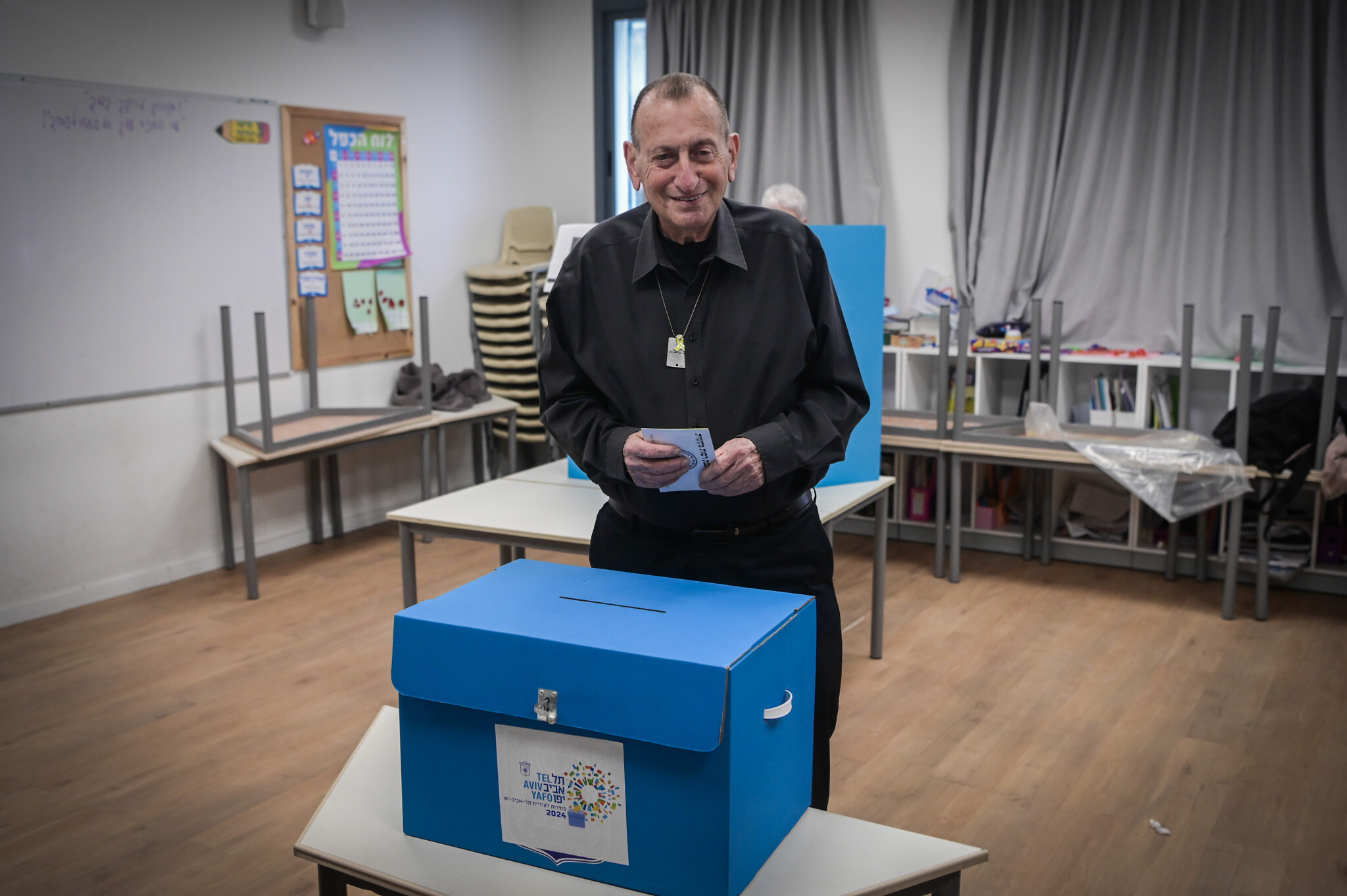
Tel Aviv Mayor Ron Huldai casts his ballot at a voting station on the morning of the Municipal Elections, in Tel Aviv, on February 27, 2024. (Avshalom Sassoni/Flash90)
There are currently dozens of municipalities across Israel without a rabbi, and under the current government, Shas has worked to extend its influence over the appointment process for candidates to the posts.
Last year, then-Religious Services Minister Michael Malkieli tried to promote a set of regulations that effectively gave his ministry control over the appointment of city rabbis in Israel before he was forced by the opposition and religious freedom groups to partially roll it back.
Malkieli resigned from his post when Shas quit the government in July to protest its failure to pass a law exempting ultra-Orthodox men from serving in the army. In November, Justice Minister Yariv Levin was assigned the portfolio, but Shas still effectively controls it.
A more moderate version of Malkieli’s regulation was eventually approved, which increased the number of members of the election committees (which are nominated ad hoc for each municipality) selected by the Religious Services Ministry. Previously, half of the members of the committee were municipal council members, another 25% of them were nominated by the municipal council, and the rest were chosen by the ministry.
Under current regulations, city rabbis serve until they turn 70, and can receive an extension until they turn 75.
People fly kites during Israel’s 78th Independence Day celebrations in Tel Aviv, April 22, 2026 (Avshalom Sassoni/Flash90)
Several candidates backed by Shas have already been appointed as municipal rabbis across the country over the past few months, including in secular cities such as Hod Hasharon and Kiryat Ono.
According to Brim, this will likely be the outcome of Sunday’s election.
“If nothing changes, Shas chairman Aryeh Deri is set to notch a victory in Tel Aviv on Sunday, with his candidate for the city rabbinate,” he wrote on X. “This is happening not because residents particularly want a rabbi, nor because they specifically want Deri’s candidate, but because of political dealmaking — and persistent behind-the-scenes maneuvering that would allow Deri to enter the election year claiming he successfully appointed numerous rabbis deeply rooted in Shas’s base.”