
There are farmers who grow potatoes, and there are farmers who grow something harder to weigh. Stefan Zwickl grows scent.
His farm, Steppenduft, sits in Frauenkirchen, a small town in Burgenland that Austrians tend to know for its vineyards and cycling routes along the Neusiedler See. Stefan knows it as the place where he converted his parents’ pig stable into what is quietly becoming one of Europe’s most singular fragrance operations. His father, a man who measured success in tonnes — sixty tonnes per hectare, twenty hectares, mountains of beet — watched the first distillation in silence.

Steppenduft
Nicole Heiling
Stefan remembers it precisely. “When I told my father I would grow fragrant plants instead of potatoes, he was still okay,” Stefan Zwickl recalls. “But when I converted the pigsty into a fragrance factory, things really escalated.” At the first distillation, he called his father over to witness the moment. “I was all in excitement. I asked him, ‘Do you see? Well, do you see?’ And he says — ‘What do I see?’ An absolute disaster. He didn’t even know what I meant.” The drops of essential oil fell from the tube, slow and deliberate. His father said nothing. It took time, Stefan admits, for both of them to make the mental shift. “We had gone from a business of tonnes to a business of drops. But as time went on, even Dad began to get excited — when we first checked if we could get oil from some newly planted plant. Whether the drops of oil would flow.”
Scent As Experience

Stefan in the fields
Nicole Heiling Photography
That story — the absurdity of scale, the stubbornness required to believe in something as impractical as perfume farming in the Austrian flatlands — is the one Stefan tells with the best timing. He has a degree in agricultural engineering and food technology, fifteen years of experiments, a self-built distillery, and clients who include pharmacies, luxury hotels, and a handful of the very famous. His essential oils can cost €250 per millilitre. He grows more than fifty aromatic species. He has even managed to cultivate eucalyptus — a small forest of it, improbably thriving in Burgenland.
“I wanted to start the experiment because of climate change,” Stefan Zwickl explains. “More and more sun and warmer temperatures could promote growth. Nobody believed me and wanted to try it with me.” He eventually found a gardener willing to grow 600 young plants from seed. Six months later, he had a eucalyptus forest in Austria. Then came the distillation. “When I started, the whole stable smelled like a wellness hotel,” he says. “It was one of the most beautiful moments.”
He was right about the climate, wrong to expect anyone to believe him. That seems to be a recurring theme.
The way in is through what Stefan calls his scent safari — a walk through the fields that has attracted thousands of visitors and reads, from the outside, like an unusual agritourism gimmick. It is, in practice, a genuinely revelatory hour and a half. You are handed nothing, shown everything. A heliotrope leaf, rubbed gently, releases something between fresh laundry and marzipan. The plant Stefan calls “Haribo bear” — Artemisia abrotanum, if you want to be technical about it — smells precisely of cola bottles. Fennel grows almost to the knee. Marzipan sage, soft and sweet, makes ordinary sage feel like a punishment. Stefan explains that monks burned the marzipan variety in ceremonies for centuries, which makes sense: you’d need the ritual to feel luxurious, not medicinal.
Steppenduft
Nicole Heiling
There is also a hare. Or was. “One morning a neighbour called me to say that just before his eyes my plants were disappearing,” Stefan Zwickl says. “I jumped out of bed, cycled to the site in five minutes — and the field of lemon verbena was empty. Instead, in the middle, heavy from overeating and surely drunk from the essential oils, was a hare.” He pauses. “Normally, my plants smell too strong for animals to eat them. I don’t even have to fence the field. The only consolation is that this hare got so overeaten that it never came back.” He tells the story with the expression of a man who has made peace with disaster as a professional inevitability.
Scent Safari
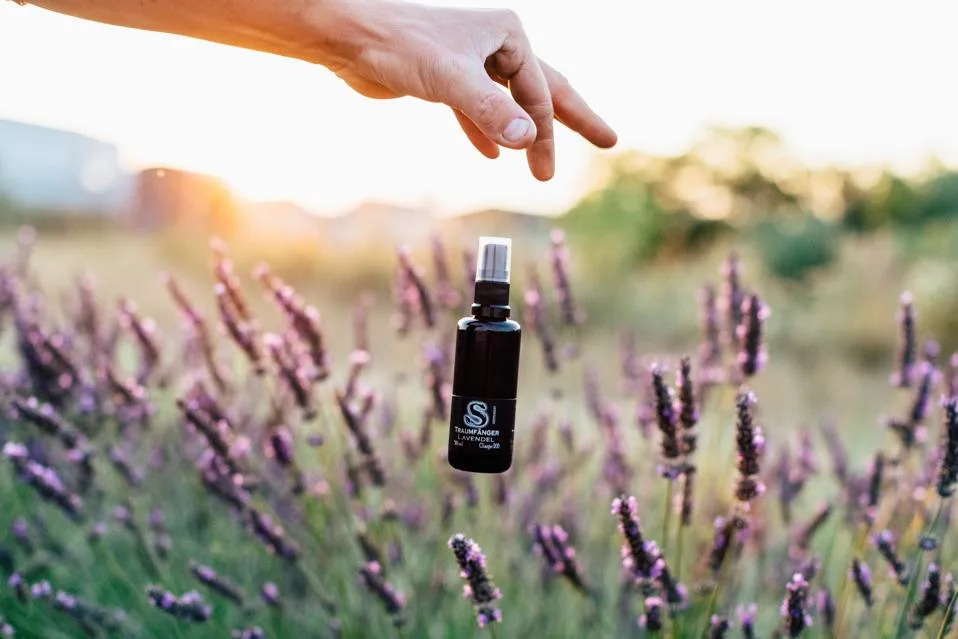
If you’re traveling to Austria, you can always book a scent safari with Stefan. “You can immerse yourself in the extraordinary world of fragrant plants and learn more about obtaining a natural fragrance,” Stefan shares. “ We have medicinal plants such as lavender, sage, thyme or mint. But also exotics that have never been cultivated in Austria, such as cinnamon basil, Arabian ringel, eucalyptus, grapefruit mint, rose scented geraniums, Mexican marigold, lemon thyme and many more.”

Scent safari
© Nicole Heiling Photography
Scent For The Sauna
Which brings us to the sauna.
Gernot Gerold — Gery, to regulars — is the long-standing sauna master at the Stanglwirt, the five-star Green Spa Resort in Going am Wilden Kaiser, which is about as far from Burgenland as you can get while still being in Austria. Alpine, wood-paneled, the kind of place where wellness is taken seriously as a discipline. In fact this is where I met Stefan – and hopefully the hotel will start using his products soon as it felt like the perfect match to me (just saying). “At the moment, we are not yet supplying Stanglwirt. But many other wellness hotels. But we have many special clients such as a countess of a castle, a pastor, a bestselling author and even doctors in palliative care units.”
Scent is the oldest sense, the one most directly wired to memory and emotion, bypassing the rational brain entirely. It is also the one travel writing ignores almost completely. We describe what we see, occasionally what we hear, rarely what we smell — even though smell is often what a place actually feels like. The moment you step off a plane, before your eyes have adjusted, your nose already knows where you are. Stefan Zwickl understands this better than most. His work is not really about fragrance or scents. It is about the way a single inhale can collapse the distance between a field in Burgenland and a sauna in the Alps. Stefan would call all of this alchemy. His father would probably still call it a very small amount of liquid. Both of them, it seems, would be right.

This article was originally published on Forbes.com