
Yesterday and today on Bondings 2.0, two leading Catholic theologians analyze Pope Leo XIV’s recent comments about church unity and about sexual morality, which he made in response to a question about blessing same-sex couples.
Yesterday’s analysis, on church unity, is by Brian Flanagan, PhD (he/him), who holds the John Cardinal Cody Chair of Catholic Theology at Loyola University Chicago, and a Senior Fellow at New Ways Ministry.
Today’s analysis, on sexual morality is by Daniel P. Horan, PhD is Professor of Philosophy, Religious Studies and Theology at Saint Mary’s College in Notre Dame, Indiana. A columnist for the National Catholic Reporter, he is the author or editor of sixteen books, including Catholicity and Emerging Personhood: A Contemporary Theological Anthropology, A White Catholic’s Guide to Racism and Privilege, and Fear and Faith: Hope and Wholeness in a Fractured World. He is co-host of The Francis Effect Podcast.

Pope Leo XIV answering questions from journalists at news conference on plane ride back to Rome.
Last week, while on a flight returning to Rome from an 11-day apostolic visit to several countries in Africa, Pope Leo XIV was asked by a German reporter to respond to the recent decision by Cardinal Reinhard Marx, the archbishop of Munich-Freising, to publish a diocesan guide for blessings of couples outside of a sacramental marriage, which includes divorced and remarried couples and same-sex partners.
The document, published in German and titled “Blessings Give Strength to Love,” reaffirms the Vatican’s position in the 2023 Dicastery for the Doctrine of the Faith document Fiducia Supplicans that such blessings of couples in so-called “irregular situations” are not to be confused with sacramental marriage, but established a more formal set of blessings for same-sex couples. At issue in the publication of this diocesan guidebook is that it appears to some to violate the emphasis in Fiducia Supplicans that such blessings be spontaneous, not ritualized. .
Pope Leo’s response to the question took a turn that surprised many, shifting from the specific topic of Cardinal Marx’s support for formalizing blessings of same-sex couples (Leo acknowledged that the Vatican had already addressed the German bishops conference) and toward the question of whether or not too much emphasis is placed on sex and sexuality in matters of Catholic moral theology.
Speaking in English, he said: “First of all, I think it’s very important that the unity or division of the church should not revolve around sexual matters.” He added, “We tend to think that when the church is talking about morality that the only issue of morality is sexual. And in reality, I believe there are greater and more important issues such as justice, equality, freedom of men and women, freedom of religion that would all take priority before that particular issue.”
While the substance of his remarks aligns well with what his predecessor Pope Francis conveyed during his pontificate, such as when he said in 2013 that pastoral ministers “cannot insist only on issues related to abortion, gay marriage and the use of contraceptive methods,” Leo’s pointed remarks appear to emphasize both a rebuke of those fixated on sexuality to the exclusion of other moral issues, and an emphatic embrace of other matters of peace and justice “that would all take priority before that particular issue [of sexual morality].”
 This is a welcome pastoral instruction and authoritative reminder that there is a hierarchy to church teaching and that not all doctrines or moral principles are of equal weight, importance, or priority. Far ahead of sexual ethics stand fundamental moral principles like the universal and inalienable dignity of the human person, the goodness of creation, the primacy of love and promotion of the common good.
While Leo doesn’t go so far as to say that obsessions with, and divisions arising from, preoccupations with sexual ethics at a time when schools and hospitals are being bombed in Iran, when communities are facing threats of civil war and political instability, when global climate change threatens all life on this planet, and migrants and refugees are scapegoated and dehumanized is a perverse and offensive fixation, his emphatic call to prioritize justice, equality, and freedom ought to give sex-obsessed clergy and laity pause.
Leo’s remarks last week reminded me of something I once heard New Ways Ministry’s own Sr. Jeannine Gramick, SL say in the context of a presentation she delivered in 2021 at Saint Mary’s College in Notre Dame, Indiana, when I was director of the Center for the Study of Spirituality. She invited the audience to consider what might be different in the Catholic Church’s views about and treatment of LGBTQ+ persons if instead of beginning with sexual ethics every time this community is engaged or discussed the church began with and viewed the LGBTQ+ community first through the lens of Catholic social ethics.
Her point was both so simple and yet incredibly profound, and it has stayed with me for years. The kind of questions we ask inevitably shape the sorts of answers and responses we elicit. If instead of presuming things about sexual expression and particular acts as the starting point, discussions about the LGBTQ+ community began by emphasizing the universal dignity of all people, the common good, the preferential option for the poor and marginalized, the dignity of labor and community, and church’s teachings on rights and responsibilities, things might look very different and we might draw closer to what Leo challenges us to live in terms of justice, equality, and freedom.
 What Pope Leo and Sr. Jeannine have advocated in terms of pastoral ministry and outreach has also been taken up in scholarly conversations about theology and ethics. I am reminded as well of the important work of the Catholic ethicist Sr. Margaret Farley, RSM, in her 2006 book Just Love: A Framework for Christian Sexual Ethics.
In an effort to provide an alternative framework for conceptualizing sexual ethics grounded in the Christian tradition and scriptural witness of Jesus’s teaching and ministry, Farley compellingly proposes that we move away from merely acts-based evaluation of whether a sexual act or relationship is moral and toward a prioritizing of embodied love that reflects mutuality, dignity, freedom, and the flourishing of all persons in the relationship. Among the criteria she includes is social justice, anticipating the insights of Pope Leo and Sr. Jeannine, among others.
Pope Leo’s remarks, while brief and extemporaneous, nevertheless provide a sign of hope for those who have long advocated for another way to think about sexual ethics in the church and the need to reintegrate human sexuality—which is but one dimension among many others in human identity—with the church’s more important and fundamental moral teaching on dignity, life, freedom, equality, and justice.
–Daniel P. Horan, St. Mary’s College, Notre Dame, Indiana, May 1, 2026
EDITOR’S NOTE FOR FURTHER READING
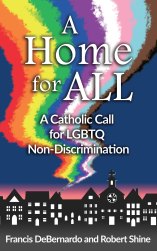 In 2022, New Ways Ministry published a book A Home for All: A Catholic Call for LGBTQ+ Nondiscrimination. The book was based on New Ways Ministry’s 2021 theological statement of the same name, which made the case that the church’s social justice tradition was prior to the sexual ethics tradition, and so should be given greater weight when discussing LGBTQ+ issues. The statement was endorsed by over 750 theologians, scholars, and church leaders, as well as over 2,000 lay people, and 100 Catholic organizations.
To order copies of the book, which is excellent for parish adult education and LGBTQ+ ministry discussions, click here.
To view the theological statement and its endorsers, click here.