
 Credit: Microsoft Copilot
This story originally appeared in the May 1 issue of The AI Economy on LinkedIn. Read the full issue here.
The promise of enterprise AI has never been louder. Agentic systems. Autonomous workflows. Decisions made at machine speed. But a new survey from Harvard Business Review Analytic Services and content management firm Hyland lands like a cold splash of water on that narrative. The real obstacle to AI adoption isn’t the technology—it’s the data underneath it.
In a survey of 325 business leaders, 94 percent of respondents say that well-connected data, processes, and applications are highly important to successful AI adoption. However, more than a quarter (27 percent) say those elements are currently well connected within their organization. That gap is a sign that enterprises have sprinted toward AI deployment without laying the groundwork to support it.
The culprit: unstructured data.
While 65 percent of respondents say their organization’s structured data—databases, spreadsheets, formatted records—is at least prepared for AI use, only 39 percent say the same about their unstructured data—the emails, PDFs, images, videos, and documents that make up the majority of the enterprise’s knowledge corpus. And yet, 81 percent admit that structured and unstructured data make AI systems more intelligent and trustworthy. They know what needs to happen. They just haven’t done it.
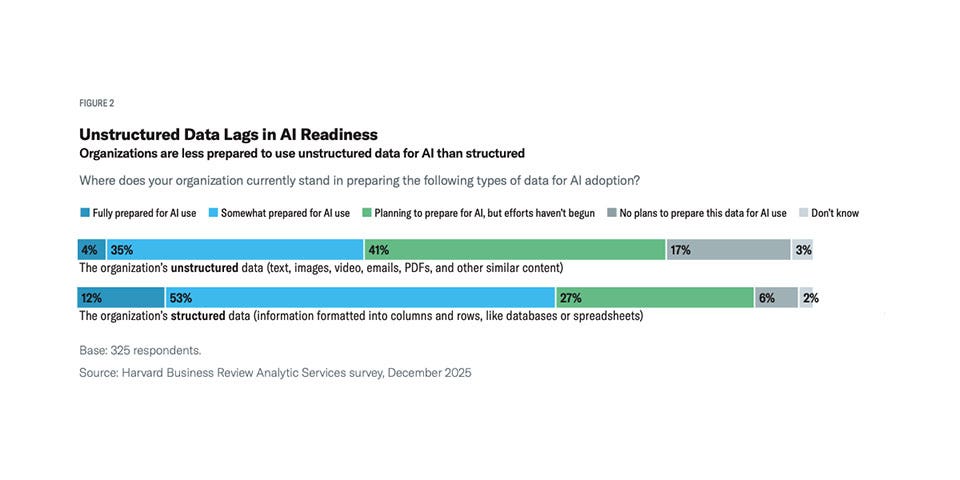 How organizations stand in preparing structured and unstructured data for AI adoption (December 2025). Credit: Harvard Business Review Analytic Services/Hyland
“As organizations move into the next phase of AI, the challenge is no longer just access to models, but whether the business is ready to operationalize AI in a way that is governed, contextual, and trusted,” Jitesh S. Ghai, Hyland’s chief executive, says in a statement. “For many organizations, unstructured data is both the most overlooked asset and the biggest obstacle to scaling AI effectively.”
It’s becoming an urgent problem that companies need to tackle.
According to Amy Machado, IDC’s senior research manager, many organizations are reviewing their content and data and recognizing that a key reason their AI initiatives fail is that their data isn’t AI-ready. “Many are going back to the basics—having accurate contextual content and data, which requires curation, guardrails, and an understanding of your data and content landscape,” she says in the report.
The gap between structured and unstructured readiness reflects years of organizational neglect. Structured data lives in systems purpose-built for querying. Unstructured data—the contracts, customer emails, scanned forms, meeting recordings—can be anywhere. It’s the institutional knowledge AI needs most, and it is the hardest to wrangle. A growing market of infrastructure startups, including Bem and Unstructured.io, has emerged specifically to tackle this pipeline problem, converting messy enterprise content into formats AI systems can actually consume. That a dedicated market now exists for this work is itself a sign of how widespread this problem has become.
The pressure to solve it is only going to intensify. It’s critical for organizations using agentic AI to ensure information flows seamlessly across systems, workflows are orchestrated, and governance is in place. Data can’t be kept in siloes. Yet despite software vendors’ hype about embracing the agentic enterprise and becoming frontier firms, nearly half of respondents say they’re still exploring or piloting agentic AI, with a mere 17 percent reporting that they’ve implemented it. This shows how far most organizations still are from turning the ambition of agentic AI into operational reality.
HBR advises that organizations take a “coordinated approach that strengthens the foundations of AI,” meaning preparing data and content for AI, integrating intelligence into business processes, and aligning leadership, culture, and skills around new ways of working.
Truth be told, more than a third of respondents (39 percent) say their organizations still favor separate, standalone tools instead of having AI embedded throughout their workflows. Only 12 percent report the contrary. When it’s viewed as an “add-on,” disconnected from the data and content it needs, it’s unsurprising to see that AI would underperform.
The report frames this as an operating model challenge as much as a technical one. Bridging the gap requires business leaders and IT to align on a shared data strategy that prioritizes common definitions, governance, and reuse across workflows. That is organizational work, not engineering work—and it’s what stalls in large enterprises because it does not belong to any single team.
Some executives have decided to take action to address this problem. Half of all respondents say their firms intend to prioritize data quality improvements over the next 12 months. Nearly half (48 percent) say enhancing data talent and skills is also a priority, followed by defining a clear data strategy and integrating data sources (45 percent each) and enhancing data management and governance (43 percent).
“Once you have AI-ready data, it opens up a whole new world of possibilities for the future,” Machado says. “It allows you to reimagine your processes. It allows you to optimize them. It allows you to create new products and new ways of working. But if you don’t have that data foundation, all that is out of reach.”
The bottom line: enterprises have invested significant time and resources in AI capabilities but have underinvested in AI readiness. For organizations eyeing agentic AI as the next frontier, the foundation problem can no longer be a side project. It’s now the whole project.
Thanks for reading The AI Economy! This post is public so feel free to share it.