Thank you for reading! Letters from Leo is a reader-supported publication. To receive new posts and support this movement, consider becoming a free or paid subscriber.
Let me say this clearly at the outset. I am not suggesting that Pope Leo XIV chose Bishop Evelio Menjivar-Ayala to lead the Catholics of West Virginia in order to challene nor embarrass Congressman Riley Moore.
The pope chose this man because the Diocese of Wheeling-Charleston needed a shepherd, and because Menjivar — a Salvadoran refugee turned American priest and bishop — has the heart and formation the diocese requires. There is no transcript, no memo, no smoking gun.
But I am Catholic, I believe in providence, and I believe what unfolded in West Virginia on Friday is the kind of holy coincidence the faithful are obliged to notice.
Yesterday I wrote about the retweet that foretold Robert Prevost’s papacy — his last public act on social media before the conclave, a quiet endorsement of Bishop Menjivar’s Easter rebuke of Trump’s work with Salvadoran President Bukele to send U.S. deportees to a maximum security prison in Tecoluca, El Salvador.
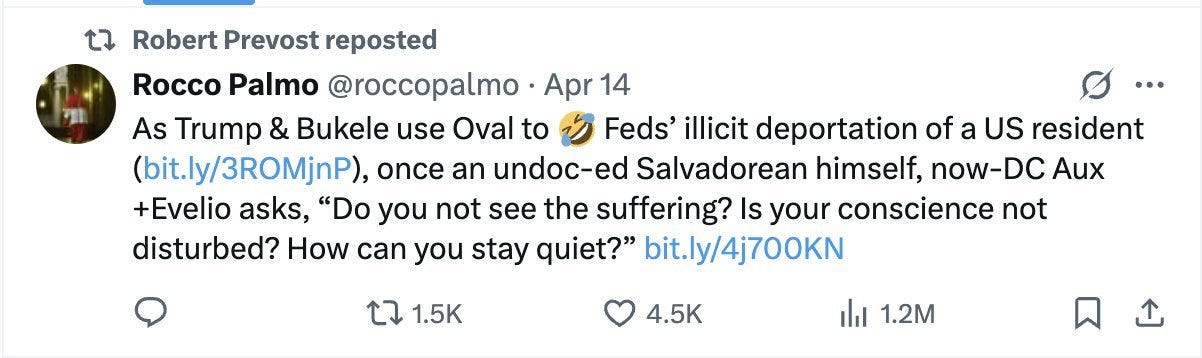
Three weeks later, Prevost was Pope Leo XIV.
On Friday, he made the man he had endorsed — a former undocumented Salvadoran migrant who as a teenager crossed the southern border in the trunk of a car — the lone Catholic bishop of West Virginia.
And on Friday, Riley Moore had to welcome him.
Moore is the second-district Republican congressman from northern West Virginia, the grandson of a former governor, and what Bishop Robert Barron — celebrating Mass for him in the U.S. Capitol last spring — called “a very ardent Catholic.�
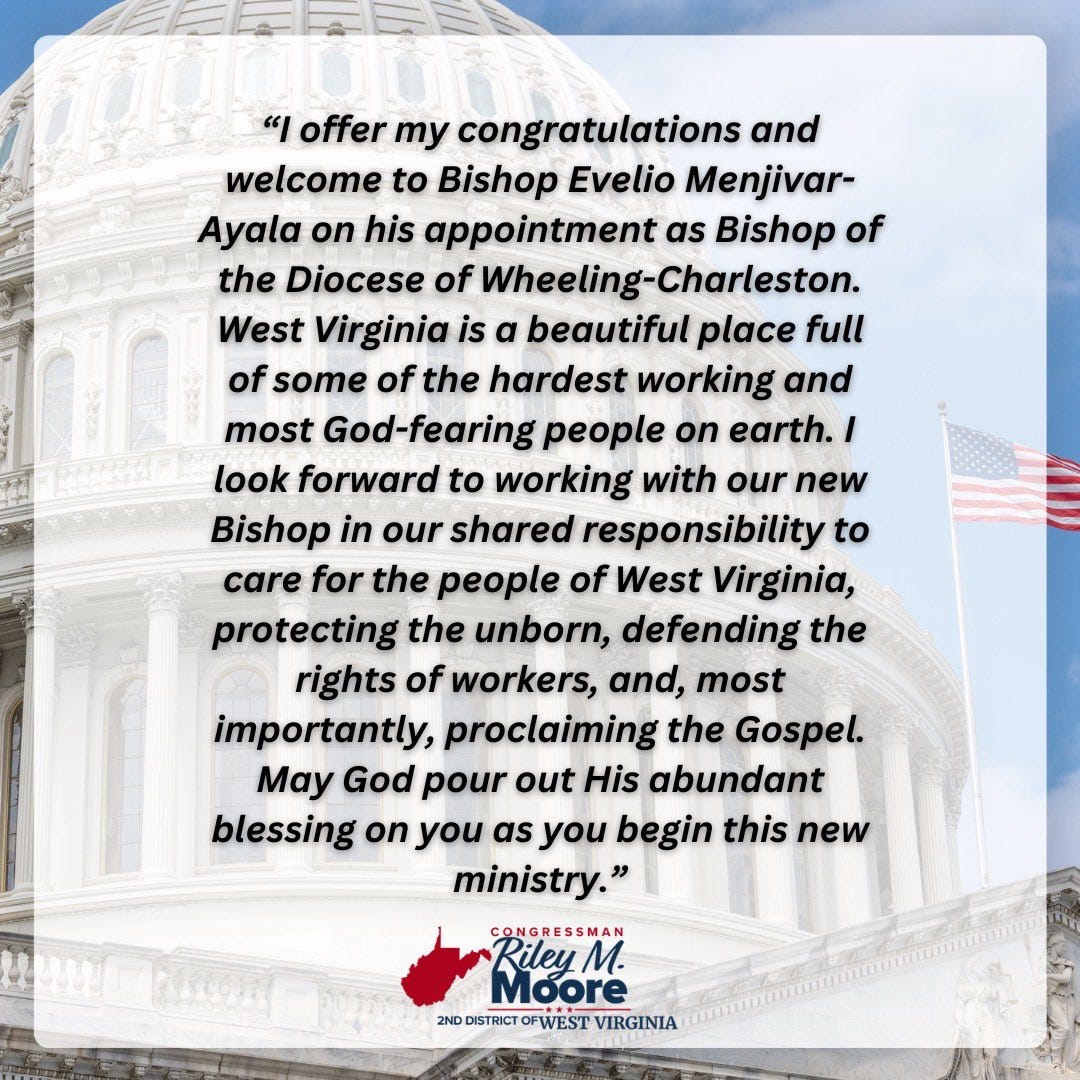
His Friday statement offered “congratulations and welcome� to Menjivar, praised West Virginia’s “hardest working and most God-fearing people,� and pledged to work with the new bishop on “protecting the unborn, defending the rights of workers, and, most importantly, proclaiming the Gospel.�
What Moore did not say is what makes the moment matter. His statement contains no reference to the bishop’s Salvadoran birth, his teenage border crossing, or, most importantly, the deportation regime that Moore’s party has spent the last fourteen months building against people who arrived in this country exactly as Bishop Menjivar did. The word “migrant� does not appear.
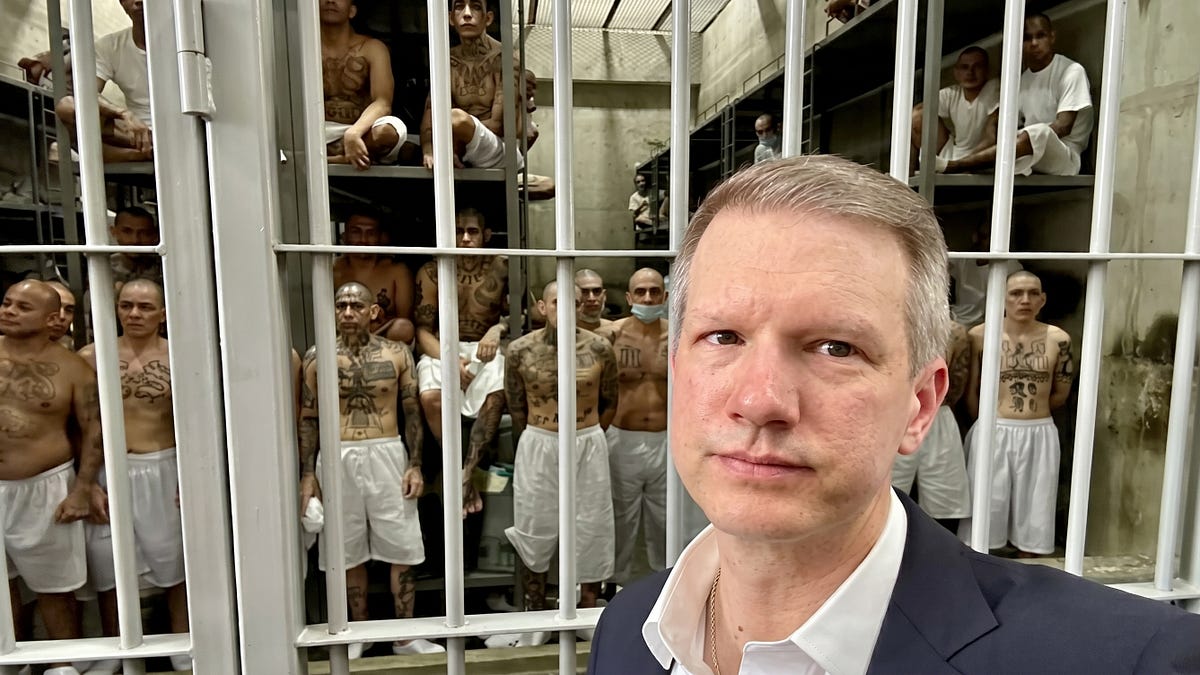
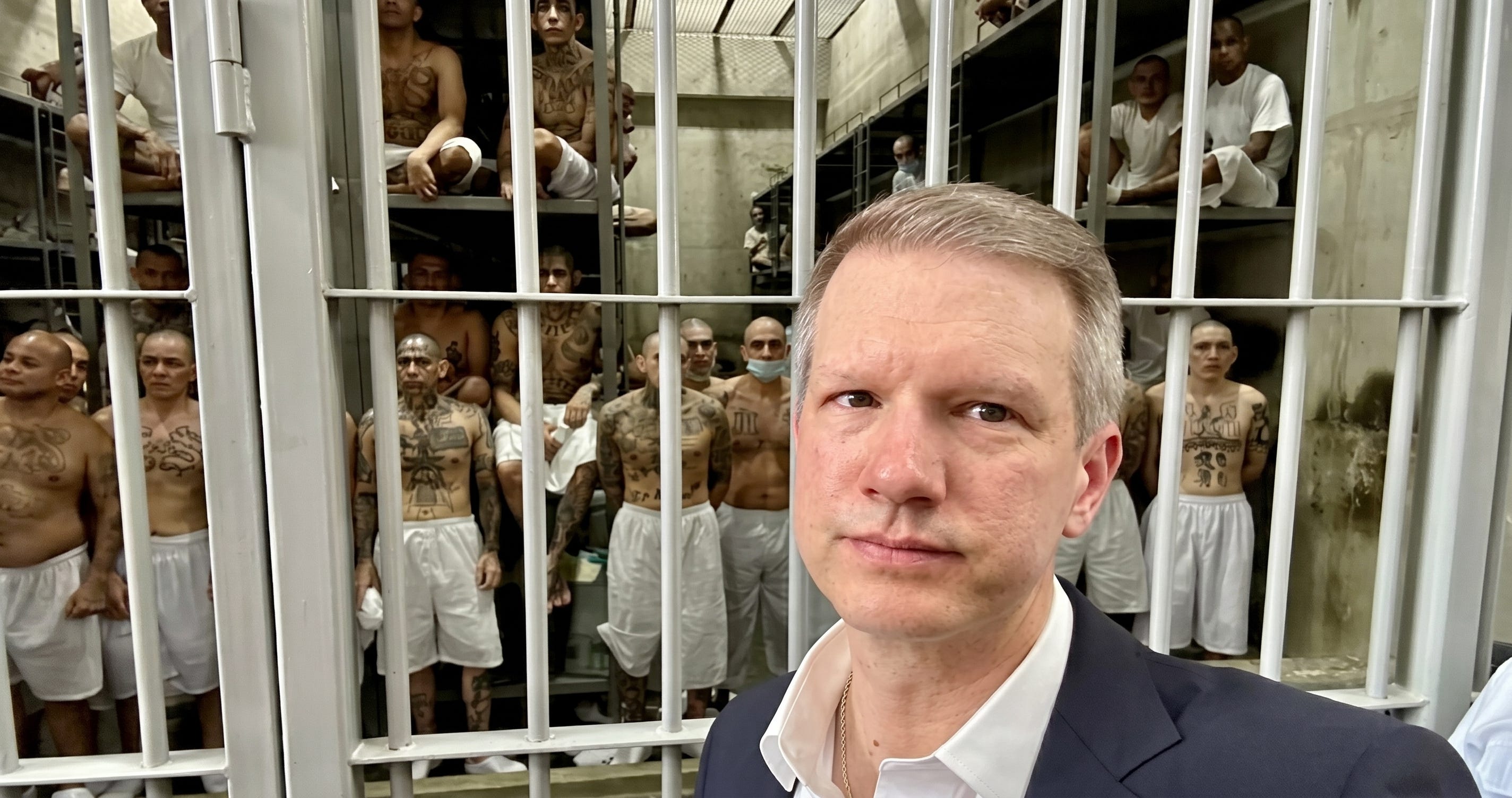
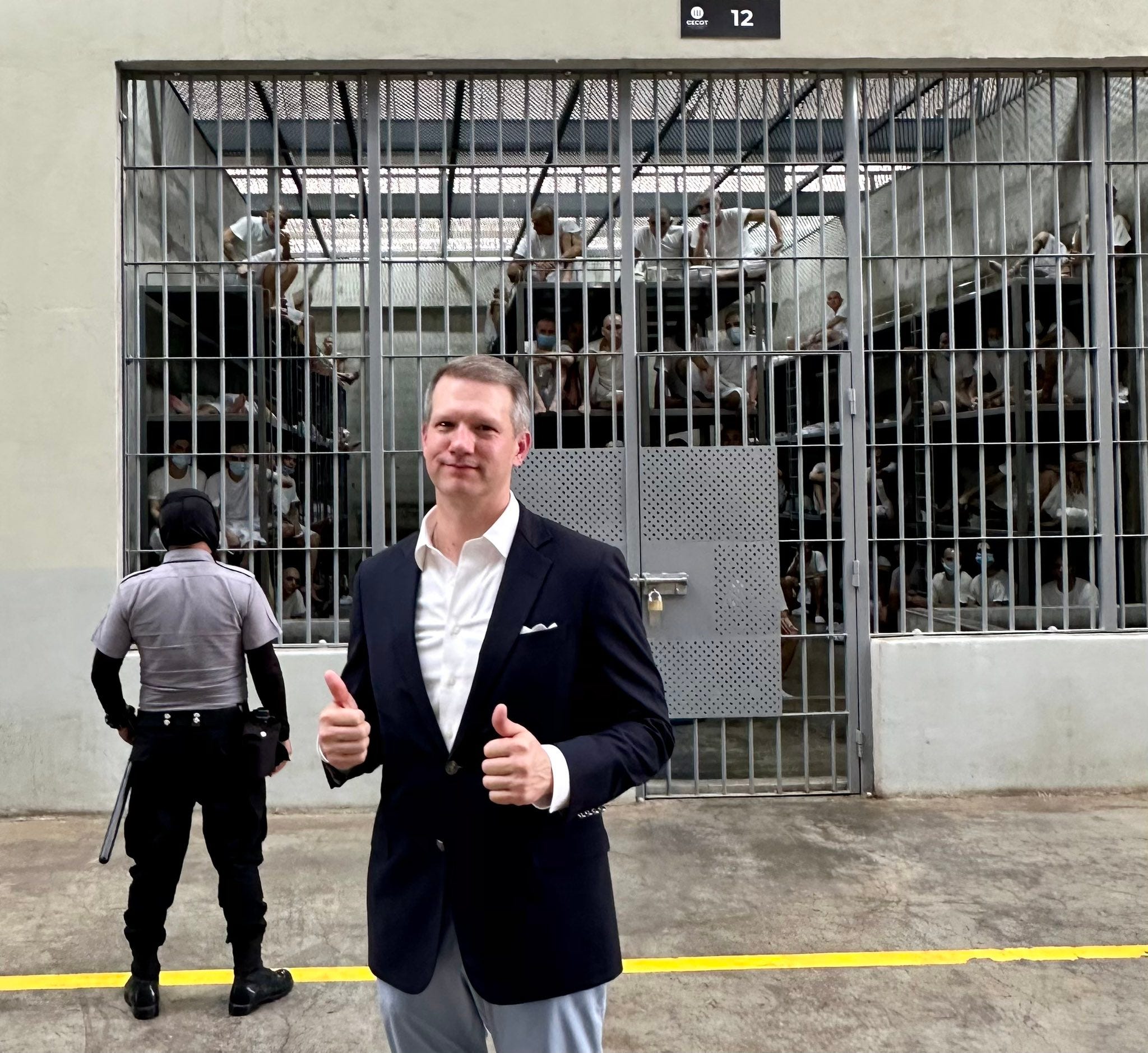
It would, last April. That month, the same congressman flew to El Salvador and toured CECOT — the Bukele regime’s “Terrorism Confinement Center,� a 40,000-bed supermax where the Trump administration has been disappearing American residents without due process.
Moore posed for photographs in front of the prison cells, two thumbs up, a row of shaved-headed deportees crowded behind him. “I leave now even more determined to support President Trump’s efforts to secure our homeland,� he wrote on X.

Rep. Riley M. Moore@RepRileyMoore
I just toured the CECOT prison in El Salvador. This maximum security facility houses the country’s most brutal criminals, including murderers, rapists, pedophiles, and terrorists. Several inmates were extremely violent criminals recently deported from the U.S.
I leave now even
11:38 PM · Apr 15, 2025 · 4.06M Views
5.33K Replies · 5.5K Reposts · 31K Likes
Among those held in the cells when Moore visited was Kilmar Abrego Garcia, a Maryland husband and father with no criminal record whom the federal government has acknowledged it sent there by mistake — a mistake the Trump administration still refuses to correct.
Mike Lewis at Where Peter Is captured the moral architecture of that photograph: the ardent Catholic congressman, two thumbs up at the Salvadoran gulag.
A month before the CECOT trip, Riley Moore had hosted Bishop Robert Barron of Winona-Rochester at the U.S. Capitol. Barron celebrated Mass for members of Congress at Moore’s invitation, sat with him as the congressman’s guest at Donald Trump’s joint address, and posted a seven-minute reflection the next day calling the speech “a kind of high liturgy of our democracy.�
Barron compared the procession of senators and justices into the chamber to a bishop’s procession at Mass.
The bishop’s video covered everything except what would have mattered: Moore’s enthusiasm for mass deportation, the “deportation valentine� Moore had retweeted from the White House, the gap between his host’s politics and the migration teaching Pope Francis had been issuing for a decade.
Barron praised Moore as “a very ardent Catholic� and moved on. NCR’s John Grosso annotated the whole performance line by line. The cameras did the rest.
Moore moves in a particular ecosystem of American Catholic politics, one whose cardinal-of-record is Gerhard Müller — the German prefect emeritus who has spent the past months publicly refuting Pope Leo XIV’s migration teaching and assuring readers that Catholics are not bound to it.
Bishop Barron is Müller’s American counterpart — a media empire careful never to break with Trump on immigration, eager to model bishopric collaboration with the Republican congressional caucus.
Letters from Leo has documented Barron’s pattern for months, including the leaked video showing him clapping as a TPUSA pastor compared Donald Trump to the risen Christ.
Riley Moore at CECOT, with his thumbs raised over a row of shaved-headed deportees, was the worldview taking a photograph of itself.
The deepest providence is the smallest detail. Bishop Mark Brennan, the West Virginia bishop whose retirement Pope Leo accepted on Friday, is the same priest who decades ago helped Evelio Menjivar obtain his green card.
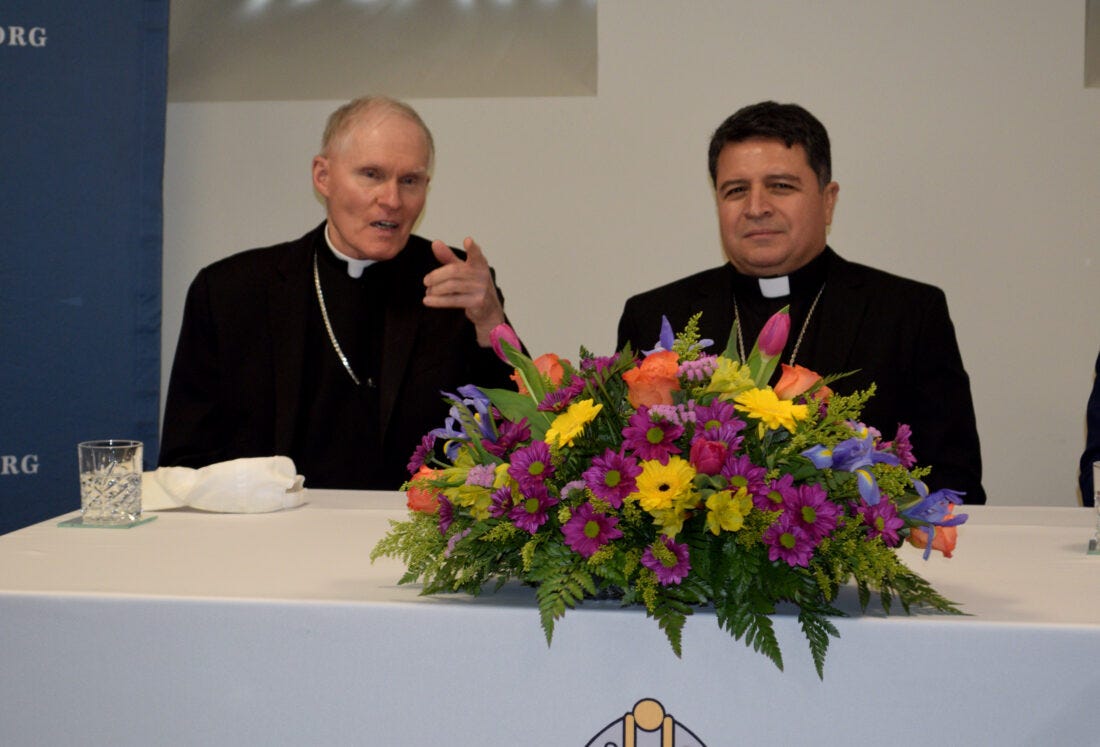
Brennan ran the priest-recruiting office for the Archdiocese of Washington when Menjivar was a young Salvadoran finishing his GED at night and volunteering as a parish receptionist. Brennan saw the candidate, did the paperwork, and put him on the path that ran through the Pontifical North American College in Rome, through ordination, through the auxiliary bishopric of Washington, and now to the cathedra in Wheeling.
The man who once helped a Salvadoran refugee become legal in America has just handed him his diocese.
Bishop Menjivar himself has refused to make this moment about him. In his first appearance after Friday’s announcement, he made clear that he is less interested in his own biography than in the pastoral needs of West Virginia families — that he intends to be the bishop of every Catholic in the state, no matter who they voted for.
That is the pastoral theology Pope Leo XIV is rebuilding the American hierarchy to embody — the conviction that a bishop is sent for the sheep, all of them: the coal miner, the schoolteacher, the deer hunter, the ICE officer, and the migrant working second shift at the Beckley nursing home.
This is why I find providence in the timing, even as I refuse to claim it as cause.
The pope did not appoint Bishop Menjivar to counter Riley Moore or Bishop Barron. He appointed him because Wheeling-Charleston needed a pastor, and because the Catholic Church believes a man’s life is qualification for the work the Lord prepares.
The timing, however, belongs to the Holy Spirit. And the Holy Spirit has a sense of irony that the American hierarchy ignores at its peril.
Bishop Menjivar will be installed in Wheeling in July. In his first weeks, he will baptize West Virginia babies, bury West Virginia dead, and stand at the altar of the Cathedral of St. Joseph in a state where his predecessor’s retirement just handed Riley Moore a public-relations problem the congressman is not currently equipped to handle.
Moore can keep his statements polished, his thumbs raised. The Catholic Church is sending him a bishop whose life indicts the politics he represents and asking him to call that bishop his own. Providence works that way. The Holy Spirit has put the question on Riley Moore’s desk. The answer is his to write.
At Letters from Leo, we stand with Bishop Evelio Menjivar — and with the millions of American Catholics who refuse to let our hierarchy be coopted by congressmen who pose for photographs at deportation prisons or by bishops who pretend not to notice.
Pope Leo XIV is rebuilding the American Church around the witness of the people his country tries to exile. Our work is to refuse to let any of it be normalized.
In an era when an “ardent Catholic� congressman can flash two thumbs up at a Salvadoran prison and a Catholic bishop can sit beside him as his guest at the State of the Union, the country needs a Catholic voice that names what is happening, grounds the resistance in the Gospel, and refuses to pretend the Church has nothing to say about cruelty.
This is the fastest-growing Catholic community in the country because the moment demanded one. Readers come here for analysis that does not flinch — and for a movement of faith built on the conviction that human dignity is not a partisan issue.
If you believe this movement matters — Catholics and people of goodwill standing with the bishops Pope Leo is sending into the heart of the deportation regime — I am asking you to join us.
If you’d like to invest in our mission, here are three ways you can help this Easter season:
Subscribe as a paid member to receive exclusive posts about the life and formation of Pope Leo and help sustain this newsletter.
Donate with a one-time gift to fuel this project’s mission.
Share this post (and Letters from Leo) with a friend who might enjoy it.
Paid members receive my full biographical series on the life and formation of Pope Leo XIV, my ongoing Epstein-Bannon Investigation, and the best of our full archive.
Whether you give $5, $50, $500, $1,000, or more, your presence here matters — no matter your faith or your politics.
Thank you for reading. I’ll see you on the road.
