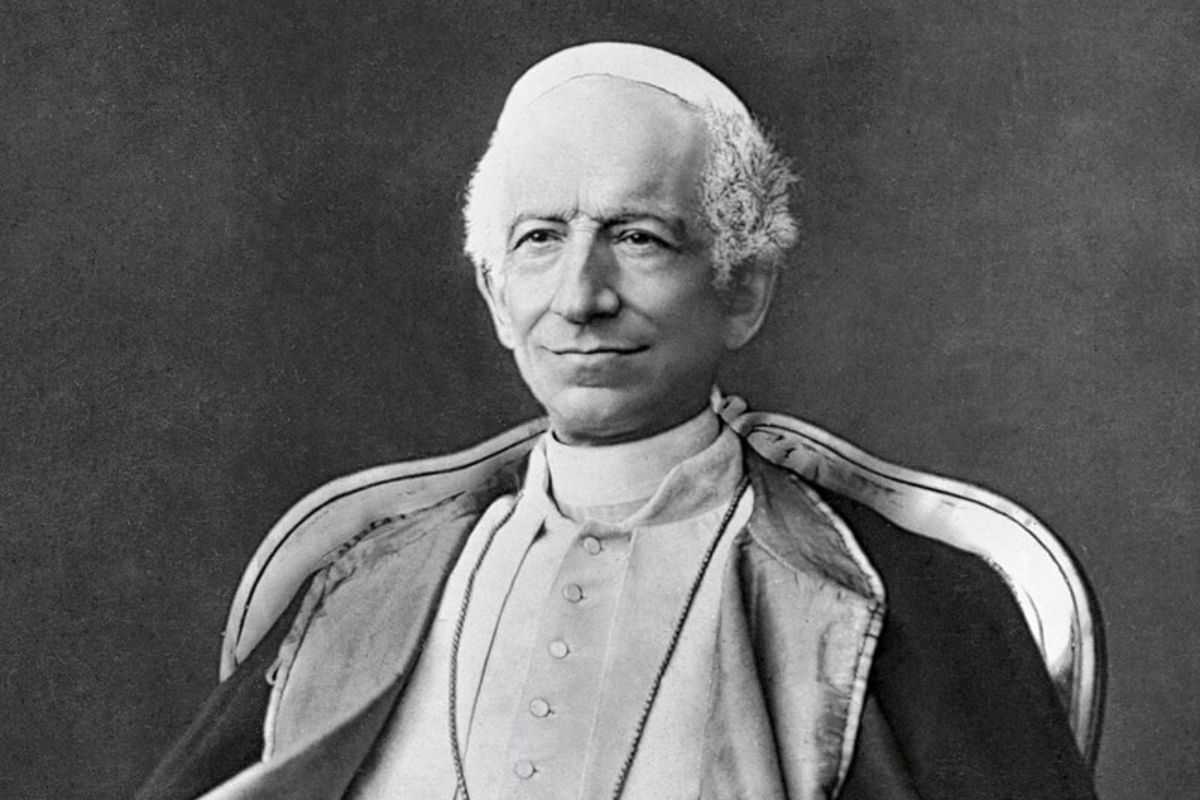
The Vatican Observatory has announced that an asteroid has been named in honor of Pope Leo XIII, highlighting the 19th-century Pontiff’s role in renewing the Church’s commitment to scientific research.
The asteroid, officially designated (858334) Gioacchinopecci, takes its name from Gioacchino Vincenzo Raffaele Luigi Pecci, the birth name of Leo XIII, who led the Catholic Church from 1878 until his death in 1903. The name was approved by the Working Group for Small Body Nomenclature of the International Astronomical Union, according to the Vatican Observatory.
Leo XIII re-established the Vatican Observatory in 1891, following the loss of the Papal States and their scientific institutions. In his motu proprio Ut Mysticam, he stated the Church’s desire to promote “true and solid science,” at a time when the relationship between faith and scientific inquiry was often presented as one of conflict.
Three other asteroids were also named for figures connected to the Observatory: (836955) Lais, after Oratorian Father Giuseppe Lais; (836275) Pietromaffi, after Cardinal Pietro Maffi; and (688696) Bertiau, after Jesuit astronomer Florent Constant Bertiau. All four objects were discovered using the Vatican Advanced Technology Telescope in Arizona.
Father Lais served as deputy director of the Vatican Observatory for three decades and took part in the international Carte du Ciel star-mapping project. Cardinal Maffi, archbishop of Pisa, served as president of the Observatory from 1904 until 1931. Father Bertiau, a Belgian Jesuit, contributed to the institution’s scientific development in the 20th century.

Vatican Observatory
How do you get an asteroid named after you?
The naming process for asteroids follows a formal procedure. After discovery, a minor planet receives a provisional designation. Once its orbit is established with sufficient precision, it is assigned a permanent number. Only then can discoverers propose a name for approval by the International Astronomical Union’s nomenclature group.
Leo XIII is not the first pope to be remembered in this way. Asteroids have also been named for Pope Gregory XIII, associated with the Gregorian calendar, and Pope Benedict XVI.
Today, the Vatican Observatory continues its international research from its headquarters at Castel Gandolfo and through the Arizona telescope, maintaining a scientific mission that Leo XIII helped restore more than a century ago.