
Last fall, FaithWorks (formerly Fellowship Southwest) led a pilgrimage to the Texas-Mexico border. The pilgrims included the organization’s Racial Justice Advocates pilot cohort and a documentary film crew. Noted writer and historian Jemar Tisby also joined the group.
The result, Jesus Was a Migrant, is the first film project released by Tisby Media.
The 31-minute documentary offers a moving glimpse into the lives of some asylum seekers. It’s also a scathing indictment of those who call themselves Christian while supporting the current administration’s racist rhetoric and cruel violence.
My favorite sequence on this point is an exchange between Tisby and the director, Lauren Vernea, where she references Revelation 7:9 in asking him what he thinks the so-called-Christians who are supporting this endeavor will experience in heaven, where every nation, tribe, people and language are there. Tisby’s quip, “What makes you think they’ll get to heaven?� perfectly encapsulates the theological crisis facing our country, for the battle over how we treat immigrants is also a battle over the nature of Christianity.

Jemar Tisby
The film premiered April 9 and is now available through Tisby Media. Rather than distributing the film through regular streaming platforms, FaithWorks and Tisby Media hope congregations will host screenings followed by discussions.
I recently spoke with Tisby about the film and his media company. What follows is an excerpt of our conversation, lightly edited for clarity and length.
Mara Bim: So how did this project come about?
Jemar Tisby: It came about so organically and, you know, as a person of faith, providentially. I had been trying to go on a pilgrimage with FaithWorks for a couple of years, and the scheduling just didn’t work. So we finally got it on this one. We go to El Paso and Ciudad Juárez and, of course, I think the most prominent divisive aspect of this administration has been its handling of immigration, both internationally and domestically. So it was a pressing issue.
FaithWorks already was going to film the pilgrimage and do something with it. And right at the same time, I’m saying, “Hey, I’m getting into production, how about this: I get the footage and I come up with a film?� Originally, it was supposed to be a mini-documentary, 10 to 12 minutes. But the moment we got into the migrant shelters, I knew we had to tell a more robust story.
You could feel the atmosphere in those rooms as they were sharing these gut-wrenching stories — harrowing tales, really, of leaving whatever hardship or persecution in their country and coming to the border only to have that ripped away from them through an executive order. No notice. No grace period. And certainly no compassion. And there’s children involved. It’s not just the adults; it’s little kids. So immediately, I knew we had to tell a bigger story.
MB: So you’d never been on one of these trips like this?
JT: I’ve been on many different pilgrimages, but never to the border.
MB: What was it about being at the border that was so impactful for you?
JT: We forget the people behind the policies, so what this pilgrimage did was humanize this issue we read about — we argue about. What it did was center the human beings who are most impacted by it. And then, it’s like a light bulb goes on. This isn’t just words on a page that we make a law or a policy about. These are people’s lives. And so what I hope the film does is remind us of the people being affected by the policy, and then maybe the policies will put people first rather than partisanship.
“When you hear these stories, not only does it humanize but it reminds you this shouldn’t be a partisan issue.�
When you hear these stories, not only does it humanize but it reminds you this shouldn’t be a partisan issue. How we treat people — whether they are documented or undocumented, whether they were already in the country or trying to get in the country — it should not change. And I absolutely think we should have clear rules about how to enter the country properly, but in this case, they were following the rules and the legal pathway was ripped away.
And so it’s just beyond infuriating that the talking points among some are, “Well, they should enter legally.� And they say, “OK, we’ll undergo the process.� And then, you take away the process for them to enter legally and then get mad when they come in through different means. So, it is mind-boggling. But you can only get there when you either forget there are people at the center of it or you think those people are somehow unworthy of the same dignity and respect you think you deserve.

Migrants reach through a border wall for clothing handed out by volunteers, as they wait between two borders. (AP Photo/Gregory Bull)
Everyone’s affected by this, right? Because we’re at the southern border, right? So, mainly people from Central and South America, but even in the Black community, there’s immigrants from African countries, or from Haiti, where the president called it an asshole country, right? So it’s going to affect all of us and all of our communities.
Years ago, I was in Northwest Iowa speaking at a college there and the largest nonwhite population is Spanish-speaking in Northwest Iowa, which is one of the whitest states in the country. So, talking about African Americans, a lot of folks were like, “This isn’t our issue.� To which I say, “And isn’t it odd you have a Black producer, a Black director — why are we making a film about immigration at the southern border?�
I go back to that quote from MLK, “Injustice anywhere is a threat to justice everywhere.� But more specifically, the same surveillance and incarceration tactics they’re using on migrants now, they have used on us before. And they are adapting and evolving so they can continue to use it on other populations in the future. So it is coming for us. It will come for us in case you need a sort of self-interested reason beyond, “These are just human beings who deserve better.�
MB: Yeah, I speak to a lot of white congregations. I was just at one this past Sunday, I’m going to one this next Sunday, and I always end with, “If you don’t care about anything else, this is coming for you. If they’re going to do this out in the open, nobody’s safe.� But it’s interesting to hear that from a Black perspective.
Changing subjects, let’s talk about how this film fits with what we understand to be traditional Christian media. Why did you launch this company?
JT: Tisby Studios is committed to telling honest stories at the intersection of faith, history and justice. I have come up with four types of Christian films, and most of what we think about as Christian film falls in the first two categories: foundational and devotional.
Foundational films are the ones that tell Bible stories: House of David, Chosen, Prince of Egypt, right? The Bible is the intellectual property. Those films are of varying qualities, but the point is to visualize and dramatize a Bible story.
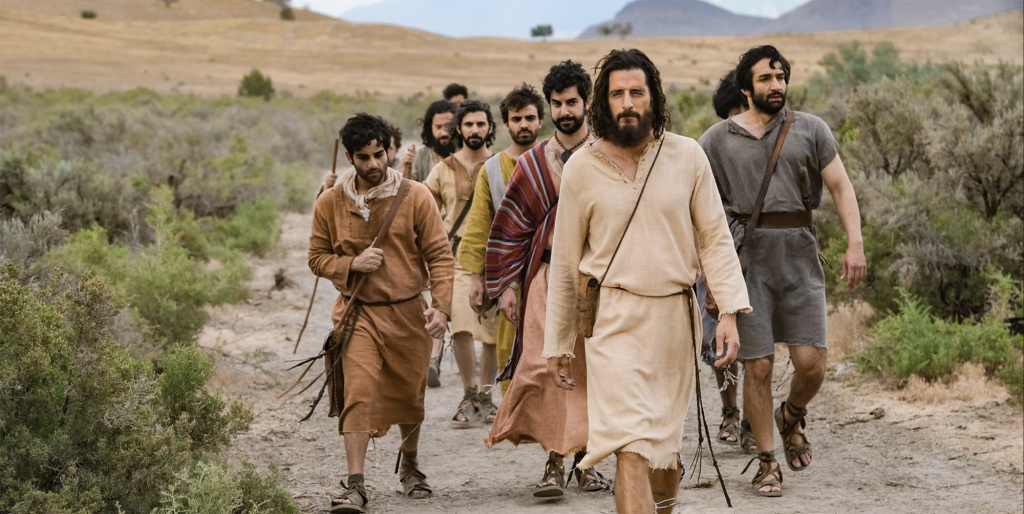
Jesus and the disciples in “The Chosen.� (Photo: IMDB)
Devotional films are probably what most of our thinking goes toward when we hear Christian films. I call them devotional because they are almost always explicitly evangelistic, moralistic. They have a tension, but it gets neatly resolved at the end. And they are conveying a very clear message: “This is how you should live. This is how you should act.�
Now, contrast that with the third category: explorational films. These films live in the mystery. They live in the ambiguity. They ask questions. The most powerful recent example I can think of is Knives Out: Wake Up Dead Man. Faith is central — the main characters and the antagonists are Catholic priests, and that’s not incidental. It’s critical to the plot and also the most emotional points. But it doesn’t wrap up nice and neatly in terms of “Here’s what you should believe,� or “Here’s the answer.� Other films like The Mission or Conclave — those are explorational faith films. They make you think, and there’s no neat bow at the end.
“The headlines moved on, but the migrants didn’t.�
Tisby Studios makes transformational faith films. We make films that don’t stop at personal piety or moralistic behavior. We interrogate institutions, systems, policies to understand justice. And then we don’t necessarily resolve the tension, but we channel toward action.
So our films are designed to provoke a justice response. And that’s why this film feels different. All our projects will have that texture of “I’m learning about the issue, and now I’m left with a holy burden of asking, ‘What do I do about it?’�
MB: You left the border and then you were working on the film. The film is done, you had the premiere, so what is still sitting with you after going through that whole journey?
JT: The migrants are still there. I keep saying the headlines moved on, but the migrants didn’t. They’re still in the shelter. So now it’s been more than a year since January 2025, and a shelter is no place to raise a family. It’s no place to educate your children. It’s no place to feel rooted. My heart just breaks knowing what they must be experiencing.
But I’m also encouraged, because we each have our part to play. When we went down there, we asked them, “What can we do to help?� And they said, “Tell our story.� And this film is our holy labor to tell their story.
MB: My church plans to share this film at some point.
JT: That is key to this film. It’s designed to be watched in community so it fosters action. And my hope is that after the 30 minutes or so, when you view it, you would look to the person next to you and say, “What do we do next?�
And that is the way we center the migrants and we honor their stories. It’s not only to get the information, but to feel what I call a holy burden. To want to do something.
Â
To host a screening and access supporting discussion materials, visit https://jesuswasamigrant.com/.