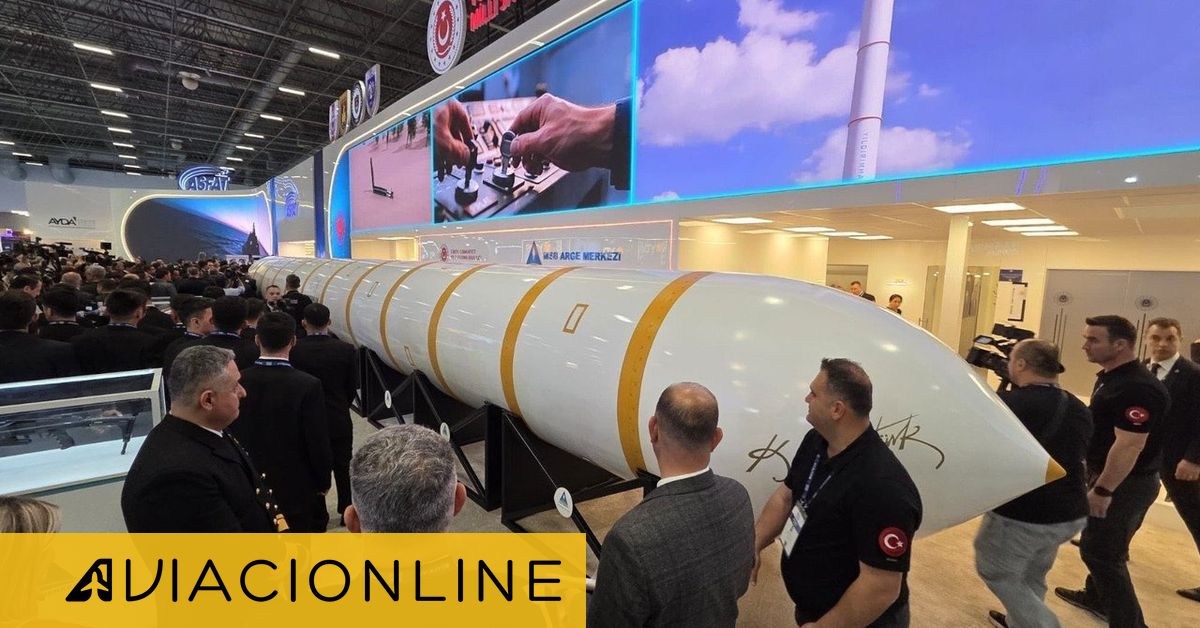
At SAHA 2026 in Istanbul, Turkey publicly unveiled the Yildirimhan for the first time, an intercontinental ballistic missile (ICBM) developed by MSB ARGE. It represents the most ambitious missile program in the country’s history and a clear qualitative leap beyond its previous systems.
The announcement, accompanied by remarks from Defense Minister Yaşar Güler, positions Yildirimhan as the longest-range missile ever developed by Turkey. While official information remains крайне limited, preliminary data from the exhibition points to a system with an estimated range of up to 6,000 km, firmly placing it in the intercontinental category.
X de Jungle Journey
X de Zain Sajjad
Turkey enters a new league
Until now, Turkey’s ballistic capability has been centered around the Yildirim family and the Bora missile, developed by Roketsan, with ranges between 300 and 900 km — and extended variants reportedly reaching up to 2,500 km, though unconfirmed.
What is Yildirimhan?
It is Turkey’s first intercontinental ballistic missile (ICBM), developed by MSB ARGE, with an estimated range of around 6,000 km.
What is its range and coverage?
The missile is estimated to reach 6,000 km, allowing coverage of all Europe, much of Russia, nearly all of Africa except its southernmost regions, the Middle East, India, and parts of inland China.
What type of propulsion does it use?
It is believed to use liquid propulsion with nitrogen tetroxide (N₂O₄) as oxidizer, unlike previous Turkish solid-fueled systems.
Can Yildirimhan carry multiple warheads?
There is no official confirmation. However, the shape of the reentry vehicle suggests a potential MIRV configuration or compatibility with hypersonic glide vehicles (HGV).
Does this violate international agreements?
Not necessarily. Turkey is a member of the Missile Technology Control Regime (MTCR) and a signatory of the Nuclear Non-Proliferation Treaty, but these do not prohibit the development of such delivery systems.
What is the impact within NATO?
Its emergence introduces a new strategic variable, expanding Turkey’s power projection and forcing the alliance to integrate, manage or leverage this capability.
Yildirimhan breaks with that paradigm. Not just in range, but in architecture. Unlike its solid-fueled predecessors, the new system appears to rely on liquid propulsion using nitrogen tetroxide (N₂O₄) as an oxidizer. This places it closer to earlier generations of ICBMs, offering greater thrust control at the cost of increased logistical complexity.
Based on what has been displayed, the missile features a multi-stage design, with the first stage powered by four rocket engines. The total number of stages has not been confirmed, but its size and configuration suggest a three-stage system.
Hypersonic speeds and potential MIRV configuration
Based on the limited available data, the missile is expected to reach speeds between Mach 9 and Mach 25, consistent with long-range ballistic trajectories. One of the most notable elements is the geometry of the reentry vehicle: the shape of the nose cone suggests it may not be designed for a single warhead, but rather a MIRV configuration or, at minimum, compatibility with multiple payloads or hypersonic glide vehicles. There is no confirmation, but the design is a relevant indicator.
Declared range and strategic coverage
With an estimated range of 6,000 km, Yildirimhan dramatically expands Turkey’s strategic reach. Launched from any point within Turkish territory, it could cover all of Europe, reach most of Russia — excluding its far eastern regions — span nearly all of Africa except its southern extremities, cover the entirety of the Middle East, reach India, and penetrate parts of China. In the latter case, it would be capable of striking inland regions, though much of the country’s economically critical coastal areas would remain out of range.
X de Current Report
Legal framework and strategic autonomy
From a legal standpoint, the program does not violate any international commitments. Turkey is a member of the Missile Technology Control Regime (MTCR), which restricts proliferation but not domestic development. It is also a signatory of the Nuclear Non-Proliferation Treaty, which limits nuclear weapons, not conventional delivery systems. Additionally, Turkey adheres to the Hague Code of Conduct, a voluntary transparency framework.
In short, Turkey can develop ICBMs without breaching international law.
Strategic impact: a move that shakes NATO and beyond
The unveiling of Yildirimhan is not just a technical milestone — it is a high-stakes political signal. Within NATO, only the United States, the United Kingdom and France possess comparable capabilities — and in Europe’s case, exclusively in the nuclear domain and from submarine-based platforms. Turkey’s entry into this space, even at an early stage, introduces unavoidable tensions within the alliance.
The system appears designed to ensure credible deterrence in a context of eroding global security guarantees. In that environment, actors such as Russia and Israel are unlikely to ignore the emergence of a vector with this range and potential.
At the same time, the move can be interpreted through a European lens. While countries like France and Germany explore conventional “deep strike” capabilities in the 1,000–2,000 km range with ArianeGroup, Turkey suddenly presents a system in a completely different league. It is not far-fetched to assume that Ankara may seek to position itself as a supplier or partner within a future European long-range strike framework, potentially offsetting part of the political cost associated with such capabilities. Recent statements by Recep Tayyip Erdoğan appear to align with this direction.
X de Recep Tayyip Erdoğan
But beyond the technical uncertainties — which may take years to clarify — Yildirimhan already serves a key function: signaling intent. Turkey is not just extending its reach; it is redefining its role within the Eurasian security architecture, moving toward a genuinely strategic projection capability in an era marked by the proliferation of high-speed, high-penetration strike systems.
If the program matures into an operational platform — particularly if it integrates MIRV or hypersonic glide capabilities — its impact will go beyond the military domain, becoming a political and structural factor within NATO, where it would shift from a national development to a variable the alliance will have to integrate, manage, or exploit.