
 Austria overtook USA in terms of annual skier visits for the 2025-26 season. | Image: Vail Resorts
A country with nine million people — smaller than the state of Maine — just recorded more skier visits in 2025–26 than the entire United States. Austria’s cable car industry reported approximately 54 million skier visits for the 2025–26 winter — one of the best seasons on record and roughly 4% above last year. The total edged past the United States’ 52.6 million, as reported by the National Ski Areas Association (NSAA).
Based on available data, this has only happened twice before in the modern era — in the 2001–02 season, when Austria recorded approximately 56 million visits against the USA’s 52.2 million, and again in 2017–18, when Austria’s 54.6 million edged the USA’s confirmed 53.3 million. Whether it occurred in other seasons is difficult to confirm, as consistent historical data from the late 1990s is not readily available. What is clear is that outside of these rare alignments of a strong Austrian season and a weaker American one, the USA has held the top position. What is important to notice is that this is not a trend reversal or based on a strong snowfall season. The snowfall in Austria last season was below average. What drove this divergence were fundamentally different choices about managing an increasingly uncertain future.
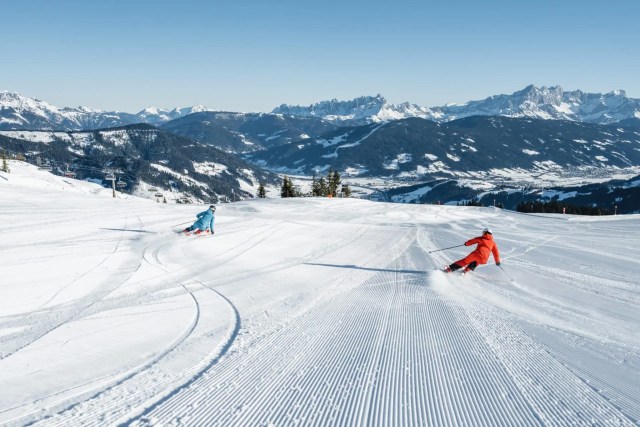 Skiers in Flachau, Austria, the fourth most popular ski region in the Salzburg state. | Image: Flachau Facebook
A Tale of Two Countries
In Austria, the season was defined by one thing above all: reliability. A strong early start — secured almost entirely by technical snowmaking — set the tone for consistent operations through the critical December and January windows. Franz Hörl, chairman of the Austrian cable car association, was direct at the annual Seilbahntagung in Vienna: without snowmaking, Austria would have lost approximately 10.4 million ski days and 8.7 million overnight stays this winter alone. The infrastructure that delivered those days generated an estimated €1.2 billion in additional economic value.
In the United States, the story was almost the inverse. The 2025–26 season was shaped by weather volatility — a slow start in the West, multiple rain events, and record warmth in March that suppressed visitation across the country’s largest destination markets. National snowfall averaged 112 inches, well below the 10-year average of 169 inches and the lowest in more than a decade. “Few seasons demonstrate as clearly as this one how dependent our industry remains on regional weather patterns,” said NSAA President Michael Reitzell. The Rocky Mountain region — which typically accounts for over 40% of all U.S. visits — had one of its most difficult winters in years. The Northeast performed strongly, recording 12.9 million visits, its second-best of the past decade, and the Midwest contributed a solid 5.8 million. But the Northeast and Midwest were not large enough to offset losses elsewhere.
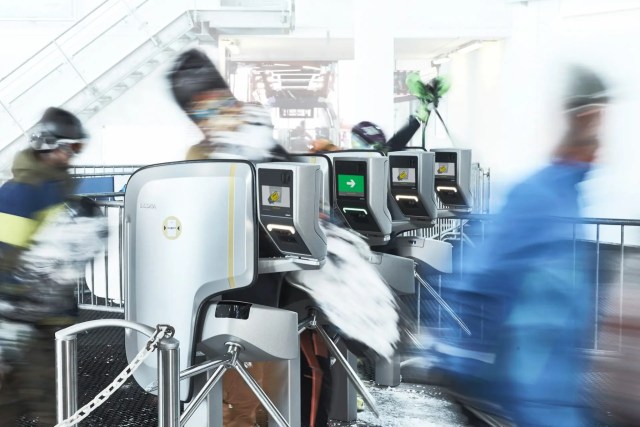 Skier visits are counted at lift gates with modern technology by companies such as Skidata GmbH. | Image: Skidata GmbH
The Snowmaking Bet — and Why It’s Paying Off
The more durable story here is not the visit numbers — it is what Austria has systematically built over the past two decades to make those numbers resilient.
Austria now covers approximately 70% of its piste surface with technical snowmaking infrastructure, one of the highest rates of any ski nation in the world. In the 5-year period from 2007 to 2012 alone, Austrian cable car operators invested over €748 million in snowmaking technology. The philosophy is straightforward: in a country where skiing generates €12.6 billion in gross economic output annually and supports 127,900 jobs, reliability is not optional. International visitors — who make up 66% of Austria’s skier visits according to Laurent Vanat’s International Report on Snow and Mountain Tourism — will not rebook a destination that cannot guarantee snow. That is the core commercial logic behind every pump station, every reservoir, every snow cannon.
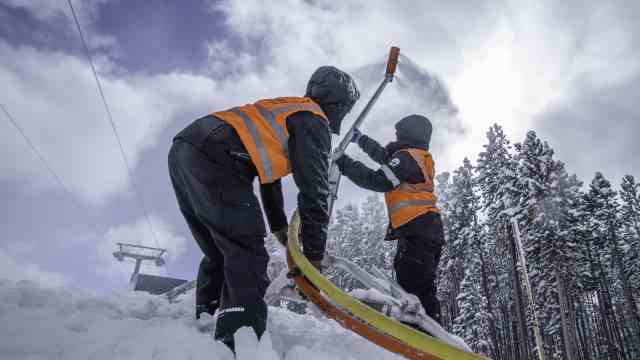 Snowmakers at Big Sky Resort, Montana. | Image: Big Sky Resort
The results at individual resort level are striking. Lech Bergbahnen AG, one of Austria’s most prestigious ski operations, produced around 750,000 cubic meters (26.5 million cubic feet) of technical snow in 2025–26 — a 31.5% increase over the previous winter. The efficiency of the investment is equally notable: energy consumption rose by only around 13% to achieve that 31.5% gain in snow volume, a direct result of the previous summer’s €8 million upgrade to the main pump station and supporting infrastructure. Klaus Nußbaumer, chairman of Lech Bergbahnen AG, was clear about what it meant in practice: “We were able to offer our guests good piste conditions from the first to the last day despite difficult natural conditions — and that is exactly our standard.” The expansion continues in summer 2026, with further infrastructure investment already planned.
 The award winning TechnoAlpin TT10 snow cannon. | Image: IF Design Awards Website
Sustainable Snowmaking — The Argument Austria Is Winning
The standard criticism of snowmaking-dependent ski resorts is environmental: manufacturing snow uses energy, energy has a carbon cost, and therefore more snowmaking means a larger carbon footprint. Austria has been quietly dismantling that argument.
A 2026 study from the University of Innsbruck, covered in detail by SnowBrains, estimated Austria’s total annual snowmaking emissions at between 6,246 and 7,424 tonnes of CO₂ — equating to roughly 120 to 140 grams of CO₂ per skier visit. For context, a Canadian study from 2023 calculated Canadian snowmaking emissions at 6,670 grams per skier visit — nearly 50 times higher per visit. The key variable, as the Innsbruck researchers found, is not the snowmaking itself but the energy mix powering it.
At the national level, snowmaking electricity consumption across Austria represents only 0.3% of the country’s total energy consumption, with 90% of that coming from renewable sources. At Lech specifically, the figure is even higher — nearly 100% of the electricity used for snowmaking comes from renewable sources, and the water used returns to the natural cycle without additives. The alpine hydroelectric grid provides the backbone of supply across most Austrian resorts, turning snowmaking from an environmental liability into something closer to a circular system.
This matters for the broader ski industry conversation. As more destinations worldwide invest in snowmaking to manage climate variability, the Austrian model demonstrates that the carbon cost of that investment is not fixed — it depends almost entirely on the energy infrastructure behind it.
One Industry, Two Very Different Markets
The visit numbers alone obscure a fundamental structural difference between the two ski industries. The United States is primarily a domestic ski market, with about 97% of its 52.6 million visits coming from American skiers. That creates enormous scale — a domestic population of 330 million provides a base no Alpine nation can match — but it also creates exposure to climate change or bad season. When the West has a bad snow year, domestic demand follows the snow. There is no deep international buffer.
The regional fragmentation within the U.S. market compounds this further. A SnowBrains survey of West Coast skiers asked whether they would consider traveling to the East Coast during a poor western snow season. The answer was telling: the overwhelming majority said no — with respondents far more likely to name Japan, Canada, or Europe as alternatives than New England. “If I’m flying five hours to the East Coast, I might as well fly sixteen to Japan,” was a representative sentiment. This stands in sharp contrast to European ski tourism, where skiers routinely cross borders between destinations — a French skier switching to Austria, or a Dutch skier choosing between the two — treating the Alps as a single interconnected market rather than a collection of domestic fiefdoms. That flexibility gives the European ski economy a fluidity and resilience that the regionally siloed U.S. market simply does not have.
Austria’s model is structurally different. According to Laurent Vanat‘s data, approximately 66% of Austria’s skier visits come from international visitors — primarily German, Dutch, British, Czech, and Eastern European skiers for whom Austria is a planned annual destination rather than a weekend local option. That internationalisation creates a form of demand stability that the domestic U.S. market cannot replicate. Austrian ski bookings are made months in advance by visitors who have factored the trip into their annual budget. A bad natural snow forecast does not cancel those trips if the resort can guarantee conditions through snowmaking — which, increasingly, it can. However, it can impact long-term travel plans by these international holiday makers. Therefore, ensuring that resorts can open for key holiday periods, such as Christmas and New Years, is essential for Austrian resorts.
That structural difference matters most precisely in seasons like 2025–26, when one market is hit hard by variations in regional weather and the other is insulated from it.
 Skiers enter RFID gates at Big Sky Resort, which implemented the gates for the 2019-20 season. | Image: RFID
What the Numbers Actually Mean
Austria edging past the USA in total skier visits is a striking data point but should be understood for what it is: a rare alignment of an exceptionally strong Austrian season and an unusually weak American one, enabled by decades of targeted infrastructure investment on the Austrian side.
The USA’s long-term average comfortably exceeds Austria’s. In a strong snow year — 2022–23 saw a record U.S. total of 65.4 million visits — the gap is enormous and Austria cannot compete with that scale. Nor does it need to. Austria’s competitive advantage is not volume but reliability: high-spending international visitors, a guaranteed product, and an infrastructure model that has systematically reduced exposure to natural snow variability — while keeping the carbon footprint of that system remarkably low.
The 2025–26 season is a reminder that in an era of increasing weather volatility, the ski industry’s most valuable asset may not be the mountain. It may be the ability to make snow from renewable energy, efficiently, at scale, and put it exactly where it needs to be. Austria has been building that capability for 20 years — it is now reaping the benefits.