香花和毒è�‰çš„辯è‰æ³•
Â
Ruszkik haza! — “Russians Go Home!� — the Hungarian chant from 1956 echoing through the streets of Budapest following Victor Orbán’s crushing electoral defeat on 12 April 2026.
This year marks seventy years since Mao Zedong, concerned about restive anti-Soviet liberals in Hungary and Poland, launched the Hundred Flowers Movement in China. Aware of widespread dissatisfaction with the Communist Party’s draconian bureaucrat rule, and murderous first years, Mao hoped to short circuit a similar rebellion in the People’s Republic of China.
Unnerved by the clamorous response of people who took advantage of the opportunity of the Hundred Flowers to criticise the Party’s regime, in 1957 Mao launched another nationwide campaign, this time to crush deviant ‘rightists’. Directed by Deng Xiaoping, a logistical genius, the campaign saw the purge, exile, jailing and demotion of over half a million people. Even after Mao’s death, Deng refused to repudiate that purge and it remains a cornerstone of the Communist Party’s justification of censorship as well as intellectual and cultural control to this day. Far from ridding itself of its Stalino-Maoist DNA, Xi Jinping’s China celebrates it:
***
In 1986, when John Minford and I were working on Seeds of Fire: Chinese Voices of Conscience, a group of progressives in China, including the astrophysicist Fang Lizhi, the scientist Xu Liangying, writers Wang Ruowang and Liu Binyan, as well as the journalist Dai Qing, proposed commemorating the thirtieth anniversary of the Hundred Flowers Campaign of 1956 (and reflecting on the events of 1957). Even at that post-Mao high point of cultural liberalisation, they were forbidden from doing so. This chapter in Seeds of Fire 40th Anniversary recalls that failed venture. It consists of:
An opening quotation from ‘On the Correct Handling of Contradictions Among the People’, a landmark speech made by Mao Zedong in February 1957 the message of which he egregiously betrayed for the rest of his life;
Excerpts from WJF Jenner’s introduction to Fragrant Weeds—Chinese short stories once labelled as “Poisonous Weeds�, a collection published in Hong Kong in 1983. Jenner is an historian whose work has featured in Xi Jinping’s Empire of Tedium (see The Tyranny of Chinese History and The Lugubrious Merry-go-round of Chinese Politics);
An essay on Hungary and China by Sam Chetwin George, a Senior Fellow at the Asia Society’s Center on U.S.–China Relations. George was previously Director of China Research at a leading global geopolitical advisory firm and is a Research Fellow at China Heritage, working in the tradition of New Sinology; and,
An interview with Liu He 何æµ� (Leo) and Sam George published by Magyar Narancs, a Hungarian magazine devoted to politics and culture. Liu is a research fellow at the Hoover Institution, Stanford University, in its Program on the US, China and the World. He is the host of JF Pod å£é¢¨æ’客, coproduced with JF Books in Washington, DC, and the publisher of Peking Hotel on Substack.
The Chinese rubric of this chapters is 香花和毒è�‰çš„辯è‰æ³•, ‘the dialectal relationship of fragrant flowers and poisonous weeds’.
— Geremie R. Barmé
Editor, China Heritage
8 May 2026
***
Let a Hundred Flowers Blossom
Let a Hundred Schools of Thought Contend
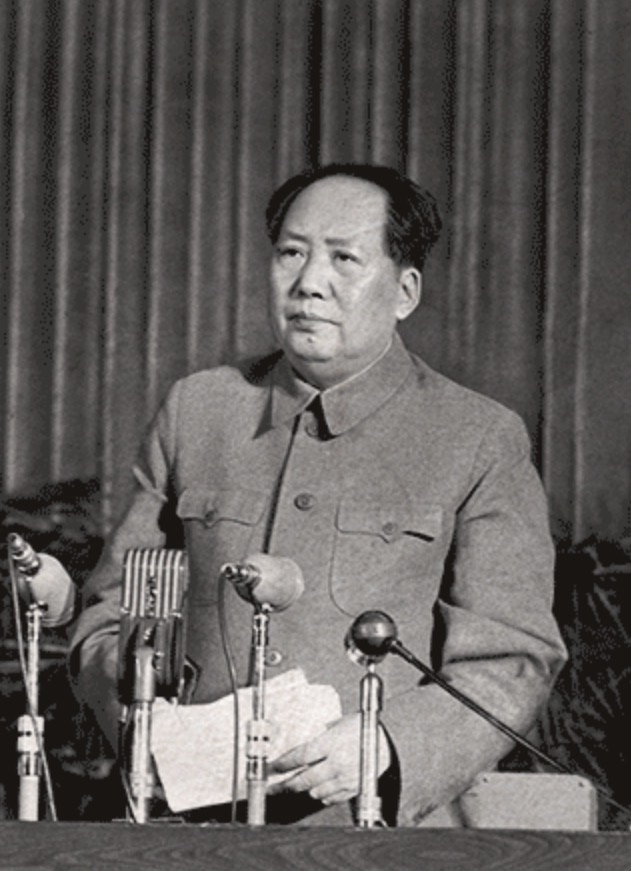
 Mao Zedong addressing the issue of the Hundred Flowers in February 1957. Shortly thereafter, he would soon execute a volte face
Literally the two slogans — ‘let a hundred flowers blossom’ and ‘let a hundred schools of thought contend’ — have no class character; the proletariat can turn them to account, and so can the bourgeoisie or others. Different classes, strata and social groups each have their own views on what are fragrant flowers and what are poisonous weeds. Then, from the point of view of the masses, what should be the criteria today for distinguishing fragrant flowers from poisonous weeds? In their political activities, how should our people judge whether a person’s words and deeds are right or wrong? On the basis of the principles of our Constitution, the will of the overwhelming majority of our people and the common political positions which have been proclaimed on various occasions by our political parties, we consider that, broadly speaking, the criteria should be as follows:
Words and deeds should help to unite, and not divide, the people of all our nationalities.
They should be beneficial, and not harmful, to socialist transformation and socialist construction.
They should help to consolidate, and not undermine or weaken, the people’s democratic dictatorship.
They should help to consolidate, and not undermine or weaken, democratic centralism.
They should help to strengthen, and not shake off or weaken, the leadership of the Communist Party.
They should be beneficial, and not harmful, to international socialist unity and the unity of the peace-loving people of the world.
Of these six criteria, the most important are the two about the socialist path and the leadership of the Party. These criteria are put forward not to hinder but to foster the free discussion of questions among the people. Those who disapprove these criteria can still state their own views and argue their case. However, so long as the majority of the people have clear-cut criteria to go by, criticism and self-criticism can be conducted along proper lines, and these criteria can be applied to people’s words and deeds to determine whether they are right or wrong, whether they are fragrant flowers or poisonous weeds. These are political criteria. Naturally, to judge the validity of scientific theories or assess the aesthetic value of works of art, other relevant criteria are needed. But these six political criteria are applicable to all activities in the arts and sciences. In a socialist country like ours, can there possibly be any useful scientific or artistic activity which runs counter to these political criteria?
— Mao Zedong, 27 February 1957
Fragrant Weeds
WJF Jenner
1983
As the “Hundred Flowers� movement of 1956-7 recedes further into the past it becomes no less important. It came at a turning point in the story of the People’s Republic. The new state founded in 1949 had been remarkably successful. It had provided the first strong and unified government China had known since the eighteenth century. An economy that had been in ruins had been put back together and was from 1953 onwards receiving huge capital investments under the first Five-Year Plan. Private landlordism had been ended. Industry and commerce were flourishing. Internationally China stood higher than at any time since the Opium Wars. In Korea she had taken on the world’s greatest power and ended the war in a stronger position than when she entered it; and she was being treated with respect in international diplomacy.
This phase of China’s development had been intended to achieve not immediate socialism but something roughly equivalent to the results of Europe’s bourgeois revolutions of the seventeenth to nineteenth centuries. The big difference about “new democracy� or the “people’s democratic dictatorship� was that it was under Communist Party control: China’s bourgeoisie had failed to withstand the challenge either of Western and Japanese imperialism or of China’s own traditions that were lumped together under the label “feudalism�. An eventual transition to socialism had always been on the Party’s programme, but until 1955 the general impression had been that this would be a gradual process spread over several decades.
These first years of the new state had not been painless. Apart from the bloody war in Korea, the land reform programme and the elimination of the remaining organised resistance to the new order had involved much killing; and such groups as officials, businessmen and intellectuals had been subjected to harsh propaganda campaigns intended to change their attitudes. But in most ways the life of most people was better. There was a feeling that the country had stood up and was moving again after generations of passivity and weakness. Production and incomes were both rising. New China was not just a rhetorical expression.
By 1956 there had also been time for some of the characteristic problems of the new system to make themselves felt. Yesterday’s fighter in homespun living among the peasants could as today’s chauffeur-driven senior official or more humble section head slip into the high and mighty ways of the mandarin. The combined effect of China’s political traditions and the new Soviet-style structure was to create an enormous Party and state bureaucracy. Most of the pieces in this volume give glimpses into this world. Liu Binyan shows us some scenes from the life of a Party newspaper office. Wang Meng’s “Newcomer� learns with a mixture of disillusionment and growing maturity that a local Party organisation department is not exactly what as a naive youngster he had expected it to be. The section head of Nan Ding’s story, a minor cultural functionary so used to basing all his judgements on his boss’s prejudices that he loses the ability to make his own mind up, is utterly at a loss when a new boss asks his opinions but gives no hints as to the answers he wants to hear. The plants of Liu Shahe’s little allegories flourish in the rich soil of the official world. Geng Longxiang’s Hospital Director Li represents other such pompous and self-seeking asses in authority; a rural version of the petty tyrant in the making can be seen in Qin Zhaoyang’s “Silence�; and a trade union official who does not care about the interests of his members is one of the two protagonists of Li Guowen’s “The Election�. Office-holders such as these existed: that was never really questioned. What was remarkable was that writers had been allowed to portray them. During the years of war against Japan and the forces of Chiang Kai-shek the Communist Party had required the arts to follow its current political needs closely. When first the survival of the nation and then the victory of the revolution over a corrupt and brutal old order had been at stake writers had generally been willing to be propagandists under orders. The few dissenting voices raised from time to time had nearly all been those of writers loyal to the cause who were protesting at shortcomings within the movement in the hope of reforming it.
Such protests had been silenced, and in the first years of the People’s Republic literature had tended to remain tied to the propaganda needs of the day. The results were disappointing: the simplicities of the Yan’an era no longer seemed to work, and the dogmas borrowed from official Soviet literary policy of the 1930s and 1940s produced little of outstanding quality. Because writers were so closely controlled they could not create works worthy of the stirring age in which they were living. Campaigns against various kinds of “bourgeois� thinking did not help to emancipate minds, especially after 1955, when Mao Zedong raised his disagreements with the somewhat unorthodox Marxist critic Hu Feng to the level of a life and death struggle between revolution and counter revolution,
Early in 1956 a new policy was announced by Zhou Enlai: henceforward intellectuals were to be more trusted and given better treatment. In May Lu Dingyi, the head of the Central Committee’s propaganda department, made a speech spelling out the Party’s new emphasis on allowing the arts more autonomy, and encouraging criticism of its own besetting sin of dogmatism. The title under which the speech was published — “Let a Hundred Flowers Bloom, Let a Hundred Schools of Thought Contend� — provided the label for the new movement.
The official invitation to a wider freedom won its first successes within the Party’s cultural machinery. Those who responded most enthusiastically in 1956 tended to be younger writers who had been brought up in the Communist movement and were secure in their loyalty to it, rather than established figures who had first made their names twenty years or more earlier. They were encouraged by some of the editors in the literary magazines who themselves felt frustrated by the prevailing dogmatism that was shackling creativity. One of these, Qin Zhaoyang in People’s Literature, both ensured that work such as that of Liu Binyan and Wang Meng was printed and wrote a long article that appeared in the magazine’s September issue: “Realism: the Broad Road.� This called for a more truthful kind of writing freed from excessively close political direction. Old conventions had to be smashed boldly. Neither the Yan’an views of Mao Zedong nor the official Soviet doctrine of socialist realism — which limited realism to what was useful as propaganda for socialism — were enough. Qin and those who thought like him had been much influenced by the opening up of Soviet literature after Stalin’s death.
The first blooming of the hundred flowers was blighted by a chilly winter in which the old orthodoxies reasserted themselves. Then in the spring of 1957 Mao Zedong set things moving again. The freedom to criticise was at its height in June when a reversal of line led to a new movement that was to have disastrous consequences — the anti-rightist campaign of 1957-8. In this terrible campaign hundreds of thousands of people who had spoken up were harshly punished. All the pieces in this volume were labelled as “poisonous weeds� to be uprooted, as opposed to fragrant flowers that could be allowed to blossom. Many of the authors were formally designated as rightists. Not only were the lives of the rightists, their families and their friends ruined — in some cases, as with a feature by Liu Binyan on a bridge construction site, even the models for characters in a story suffered — but China thereby silenced the voices that might have warned of the worst follies of the “great leap forward� and the “cultural revolution�. Writing about the dark side of socialism, advocating realism even when it hurt, and appearing to interfere in real life (as by exposing abuses) were all banned. Thus it was that while some writers could allude subtly to the famine of 1960-62, this catastrophe could not be openly discussed at the time in the press. It was precisely the appalling consequences of this forced silence that made the appearance in Shanghai in 1979 of a volume of former “poisonous weeds� whose contents included the pieces translated in this book so heartening a confirmation that the lessons of the previous twenty-two years had, to some extent, been learned. Since 1979 writers in China have once again been permitted to deal with the problems and tragedies, as well as the successes, of their country. This hard earned right has been threatened and restricted, but it is still being clung on to.
***
 ‘I can give as good as I get’, by Huang Yongyu
***
The other main area in which 1956-7 saw a widening of literature was in dealing with personal relationships, which of course cannot be reduced simply to class feeling, as some of the more idiotic of ideologists maintained they could. In 1956 it became possible to publish love stories. The student heroine of Zong Pu’s “Red Beans� is torn between her political commitment to the new China emerging from the dying old order around 1948 and her love for an attractive, gifted but selfish fellow-student who wants to take her away to America. To most readers it will be obvious that her loyalty to cause and country was all the stronger because it demanded and obtained the sacrifice of a deep love. But to the story’s critics it was disgraceful that a sympathetic character should feel anything but hatred for the young man who so evidently despises the revolutionary movement.
So although the story may seem a little overdone in its romanticism it took courage to write and publish. The other love story in this collection, Liu Shaotang’s, is set in another university after 1949, and was bold in suggesting that an unhappily matched couple might do best to part. By traditional standards of morality a woman belonged to a man for the rest of her life once they were even engaged to be married, and writers who reflect more enlightened values in society still come under heavy fire from moralizing critics who hold them responsible for the problems they describe.
The controversies that some of these stories initially aroused were lively and not just one-sided. They were concerned not with questions of artistry and technique, but with their content; and it is for their subject-matter that they keep their interest today. Most of their authors were young and inexperienced writers at the time, and there had not been in the carly 1950s the kind of environment in which fine writing could flourish. Neither then nor now was the quality of the writing the point at issue. The storm that was whipped up once the anti-rightist campaign started was not about that, nor was it normal disagreement over contentious questions. The writers found themselves caught up in something much bigger: the dramatic speeding up of the switch from “new democracy�, under which nearly all land and much of industry and commerce had remained in private hands, to all-out socialism.
During 1955 there had been a policy change at the top of the Party over how to handle the problems that had arisen after the land reform was over. Precisely because the redistribution had brought about a much less unequal divison of property in the countryside many peasants were now eating more of the crops they raised instead of handing over grain to landlords and creditors who put it on the market. Although output increased each year, less was being sold to the state. How were the cities and towns to be fed? The problem was even more serious as the five-year plan was pushing up the urban population. Even those at the head of the Party and the state who would have preferred a steady and well-prepared transition to socialist agriculture were forced by the procurement problem to go along with Mao and the others who were ideologically and temperamentally inclined to rush ahead to the socialist millennium.
The Hundred Flowers movement was not in itself connected with the transition to socialism in agriculture, industry and commerce that took place in 1956. But once the country had been committed to the new course of action, excitement and tension rose. All other issues had to be subordinated to it. Thus it was that criticisms of bureaucratic evils far older than the People’s Republic could be misrepresented as frenzied attacks on the Party and the building of socialism.
There was a false logic that argued along these lines: now that feudal and imperialist power had been overthrown in China, and the main contradiction in society was between socialism and capitalism, any exposure of abuses in the system was anti-socialist and an attempt to restore the power of the bourgeoisie. The argument might have held some water if the bourgeoisie had ever held power in China, and if many of China’s ills both before and after 1956 had not been precisely due to the shallowness and weakness of bourgeois and modern capitalist influences. Thus it was that the writers, teachers, officials, students and other intellectuals labelled as rightists who could have done so much for China’s socialism were treated as its enemies. Events were later to show that the cost in lives and in efficient development of silencing critics was to be very high indeed, while bureaucracy was given over twenty more years in which to entrench itself.
The young writers of a quarter of a century ago are now all middle-aged, and though they have had much experience of life’s trials since then their writing careers have only begun again in very recent years. The issues they wrote about then are, unfortunately, still alive. Despite all that has happened many of them are even now still pressing for a more truthful literature in China. Former rightists have played a key part in the emancipation movement of the last three or four years. There are still officials who resent their return to public life and print, feeling that the anti-rightist campaign was fully justified. This is one of the more depressing aspects of the present highly complicated cultural scene, but there are other grounds for hoping that enough people have learned enough from the last twenty-five years to prevent a replay of old mistakes. If modernisation is finally achieved the writers represented here will be entitled to a share of the credit; and had they been heeded earlier China might have been spared some unnecessary suffering.
***
Source:
Liu Binyan et al, Fragrant Weeds—Chinese short stories once labelled as “Poisonous Weeds�, translated by Geremie Barmé and Bennett Lee, edited by W.J.F. Jenner, Hong Kong: Joint Publishing, 1983
 Universal History Archive/Universal Images Group via Getty Images
***
Since there is fire in Poland and Hungary, it will blaze up sooner or later. Which is better, to let the fire blaze, or not to let it? Fire cannot be wrapped up in paper. Now that fires have blazed up, that’s just fine. In this way numerous counter-revolutionaries in Hungary have exposed themselves. The Hungarian incident has educated the Hungarian people and at the same time some comrades in the Soviet Union as well as us Chinese comrades.
— Mao Zedong, 15 November 1956
***
What China Will Learn from Orbán’s Defeat
Sam Chetwin George
1 May 2026
After watching Nikita Khrushchev’s repudiation of Stalin lead to a revolution in Hungary, Mao Zedong concluded that under one-party rule, no amount of political liberalization is safe. The defeat of Viktor Orbán in Hungary’s parliamentary elections last month most likely reinforced that lesson for Chinese President Xi Jinping.
Ever since the Hungarian Revolution of 1956, the country has served as a cautionary tale about the dangers of political reform in one-party states. After Viktor Orbán’s defeat in Hungary’s parliamentary elections last month, this lesson is being pondered again by the world’s autocratic powers—not least China.
The story starts 70 years ago with Nikita Khrushchev’s “Secret Speech,� delivered to a closed session of the 20th Congress of the Communist Party of the Soviet Union. In that speech, Khrushchev denounced Stalin, condemning his predecessor’s cult of personality, his brutal purges, and his lack of preparedness for the Nazi invasion.
Supposedly delivered in secret, the speech nevertheless quickly leaked, sending shock waves through the Eastern Bloc countries then under the Kremlin’s thumb. The idea that Stalin, the emblem of absolute power, could come under attack from one of his own acolytes elevated hopes for new political possibilities.
The effect was particularly dramatic in Hungary. A Budapest debate club called the Petőfi Circle—named after the poet who helped inspire the Hungarian Revolution of 1848–49 against the Austro-Hungarian Empire—had been founded in 1955 by the Communist Youth League as a controlled outlet for tame discussions about reform. After Khrushchev’s speech, the group’s members began to ask more radical questions.
In debates that drew thousands of spectators, members criticized Hungary’s Stalinist leader, Mátyás Rákosi, and called for press freedom, economic reform, and political rehabilitation and restitution for purge victims. This helped ignite widespread opposition to Soviet rule. Within months, student protests had widened into the Hungarian Revolution of 1956, a national movement that sought effective independence from the Soviet Union. Khrushchev ultimately sent in troops to crush the uprising.
Communist Party of China (CPC) Chairman Mao Zedong watched the events in Budapest unfold with growing unease, given the uncomfortable parallels between himself and the version of Stalin that Khrushchev had renounced. Concerned that similar disillusionment might be brewing in China, Mao launched the Hundred Flowers Campaign in 1956, creating space for citizens to air grievances and suggest improvements without threatening the CPC’s legitimacy.
The campaign’s results shocked Mao. Instead of a well-controlled safety valve through which mild criticism and discontent could escape, a deluge of demands for press freedom, calls for the CPC to loosen its grip on economic and cultural life, and accusations of entrenched privilege poured out.
By mid-1957, Mao concluded that the experiment could pose an existential risk to him and to the CPC’s rule. The result was the Anti-Rightist Campaign, which claimed that some of the criticisms were “poisonous weeds� rather than the “fragrant flowers� Mao supposedly welcomed. More than 550,000 intellectuals and professionals were caught in the campaign’s net; most were sent to labor camps, and many committed suicide. Their families bore the stigmatizing “rightist� label for years.
Khrushchev’s repudiation of Stalin had led to a revolution in Hungary, and Mao’s experiment with liberalization had produced a legitimacy crisis that the Chairman believed could be resolved only through mass repression. The lesson Mao drew from these events was that under one-party rule, an opening for dissent can easily ignite rebellion. Autocratic leaders cannot permit intellectual freedom while guaranteeing that it will not undermine the system itself. This hardline view has informed the CPC’s thinking ever since, especially under President Xi Jinping’s leadership.
Against this backdrop, Orbán’s defeat is significant for the Chinese leadership. After taking power in 2010, Orbán systematically hollowed out the country’s democratic institutions by undermining judicial independence, capturing public media, and rewriting electoral rules to entrench his party’s advantages. Taking inspiration from Russian President Vladimir Putin, Orbán sought to consolidate power through his model of “illiberal democracy,� which made genuine democratic competition increasingly difficult.
But even under an illiberal democracy, remnants of an independent press survived, and a unified opposition party was able to contest elections and mobilize civil society. In the end, this was enough to remove Orbán from power.
For Xi and his underlings, the takeaway is less about Orbán’s missteps and more about the binary nature of autocratic power. A regime that permits genuine opposition has conceded something it cannot get back. Once citizens can vote out their rulers, or debate their leaders freely, or organize an independent press, the logic of accountability has been introduced into a system designed to exclude it; once legitimized, it tends to build its own momentum.
Armed with this understanding, Xi has spent more than a decade consolidating power and purging rivals with extraordinary resolve. Orbán’s fall—the latest episode in a historical dialogue between Hungary and China that started in 1956—will only reinforce Xi’s conviction that no amount of political liberalization is safe.
***
Source:
An Interview with Magyar Narancs
Sam George and Liu He
In a historic general election, Victor Orban, Hungary’s Prime Minister for 16 years and Europe’s longest service prime minister to date, fell from his throne. A liberal-turned-populist, his rein was marred by controversies of nepotism, anti-democratic practices, pro-Russia foreign policy and a pivot to China.
I luckily had the chance to visit Budapest in person during the eventful week of April 12, and sat down for an interview with the famed Hungarian national magazine Magyar Narancs, first issued on October 24, 1989, just one day after the end of communism and the founding of the Republic of Hungary, replacing the People’s Republic. My friend from Asia Society, Sam George, was simultaneously interviewed too. He is an accomplished China analyst, a fellow Oxonian and now a Senior Fellow at the Center on US-China Relations.
The day Orban fell, I received an email from a friend, titled “Good job in Hungary�, and the message read: “I see that you and XXX did a good job restoring democracy in Hungary. Great!� This is of course pure banter, but I did not mind indulging for one second and fantasising being the straw that breaks a camel’s back wherever autocratic forces gather. So I replied: “Perhaps Beijing next?�
“No, not next. You need to warm up on some smaller problems.�
The interview itself is actually very little to do with Hungary per se, but mostly on China’s influence in Europe and the decline of the west. At any rate, since Hungary and China have been cozying up for years and Hungary is effectively rendered the CCP’s favourite backdoor into Europe, I’d count my pushing back against CCP influence in Europe in my good deeds towards the people of Hungary and Europe. So here’s me doing my entirely insignificant part in “peacefully evolving� Hungary.
Enjoy.
Leo
***
 Magazine cover
***
A crisis of Western confidence
China prefers monolithic, predictable, ideally one-man power structures. The logic of democratic alternation of power — with opposition parties and uncertainty — is alien to it.
Magyar Narancs: It is often suggested that Chinese influence poses a threat to Western democracies, yet in Trump’s second term, we may also have reason to worry about the behavior of the United States.
Sam Chetwin George: What is changing dramatically is not only the way the world perceives the roles of China and the United States, but also the classic narrative that sharply distinguishes democracy from authoritarianism. While JD Vance openly endorsed Viktor Orbán, Xi Jinping did not overtly participate in the Hungarian elections. The U.S. national security strategy quite openly backs “like-minded� political forces in Europe — far-right, nationalist, “anti-woke� actors — and the transatlantic relationship has been shaken. But none of this means that China is not also trying to advance its interests in Europe. It may proceed in a less ideological manner, but alongside business partnerships it is also seeking political ties and security cooperation. And, as in Viktor Orbán’s case, it consistently finds that less democratic leaders are much easier to deal with. The kind of security agreement signed by the Hungarian and Chinese governments in 2024 is not at all unusual wherever significant Chinese interests or assets are present. At the same time, such arrangements can easily erode democratic institutions, because they tend to strengthen the executive branch — that is, the political leadership in power.
Liu He: At the moment, there is no obvious risk of China interfering in European elections, but where it sees the need and has the capacity, it does use such methods: in Africa, for instance, it builds strong influence through investments, media presence, and political ties. By the very nature of an authoritarian system, the Chinese leadership — lacking democratic legitimacy at home — also perceives other democracies as a threat. China cooperated with and learned from Western countries during its rise, but by now it feels it has acquired the knowledge it needs; it would like to preserve the economic relationship, while remaining unwilling to undergo political change. China prefers monolithic, predictable, ideally one-man power structures. The logic of democratic alternation of power — with opposition parties and uncertainty — is alien to it. It wants to do long-term business with a stable leader.
What are we misunderstanding when we view China as a reliable business partner?
SCG: We forget that the Chinese Communist Party follows the Soviet model, on Leninist foundations. To this day, the Chinese leadership blames the West for the collapse of the Soviet Union and sees the liberation of the post-Soviet region as a series of “color revolutions.� The lesson they drew is that democracies subvert authoritarian systems from within. Xi Jinping sees himself as the heir to the October Revolution, and although the Soviet experiment failed, the historical project, in his eyes, did not end. Today’s global Chinese initiatives — on security, civilization, or development — are all meant to make Chinese norms of governance and security into international standards, and to create a world order more favorable to China. In this sense, Hungary can be seen as a testing ground.
Speaking with a Chinese and a New Zealand researcher, one inevitably wonders how objective one can be on the subject of China.
LH: I grew up in Beijing, but I attended high school and university in the United Kingdom. When I returned to China, I realized that the system keeps reproducing severe crises — from the Great Leap Forward and the famine to the Cultural Revolution and the events of June 4, 1989 and lately Zero-Covid Policy. However much China may appear to be a success story, in recent years emigration has become strikingly visible: businesspeople, students, and lower-income groups alike have been leaving the country in large numbers. I am convinced that China’s economic rise should not be attributed to the Party’s “grand design,� but rather to the fact that the authorities relaxed their grip while ordinary people tried to make their way despite the system. It is also clear that China would not be where it is without the West: without Jimmy Carter’s normalization of relations, Richard Nixon’s visit, the advice of liberal economists like János Kornai, American information technology, and European markets. So the question is: did the Party lift China up — or hold it back for decades?
SCG: I was born in Hong Kong, raised in a New Zealand family, and now work in New York at the Asia Society. My method, however, is a straightforward one: I study the history, ideology, bureaucracy, and propaganda of the Chinese Communist Party. I have been greatly influenced by Geremie Barmé’s “New Sinology,� according to which China must be read through its own intellectual history and political traditions. The main pillar of my work is that I take seriously what the Party itself says, because the system produces an enormous number of documents, and often does state its intentions quite clearly — just not always through the same channel.
The issue is rather that the West has visibly lost confidence in itself: it has become uncertain about its own institutions, its own politics, even about democratic elections themselves. Into that intellectual vacuum has burst “Chinamaxxing� — the overestimation and romanticization of China.
For a long time it was almost a cliché to say that real economic and technological breakthroughs are born in democracies. Today, however, neither Trump nor Xi nor Putin seems to believe that idea. Could that theory collapse?
SCG: Faith in it has clearly weakened, and one sign of that is the growing Western phenomenon known as “Chinamaxxing�: the idea that China is not just a successful rival, but the future itself, perhaps even capable of answering civilizational questions that Western democracies cannot. Sometimes this enthusiasm is superficial and fashionable; sometimes it poses as a serious intellectual position. According to older modernization theory, autocracies are inherently limited, whereas democracies generate genuine innovation through free thought, competition, and a strong civil society. There is much truth in that: the internet and artificial intelligence both emerged in democratic contexts. Yet while the United States lacks a coherent industrial policy sustained across administrations, China’s planning system has demonstrated its own strengths. The Party clearly defines strategic goals, allocates resources accordingly, and economic actors know exactly which sectors they must compete in to win state support — for example, in electric vehicle manufacturing. For reasons of national security, the Chinese leadership wants an economy that does not depend on American power and can, if necessary, be mobilized for war.
LH: The issue is rather that the West has visibly lost confidence in itself: it has become uncertain about its own institutions, its own politics, even about democratic elections themselves. Into that intellectual vacuum has burst “Chinamaxxing� — the overestimation and romanticization of China. This is not a new phenomenon: from the orientalist fascination of the colonial era to Maoist nostalgia, from celebrations of the Beijing Consensus to pro-China influencers, there have always been efforts to paint autocracies as glittering, modern, and successful. But China only looks strong from the outside; in reality, it is a paper tiger. Almost all of Chinese provinces are as indebted as Greece was in 2010, and the state uses its own banking system to finance megalomaniacal national vanity projects in infrastructure, real estate and other sectors. The system may not collapse tomorrow, but Beijing’s bureaucracy is locked into firefighting every single day.
A company like CATL cannot simply say no if Beijing asks something of it.
In Hungary, two Chinese giants, BYD and CATL, have established themselves with the government’s support. Could China use economic dependence as a geopolitical weapon in the same way Russia used energy?
SCG: One of Xi Jinping’s main objectives was to subordinate the private sector to the Party. The crackdown on Alibaba founder Jack Ma — who had become increasingly critical of the Party — was a highly visible example of this and a clear signal to the business world. Chinese firms, especially in sensitive industries, can only truly thrive if they align themselves with the Party’s five-year plans and national security goals, and Beijing is consciously trying to make other countries dependent on Chinese supply chains. Xi openly said six years ago that China was seeking to build a “capacity for retaliation.� Hungary, as an EU member state, is therefore an ideal tunnel into one of the world’s largest markets. I do not yet see China actually using economic dependence as a weapon in a fully explicit way in Hungary, but I do see that it has been given an opportunity to entrench industrial standards — alongside tax incentives and relaxed environmental rules.
LH: The main question is where Hungary draws the line in the face of Chinese corporate expansion. After the pandemic, Xi Jinping truly “put the private sector in order�: the Party no longer exclusively suppresses major private companies but seeks to integrate them into the system. Large firms in China compete with one another until some win and become designated as “national champions,� and then explicitly begin to serve the state’s strategic aims. A company like CATL cannot simply say no if Beijing asks something of it.
After a change of government in Hungary, could a new administration renegotiate the deals made with Chinese firms? Could we use our exclusive position to secure better terms?
SCG: Yes, and in such negotiations the issues could include compliance with environmental rules, increasing the share of local labor, or keeping a larger portion of the economic benefits in Hungary. Everything depends on how much room for maneuver Beijing perceives it has — Australia and Lithuania show that China is willing to apply economic pressure — and on what strategy the Hungarians formulate. Many countries make the mistake of not having a clear position, whereas China very much does: it has a capable bureaucracy and pre-planned scenarios.
China is already a military actor — and the main hidden enabler of Russia in the war in Ukraine.
The war in Iran and the standoff in the Strait of Hormuz highlight the weakening role of the United States as the guarantor of global security. Could China emerge as a genuine global military power?
SCG: Despite its current stumbles, the United States still has the most extensive military infrastructure in the world, with broad alliance systems and bases, including through NATO. China has so far been a free rider in that system, benefiting from secure maritime trade routes and American security guarantees, while using its free resources to build up its own economy and industry. For Beijing, it is a risk that American power — partly because of Donald Trump’s politics — is changing shape, weakening, and becoming less predictable. That is why China is compelled to build up its own security capabilities, intelligence, economic defenses, and protection of overseas interests. But, in the immediate term, it is not going to copy the burdensome American model; it will move toward a more targeted security system.
LH: Even so, China is already a military actor — and the main hidden enabler of Russia in the war in Ukraine. Sometimes, certain European countries have a tendency to forget that. China’s military budget is growing rapidly, even though the United States or anyone have any prospect of invading China. So what is China’s military budget preparing for? The answer is simply Taiwan: the Party’s goal is the unification of a Greater China, by military means if necessary. And Taiwan is a developed economy, a thriving democracy, and a key node in the global supply chain for semiconductors and AI. Its fall would trigger a global shock.
SCG: China may present itself as having “peaceful DNA�, but it is not a pacifist power. Just remember the image of Putin, Xi Jinping, and Kim Jong-un together at the September military parade in Beijing last year: that is a picture of a world order they would like to see. When Xi speaks of the “rejuvenation of the Chinese nation,� that includes the unification of Taiwan and the reordering of the South China Sea in line with Chinese interests. China has territorial disputes with several of its neighbors, and through the war in Ukraine it is supporting a conflict that serves its interests — weakening NATO, tying down American attention, while obtaining favorable energy deals. It is a cynical strategy, but a coherent and effective one.
The decline of the West is an old trope in European thought, one that Orbán and the MAGA camp also like to emphasize. Do ideologues of the Chinese Party-state also believe that the West is in decline?
LH: This is not a new idea in China but one of Maoism’s core assumptions: it holds the Party together, gives direction to society, and generates a political energy. Never mind that Europe and America remain economically powerful and are still the birthplace of vital technologies and innovation — the Western public sphere is fond of dwelling on its own problems, while official Chinese discourse relentlessly pushes for its own success stories. In my view, the “decline narrative� does more to force the West into continuous self-reflection and adaptation than actually reflecting reality. However, it is important to recognize that the decline narrative can become a self-fulfilling prophecy if over-repeated and taken too seriously.
SCG: And there are plenty of people eager to repeat it. When Viktor Orbán spoke of an “east wind� blowing through the world, he was in fact repeating a Maoist narrative: the idea that the center of gravity of history is shifting to Asia, under the leadership of the Chinese Communist Party. Think tanks linked to Chinese state security keep publishing analyses about “the end of the West,� the weakening of transatlantic unity, and the fault lines of European identity politics. Western leaders such as Ursula von der Leyen and Mark Carney are also speaking about a crisis of confidence. But the self-examination of Western countries should also be seen as a sign of healthy functioning rather than purely as a cause of paralysis and defeatism.
***
Source:
Liu He 何�, China Is Not A Pacifist Power — Liu He and Sam George interviewed by the Hungarian magazine Magyar Narancs, Peking Hotel, 30 April 2026
***
 The interview
Â