Nearly two-thirds of the Amazon rainforest could turn into degraded forest or savannah-like ecosystems if global warming reaches 1.5-1.9°C above pre-industrial levels and deforestation rises to 22%-28% of the region, according to a new study by the Potsdam Institute for Climate Impact Research (PIK) published in the journal Nature on Wednesday.

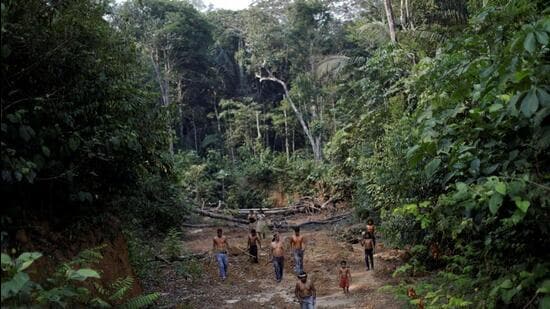
Indigenous people from the Mura tribe show a deforested area inside the Amazon rainforest in Brazil. (Reuters File)
The findings come months after 196 countries at the United Nations climate conference (COP30) in Belém, Brazil, agreed to halt and reverse deforestation and forest degradation by 2030 under Article 5 of the Paris Agreement.
The study said that without additional deforestation, such large-scale drying of the Amazon would likely occur only at much higher warming levels of around 3.7-4°C.
“Deforestation makes the Amazon far less resilient than we previously anticipated. It dries out the atmosphere and weakens the forest’s own rainfall generation,� said Nico Wunderling, PIK scientist and lead author of the study.
“Even moderate additional warming could then trigger cascading impacts across large parts of the forest,� he added.
Researchers said around 17-18% of the Amazon forest has already been lost, pushing the ecosystem closer to the critical threshold identified in the study.
The research team used UTrack, a Lagrangian atmospheric moisture tracking model, to trace moisture movement from evaporation to precipitation. The three-dimensional model reconstructs moisture trajectories using evaporation and rainfall data directly.
The study provides a detailed assessment of how warming and deforestation together affect the stability of the Amazon by combining climate projections, hydrological modelling and a network analysis of atmospheric moisture transport.
“Global warming and deforestation affect rainfall feedbacks across the Amazon system,� said Arie Staal, assistant professor at Utrecht University in the Netherlands and co-author of the study.
“When deforestation interrupts moisture transport in one area of the Amazon, entire regions hundreds or even thousands of kilometres away can also lose resilience through cascading drought effects,� he said.
Researchers said a major reason for forest degradation is the Amazon’s dependence on its own moisture recycling system. Up to half of the region’s rainfall is generated by water released into the atmosphere by trees, which later falls again as rain across the basin.
“When rainforest is lost, this moisture recycling weakens, drought stress increases and other forest regions become more vulnerable to degradation,� the researchers said.
The paper identified Amazon degradation as one of several global tipping points capable of triggering rapid and irreversible environmental impacts.
It said native biomes worldwide are under increasing threat from human activities and are already showing signs of declining resilience. Among the most vulnerable is the Amazon, where increasing droughts, biodiversity loss, degradation and deforestation are outpacing natural variability.
According to the study, reduced internal moisture transport caused by droughts and deforestation could push large parts of the Amazon beyond their physiological limits.
The paper noted that severe droughts in 2005, 2010, 2015-16 and 2023-24 have already had major impacts on the rainforest and are projected to become more frequent in the coming years.