
When Yair Lapid and Naftali Bennett first joined forces in 2013, entering the governing coalition together, it was unclear exactly what their alliance was based on.
Lapid’s party was secularist, Bennett’s religious Zionist. Lapid, at the time, called for a “divorce� from the Palestinians. Bennett ran on annexing parts of the West Bank. They had some common ground on policy, but Lapid defined his party as centrist. Bennett was firmly to the right of the election’s conservative winner, Benjamin Netanyahu.
More than anything, their partnership, dubbed the “Brothers’ Alliance,� seemed like it was based on vibes: Both men were young (Bennett 40, Lapid 49), both were relative newcomers to the political scene and both tried to offer a fresh alternative to Likud and Labor, the two parties that had historically dominated nearly all of Israeli politics.
Their partnership made a comeback in 2021, when they formed an unwieldy coalition to briefly unseat Netanyahu. Now, ahead of another election, they’ve become closer than ever, merging their two parties into a new slate called “Together� that will be led by Bennett and that, they hope, will carry the vote.
There are pragmatic reasons for Lapid and Bennett to unite: Lapid’s Yesh Atid holds 24 seats in the Knesset, which affords it oodles of public campaign funds. The merger has also catapulted the party up in the polls, and saved Lapid from the danger of garnering too few votes to win reelection.
But the Bennett-Lapid bromance appears to stretch beyond pragmatism — they seem to actually like each other.
Will it help them win? Once again, Bennett and Lapid are pitching Israel on a different kind of politics, promising to be unifiers in an age of polarization, something surveys show many Israelis are hungry for. And in an era when politics is dominated by larger-than-life personalities (like Netanyahu and US President Donald Trump), their union is meant to embody a different kind of leadership, one of warm consensus across ideological camps.
“With politicians, you always have to be careful when you talk about things such as friendship, but as far as politicians go, it’s a friendship,� said Shmuel Rosner, a political analyst and editor of the Madad, an Israeli data and polling firm. He added later, “I think people look at this relationship with [Bennett and] Lapid and they do see it as something that makes both of them very human, and in some way more endearing.�
It might not be enough to deliver victory. Bennett, who has positioned himself as a bridge across Israel’s religious-secular divide, is a polarizing figure, having broken with the right in 2021 to form a government with left-wing and Arab lawmakers. Lapid, who has always called himself a centrist, is seen by many as a standard-bearer of the left. And by uniting with each other, they may turn off portions of voters who find the other impalatable.
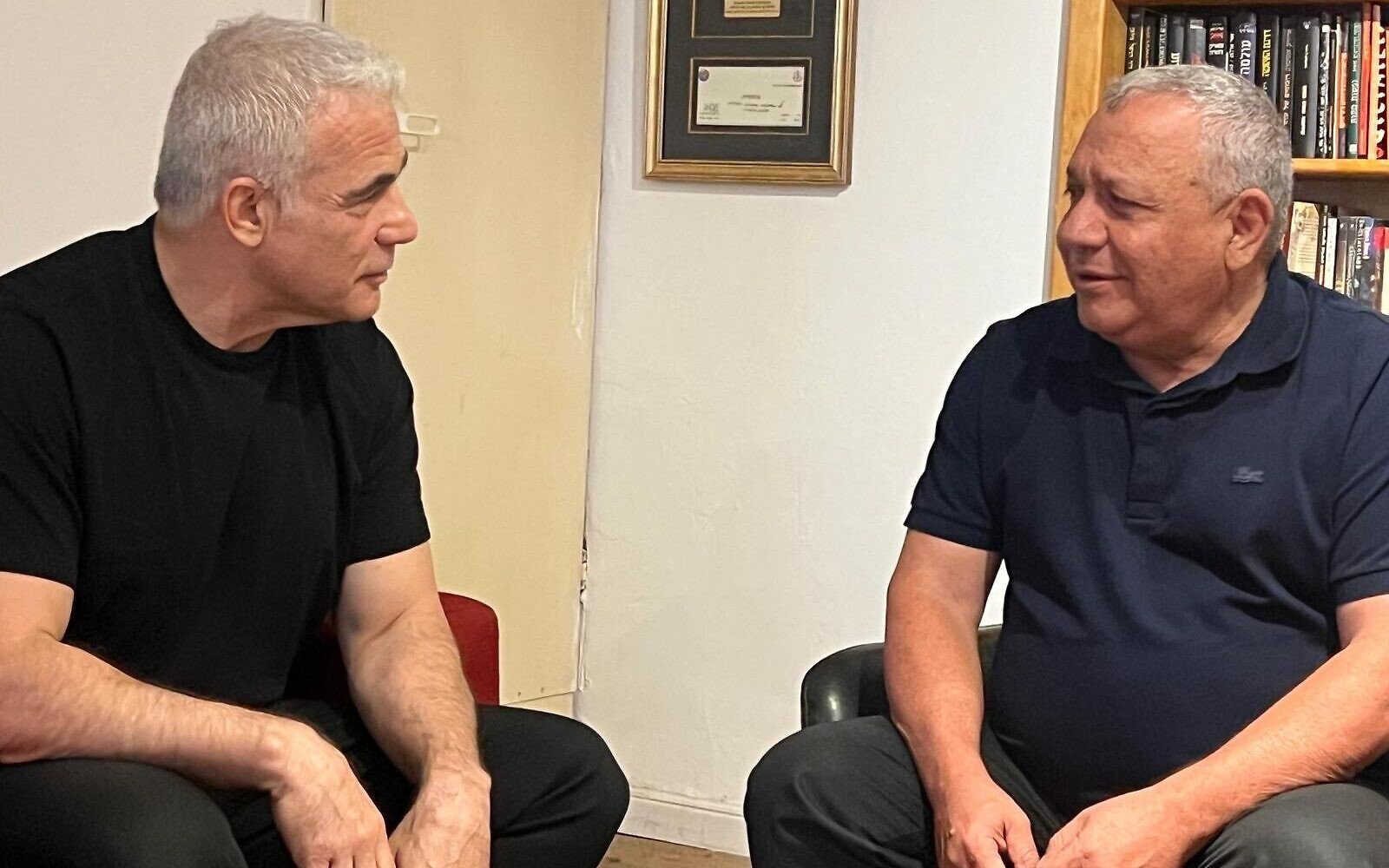
Opposition Leader Yair Lapid (L) meets with former MK Gadi Eisenkot, September 7, 2025. (Courtesy)
Meanwhile, a third opposition candidate who has not joined the Bennett-Lapid union may in fact be the best bet to unite Israel’s war-weary society: Former IDF chief Gadi Eisenkot.
Bennett, Rosner said, “will certainly try to present himself as someone that can get all Israelis to communicate and not to hate each other, etc. Is he the best person to do it? I’m not sure that he is.�
You’ve got a friend
Like any politicians who have served together, Bennett and Lapid have sniped at each other over a decade-plus of political jockeying — including, reportedly, recently. But for two men who could be rivals, who have both sought to lead Israel and who have serious differences when it comes to policy, they’re remarkably mushy toward one another.
“I am not trying to blur differences or disagreements, but there has always been something else between us: trust and friendship,� Lapid said at Together’s launch event. “We know we can count on one another.�
The feeling, Bennett says, is mutual.
“Aside from the fact that Lapid and I are friends, and that every time he has a choice between his personal benefit and the good of the country, he chooses the country, there’s another thing I love about the man,� Bennett posted on Facebook last week, praising his partner as a family man.
“With politicians, you always have to be careful when you talk about things such as friendship, but as far as politicians go, it’s a friendship�
Politically, the internal logic of the partnership is that Lapid is more identified with the center and Bennett with the right, which could help peel away voters from Netanyahu’s camp, seemingly a necessity for any party that hopes to defeat the prime minister. Bennett has made some moves to the center recently, such as endorsing civil marriage, but openly identifies as right-wing.
Polls from past years indicate that many Israelis seek the kind of unity Bennett and Lapid are pitching. Back in 2021, after four largely inconclusive elections in a row, nearly half of Israelis said they supported the coalition led by Bennett and Lapid of right-wing, left-wing and Arab lawmakers, as opposed to some 38% who preferred another round of voting.
And in the months after the Hamas-led October 7, 2023, attack, when Benny Gantz’s centrist Blue and White party (including Eisenkot) joined the coalition in an emergency war government, his party received by far the most support in surveys, roughly double that of Netanyahu’s Likud. But since Gantz quit the government in 2024, his support has collapsed, and his party has all but disintegrated.
“People who support the coalition and the opposition do understand that Israeli society is not in good shape, and that someone who can bring different parts together would be a refreshing thing to have,� Rosner said.
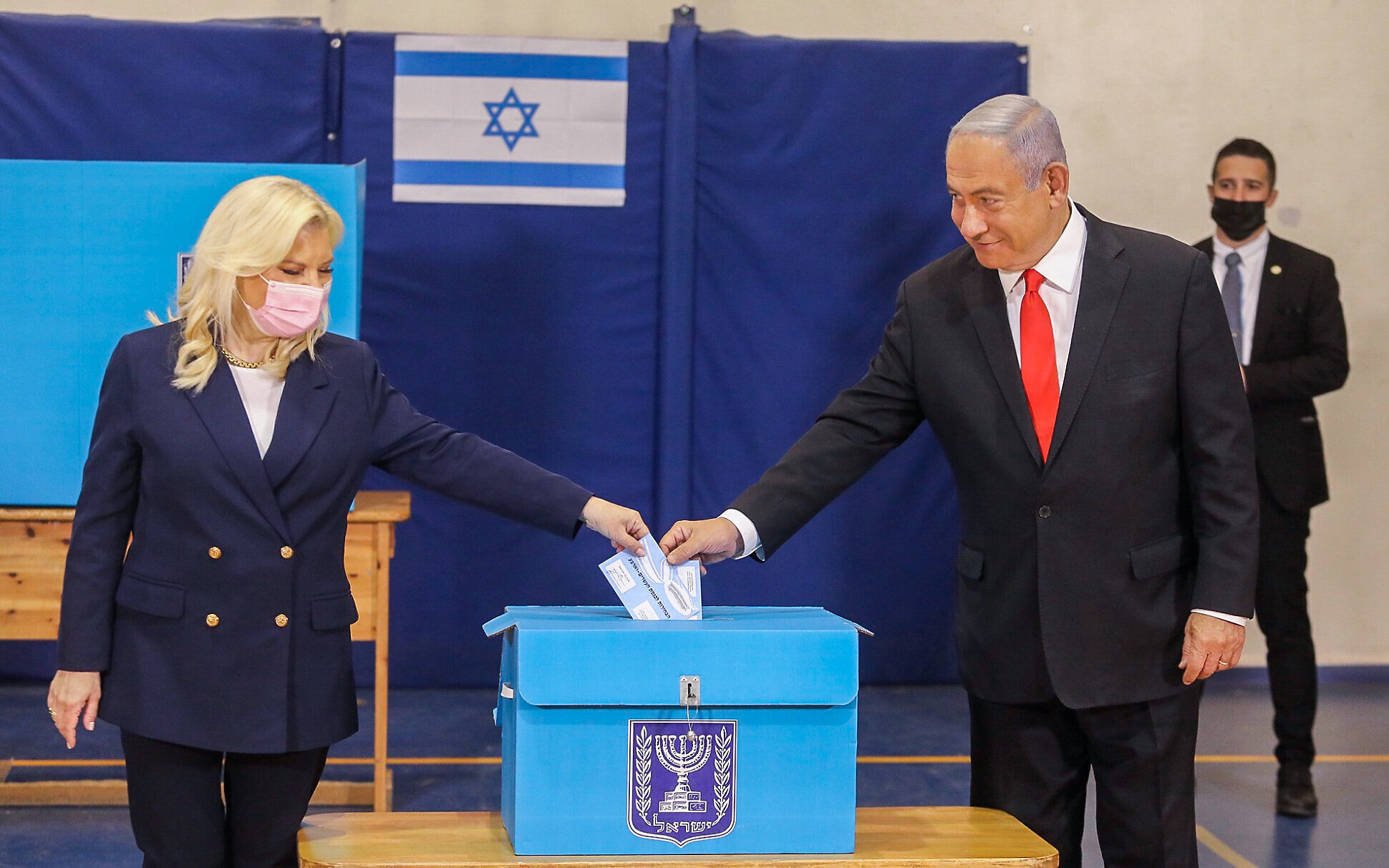
Then prime minister Benjamin Netanyahu casts his vote, together with his wife Sara, at a voting station in Jerusalem, during the Knesset elections on March 23, 2021. (Marc Israel Sellem/POOL)
Israelis quickly tired of the successive elections of 2019 to 2021, with an instant-classic comedy sketch from that time featuring Shauli, a kind of dopey everyman character, making the case for a civil war to finally solve the festering divides in Israeli society. It’s a safe bet that if Israel is thrust into another purgatory of election after election, Israelis won’t like it any more than they used to.
A leader without a base
The problem is that Bennett has alienated a swath of the Israeli electorate he wants to unify. The right doesn’t identify with Bennett — and neither does the left. Many, looking at the man who parlayed six seats in the Knesset into a term as prime minister, see him as an opportunist willing to compromise his values for a shot at power.
Bennett has consistently polled high, indicating that he has significant appeal among those who hope to see Netanyahu defeated. But he is also a controversial figure. Among many right-wing Israelis, the man who once led the furthest-right faction in the Knesset is seen as a traitor for forming a government with centrist, left-wing and Arab parties in 2021, breaking a campaign promise he had made and putting the right out of power for the first time since 2009.
And to much of the Israeli left and parts of the center, he’s no hero either, remembered for his many years advocating for the settlements, annexation and the interests of religious Zionists while standing at Netanyahu’s side.

Shmuel Rosner (Courtesy)
Plenty of people dislike Netanyahu, too, but he also has an incomparably loyal base. Bennett, by contrast, has much of Netanyahu’s polarization without any of the loyalty.
“Netanyahu is a leader of people. You can like him or dislike him, but there are people who will go through fire for him,� Rosner said. “I don’t think Bennett has the ability to be a Netanyahu, nor [does] anyone else I see in the current political sphere.�
Lapid has commanded a measure of loyalty from voters during his 14 years in politics, never winning fewer than 11 Knesset seats in an election and repeatedly outperforming polls. But Netanyahu has also spent almost all that time trying to smear Lapid as a leftist. That, pollster Dahlia Scheindlin argued in a recent Haaretz column, doomed any hope the Yesh Atid leader may have had of leading Israel following elections this year.
“He is widely viewed by the mainstream right wing as far left, almost indistinguishable from Yair Golan, head of the [left-wing] Democrats party,� she wrote. “Neither of them had a chance at winning in Israel’s unforgiving hard-right electorate today. Bennett has that chance.�
Setting a personal example
In addition to signaling compromise by uniting with his ideological foes, Bennett has also tried to position himself personally as a bridge over Israel’s religious rifts. In a 2019 Facebook post, amid his efforts to break from his religious Zionist political roots and appeal to a broader right-wing voter base, he described how he and his wife, Gilat, who comes from a secular Israeli home, accommodate their families by making small compromises on Shabbat, for example.
“Israeli-Jewish can mean religious, traditional, secular, Haredi-nationalist or Haredi,� he wrote. “Israeli Jews don’t judge each other based on how strictly they observe mitzvot. Israeli Jews love and accept every Jew.�
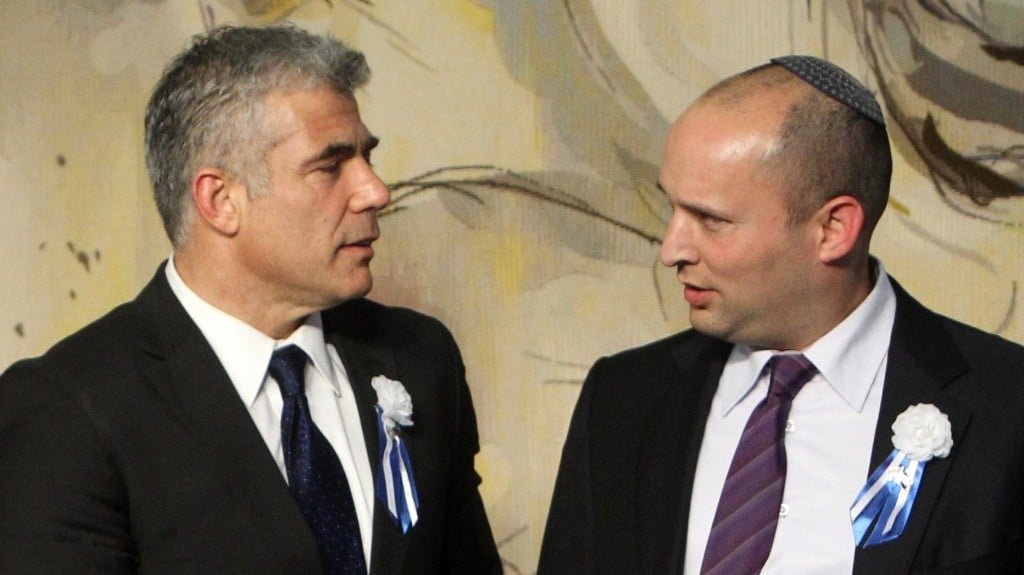
Finance Minister Yair Lapid, left, and Economy Minister Naftali Bennett at the opening session of the Knesset in January, 2013. (Miriam Alster/Flash90)
But whatever novelty Israelis may have previously found in Bennett, a former tech entrepreneur who brought youth, excitement and business savvy to the pro-settler right when he first took over Jewish Home, has since worn off, Rosner argued.
“I think now Bennett is no longer a symbol of something,� Rosner said. “He’s Bennett. He’s a well-known product.�
Someone whose personal example may have the power to inspire Israelis, analysts say, is Eisenkot, a former IDF chief who has drawn widespread respect for his career, and sympathy for his personal sacrifice: Both his son and his nephew were killed fighting in Gaza following Hamas’s October 7, 2023, attack.
“Eisenkot is a very popular person not only because of… the appreciation that the Israeli public is showing toward him as coming from a grieving family,� Channel 13 political analyst Nadav Eyal said on a recent episode of the “Call Me Back� podcast. “It’s also the fact that he comes from a tradition of serving, of true service, public service, in his family.�
Eisenkot’s poll numbers are rising, and he’s reportedly making moves to forge a union of his own with the hawkish opposition party leader Avigdor Liberman.
If that happens, Bennett and Lapid’s bid for unity could all be for naught. While they will have merged with each other, the same old tug-of-war will persist among opponents of Netanyahu — which doesn’t augur well for bringing together all of Israel, left, right and center.