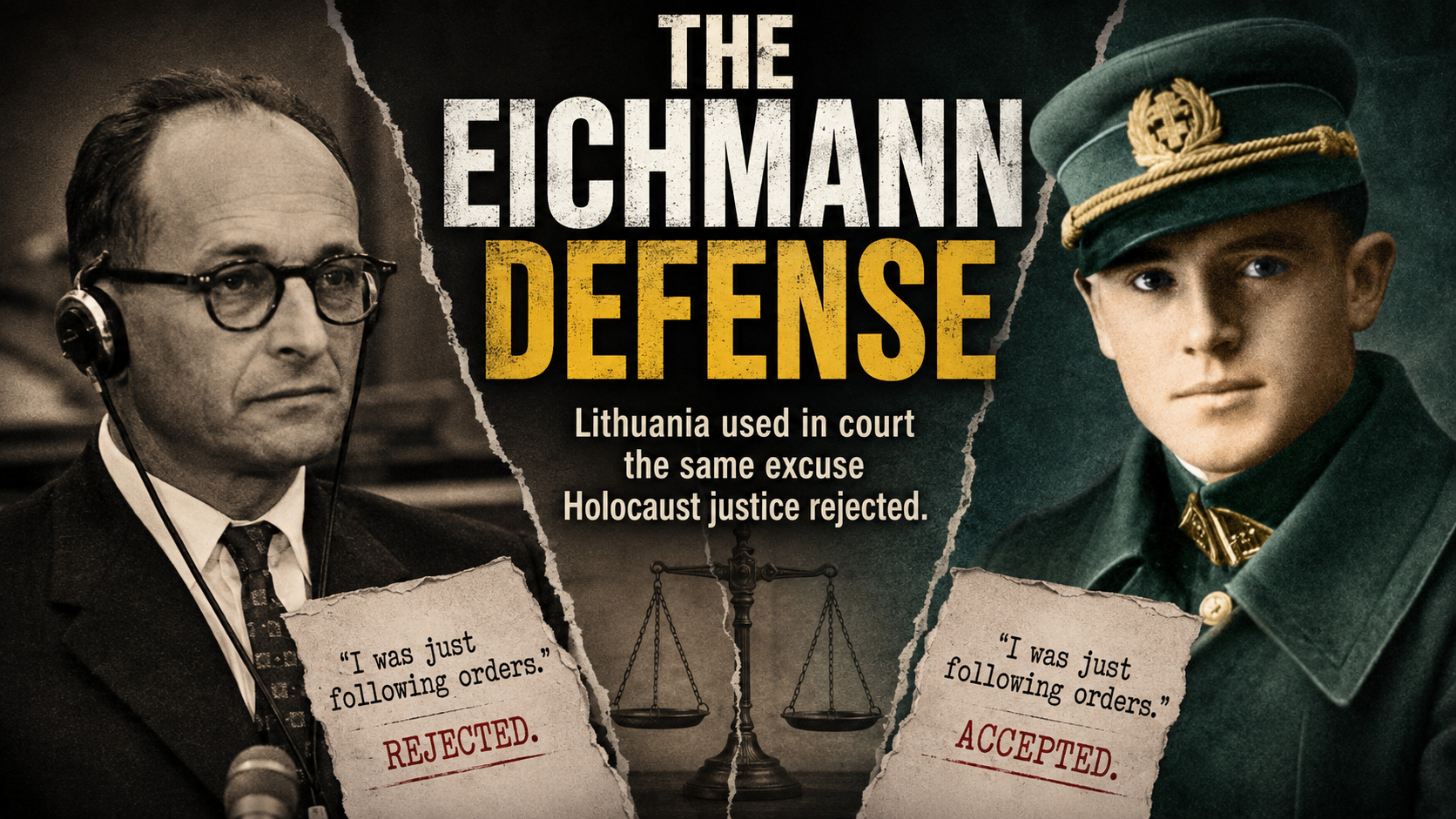
How Lithuania filed in court the defense Adolf Eichmann raised before he was hanged
Adolf Eichmann was not executed because he invented the cog defense. He was executed because that defense failed. In Jerusalem, he claimed he had not made policy, had only carried it out, and was “merely a little cog in the machinery� of destruction. The court rejected the escape route. It convicted him, sentenced him to death, and Israel hanged him on June 1, 1962.
On February 28, 2019, the State of Lithuania filed the same legal escape route in court. Its lawyer wrote it on letterhead. Its taxpayers paid for it. The state has not retracted it. The English translation is public. The Lithuanian original is public too.
The defendant was the Genocide and Resistance Research Centre of Lithuania, the LGGRTC. The plaintiff was the descendant of Lithuanian Jews murdered at Lithuanian hands. The state-funded defense, filed by attorney Liudvika Meškauskaitė, argued that Jonas Noreika — Lithuanian state-honored figure, district chief, signatory of orders consigning Jews to ghettos in the Šiauliai district where they were then shot — “could not have possibly understood� that his orders would lead to Jewish deaths. He was, the filing held, “yet another cog caught in the Nazi machine.�
The Lithuanian taxpayer funded the filing. State revenues paid the attorney’s fees. The instruction came from inside Lithuania’s own institutional apparatus. The product is a public document of the Republic of Lithuania, signed on letterhead, advancing on the state’s behalf the courtroom theory the world rejected at Jerusalem in 1961.
The historians the state deployed alongside the filing were Alfredas Rukšėnas and Arūnas Stan�ikas. Their conclusions did the work the IHRA standard identifies as Holocaust distortion: they moved culpability away from a named local administrator and into abstraction, pressure, context, and machine. Their state-paid conclusions became the evidentiary base on which Lithuania’s legal position rested.
The factual claim that Noreika “could not have possibly understood� fails against his own signature. Beginning in August 1941, as Šiauliai district chief, he signed the orders establishing the Žagarė ghetto and consigning Jews of the Šiauliai region to it. He signed orders for the inventory and confiscation of Jewish property. Those orders are collected and analyzed in the Noreika inquiry submitted to LGGRTC. The Jäger Report entry for Žagarė records the massacre of October 2, 1941: 633 Jewish men, 1,107 Jewish women, and 496 Jewish children. Total: 2,236. Many of them were the same people his orders had assembled.
Six weeks later, Lithuania’s own International Commission for the Evaluation of the Crimes of the Nazi and Soviet Occupation Regimes supplied the answer. Its Sub-commission for the Holocaust stated that Noreika personally signed the August 22 and September 10, 1941 orders for the ghettoization and expropriation of Jews of the Šiauliai District; that the victims those orders had assembled were murdered in the killing operations of summer and fall 1941; and that LGGRTC’s exculpatory treatment of him was “utterly unacceptable.� The same statement rejected the obedience-to-orders premise and noted that no ranking Lithuanian official is known to have been punished for refusing anti-Jewish German directives. Lithuania had written notice from its own Presidential Commission, a body on which LGGRTC’s own director sits. It preserved the filing anyway.
Noreika’s antisemitism predated his German-period authority. His 1933 pamphlet called for the economic and social removal of Jews from Lithuanian life. He then held administrative authority over a district in which approximately 8,000 Jews were murdered under his tenure. The cog defense, applied to a regional administrator with operational authority and a documented antisemitic record, is not a misclassification. It is a fabrication.
The filing is in English translation. The Lithuanian original is on file. The state has not withdrawn either.
The core of the cog defense had already been rejected as a complete exoneration in 1945. Article 8 of the International Military Tribunal Charter stated that acting under orders “shall not free� a defendant from responsibility, though it could be considered in mitigation where justice required it. That was the floor. Holocaust accountability could not fall beneath it and remain accountability.
Germany later confirmed the same principle by prosecuting accessory liability at Sobibor, Auschwitz, and Stutthof. Germany prosecutes the bookkeeper and the watchtower. Lithuania defends the district chief who signed the ghetto orders.
The Eichmann case was the consummation of that established line, not its origin. Adolf Eichmann was tried in Jerusalem from April 11 to August 14, 1961. His defense was that he had been a logistical functionary, that he had not personally killed anyone, that he had not authored the policy he carried out, that he could not be held responsible for outcomes he had not been positioned to comprehend. He was, the defense argued, a cog. The defense failed. He was convicted in December 1961, sentenced to death, and hanged at Ramla Prison on June 1, 1962.
Eichmann conceded knowledge. He argued he had been bound by superior orders, not that he had failed to understand what those orders produced. Lithuania’s filing went further than Eichmann took on his own behalf. It claimed the Lithuanian official did not understand what his ghettoization and confiscation orders would produce. Lithuania filed a defense more extreme than the one the defendant in Jerusalem advanced for himself.
The world recognizes the cog defense by its rejection. Hannah Arendt named the moral phenomenon the banality of evil. Israeli, German, American, British, and international jurisprudence treated the claim as the floor below which Holocaust accountability could not fall.
In 2019, the State of Lithuania built its courtroom defense on that floor.
Lithuania holds two positions simultaneously, on official letterhead, in active state files.
Position one: Jonas Noreika did not understand his orders, did not foresee Jewish deaths, and was a cog in a machine larger than himself. Filing dated February 28, 2019.
Position two: Article 170² §1 criminalizes, in specified public-order or abusive/insulting circumstances, public approval, denial, or gross trivialization of genocide, crimes against humanity, war crimes, and crimes committed by Nazi Germany or the USSR against Lithuania or its inhabitants. The Vilnius Public Prosecutor’s Office invoked that statute in a 220-page criminal case file against Artur Fridman, a Jewish citizen of Lithuania, for one Facebook post about his grandfather and what was done to Lithuanian Jewry.
Article 170² §1 entered the Lithuanian Criminal Code in 2010 as Lithuania’s transposition of Council Framework Decision 2008/913/JHA on combating racism and xenophobia. The state pledged the statute to the European Union as the instrument by which Lithuania would address Holocaust distortion. The state has used it to indict a Jewish citizen. The state has refused to use it against its own filing.
Lithuania knows how to treat collaboration as disabling when the collaboration served Soviet repression. But when the collaboration involved ghettoization, expropriation, and the murder of Jews, the same state discovers fog, pressure, context, and innocence. Jonas Noreika has carried Lithuanian state honors for decades.
The contradiction is narrower and more damaging than mere hypocrisy. Lithuania treats the Holocaust record as settled enough to criminalize a Jewish citizen’s speech, while its own state-funded defense claimed that a state-honored Lithuanian administrator who signed ghettoization and property-confiscation orders could not foresee the lethal consequences. The statute is not the problem. The state’s selective application of historical certainty is.
Against a Jew, the Holocaust record is fixed enough for indictment. Against a state-honored Lithuanian administrator, the same record becomes fog, context, pressure, machinery, and innocence.
Read against its own text, Article 170² §1 does not exempt the filing. The statute criminalizes public approval, denial, or gross trivialization of Nazi crimes against Lithuania or its inhabitants. Lithuanian Jews were inhabitants of Lithuania. A state-funded courtroom claim that a district chief who signed ghettoization and confiscation orders could not understand his orders would lead to Jewish deaths is the textbook case of gross trivialization. The Vilnius Public Prosecutor would be required to open a pre-trial investigation against the state’s own attorney of record. The Prosecutor has not done so. The statute is enforced downward, against the Jewish citizen, and disabled upward, against the state’s own filing.
The cog premise also fails historically. SS-Brigadeführer Walter Stahlecker’s October 15, 1941 report did not describe Lithuanians as inert parts of a German machine. It described German use of Lithuanian initiative, including “self-cleansing� actions and thousands of Jews killed by Lithuanian partisans in Kaunas before German civil administration was constituted. The Lietūkis garage massacre of June 27, 1941 had already shown the point. Lithuanian violence was not merely absorbed into the Nazi machine. It helped operate it.
The Vilnius Public Prosecutor’s Office has refused Article 170² complaints against state Holocaust-distortion conduct across years. The Eichmann-defense filing of February 28, 2019 was never charged under Article 170², never made the subject of a public criminal investigation, and never withdrawn.
Lithuania is a Member Country of the International Holocaust Remembrance Alliance. Membership is voluntary. Lithuania chose it. The IHRA’s working definitions are not external impositions on Lithuania. They are the standard Lithuania asked to be measured against.
The IHRA’s Working Definition of Holocaust Denial and Distortion identifies as distortion intentional efforts to excuse or minimize the Holocaust or its principal elements, including the role of collaborators and allies of Nazi Germany. The filing did not deny that Jews were killed. It did something more useful to a state-memory machine: it minimized the collaborator’s role, translated signed orders into helpless context, and moved culpability from a named Lithuanian official into the fog of “the Nazi machine.�
The IHRA did not wait to react. In April 2019, six weeks after the filing, the IHRA expert chairs issued a joint statement of grave concern over the justification of Noreika’s wartime actions toward Jews. The statement was direct, written, and addressed to Lithuania’s institutional position. It came from Lithuania’s chosen peer body. The state preserved the filing.
Lithuania has continued to send delegates to IHRA Plenary Sessions. Lithuania has continued to invoke its IHRA membership as a credential when external bodies raise Holocaust accountability concerns. Each invocation since April 2019 has been made with knowledge that the body whose membership Lithuania holds had already, in writing, rebuked the institutional position the state was defending in court. Lithuania remains listed as an IHRA Member Country. The membership is the credential. The filing is the conduct. The conduct continues. The credential is laundering.
How can IHRA maintain Lithuania’s membership when the conduct preserved in this filing is the very definition of what IHRA itself calls Holocaust distortion?
The filing was dated February 28, 2019. Today’s date is May 8, 2026. More than seven years.
The filing was not the end. The Presidential Commission rebuke and the IHRA expert chairs’ statement of grave concern, both noted above, gave the state written notice in April 2019. Lithuania’s own presidential body and the international body Lithuania chooses to belong to had spoken. On December 17, 2019, LGGRTC answered by issuing the Stan�ikas memo, which declared Noreika a rescuer of Jews. Inside ten months, the state moved from did-not-understand to actively-saved. The trajectory is the indictment. Lithuania escalated.
The state had every opportunity to disavow the filing. It did not. The Noreika administrative case proceeded through the Vilnius County Administrative Court and the Supreme Administrative Court of Lithuania, ending on April 1, 2020 with a €950 cost order against the Holocaust descendant who had asked Lithuania to correct its own exoneration of a Šiauliai district chief. A later civil track was refused at the cassation stage on August 18, 2020. The state preserved the theory and charged the descendant for challenging it.
The fabrication is not isolated. LGGRTC had already, in the Brazaitis case, manufactured the claim that the United States Congress had completely exonerated and rehabilitated Juozas Brazaitis. Congress had done no such thing. Congressman Brad Sherman wrote the Lithuanian government to say so. LGGRTC has not retracted the Brazaitis fabrication. The Meškauskaitė filing rests on the same institution’s continued operating method: state-honored Lithuanian, manufactured exoneration, refusal to retract under documented foreign notice.
In 2019, Lithuania filed the theory. In 2020, the administrative appeal ended with a cost order rather than correction. In 2020, the later civil track was refused at cassation. In 2025, the same state charged a Jewish citizen under Article 170². The state did not lack notice. It lacked the will to apply its own historical certainty against itself.
The state-funded filing remains unretracted, and no public state act identified in the record withdraws the theory it advanced. The LGGRTC has not retracted the underlying memoranda. The public position remains not confession, correction, or accountability. It remains preservation.
The State of Lithuania has filed in court, at taxpayer expense, the defense Adolf Eichmann raised before Jerusalem rejected it. Lithuania has preserved that filing across more than seven years of judicial process. It has used the same statutory machinery to target a Jewish citizen with 220 pages for a Facebook post that contradicts none of the established facts of the Holocaust against the Jews of Lithuania.
The Fridman indictment is void on Lithuania’s own record. The state cannot prosecute as denial what the state itself has filed in court as defense. Article 170² §1 cannot be unenforced against the state and enforced against the Jew.
Israel reached across borders and across time to hang Eichmann. The 1950 Nazis and Nazi Collaborators Punishment Law applied to a German national for acts committed before the State of Israel existed. Lithuania has refused to reach across the room, from prosecutor’s office to state attorney’s filing, to apply Article 170² §1 to its own document.
Israel reached out. Lithuania looks away.
The contradiction is the policy. The policy is the indictment.