
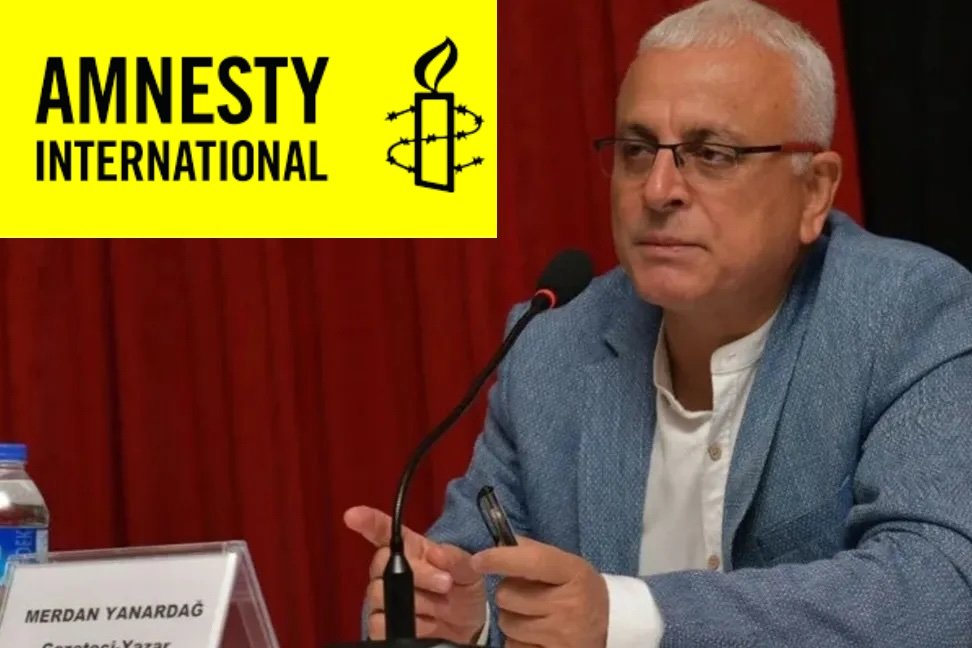
Amnesty International has called on Turkish authorities to immediately release jailed journalist Merdan Yanardağ, who was arrested on espionage charges, and to stop using the criminal justice system to target journalists for their work.
Amnesty urged Turkish authorities to end the use of overly broad and vague laws and what it described as the abuse of the penal code and justice system to suppress dissent, particularly against journalists carrying out their professional duties.
“Political espionage requires evidence showing that a person has unlawfully obtained secret or sensitive state information,” said Ruhat Sena Akşener, director of Amnesty International Turkey. She said Yanardağ’s indictment contains no concrete evidence identifying any state secrets allegedly obtained.
Yanardağ, editor-in-chief of the pro-opposition TELE1 TV station, was arrested on October 26, 2025, on charges of political espionage based on alleged ties to foreign intelligence services and claims that the station was used to influence political processes. He has denied the accusations, calling them fabricated.
Prosecutors are seeking sentences of up to 20 years for defendants in the espionage probe, with the first hearing scheduled for May 11.
Amnesty also said the appointment of a trustee to TELE1 and the station’s sale at what it described as a relatively low price were the latest examples of the shrinking space for independent and opposition media in Turkey.
Following Yanardağ’s arrest, a court placed TELE1’s parent company, ABC Radio Television and Digital Broadcasting Inc., under the Savings Deposit Insurance Fund (TMSF), effectively transferring control of the broadcaster to the state. TMSF later announced that it would auction the station, with a deadline set for June 16. The estimated sale price was set at 28 million Turkish lira ($620,000).
Turkey has seen a sharp decline in press freedom over the past decade, with journalism frequently targeted through legal pressure, arrests and media takeovers.
Journalists critical of the government have increasingly been targeted under laws criminalizing insulting public officials, disinformation and terrorist propaganda.
According to Expression Interrupted, a press freedom monitoring group, 27 journalists are currently behind bars in Turkey. The country’s deteriorating media landscape was further pointed out in the 2026 World Press Freedom Index published by Reporters Without Borders (RSF), where it was ranked 163rd out of 180 nations.