
California’s economy is a puzzle – a high-cost, high-velocity business climate that looks good, bad or indifferent on the national scale, depending on the metric you’re weighing.
My trusty spreadsheet frequently tries to put the Golden State’s economy into perspective by comparing it with the nation. And I’ve learned in four decades as a California business journalist that there’s a continuous, grand debate over the quality of the state’s business climate and its livability.
Not one number, nor any set of numbers, can provide a definitive verdict. Even so, we’ve compiled seven maps I created in recent months that compare California with other states. They might even help you form opinions on how the Golden State stacks up, economically speaking.
GDP giant
Not only does California produce the most “stuff,” as measured by gross domestic product, but it was also one of the fastest-growing state economies in 2025. Look at this data from the Bureau of Economic Analysis.
 What state economies are expanding the most, as measured by GDP. (Graphic by Flourish)
It’s a pricey place to live
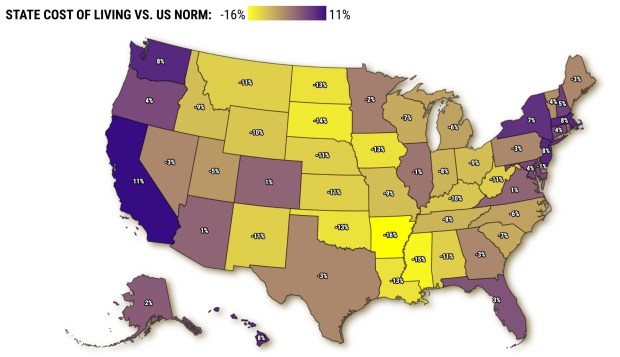 State cost of living. (Map by Flourish)
Home to big paychecks
California paychecks are typically high, nationally speaking, even after adjusting per-capita personal income for taxes and the state’s lofty cost of living. My trusty spreadsheet pondered data from the Bureau of Economic Analysis and the Tax Foundation.
 Buying power: California vs. US, cost and tax adjusted income. (Graphic by Flourish)
Big shopping sprees
Californians are also big spenders due to those fatter paychecks that are stretched by the state’s lofty cost of living. Look at this government consumer spending data.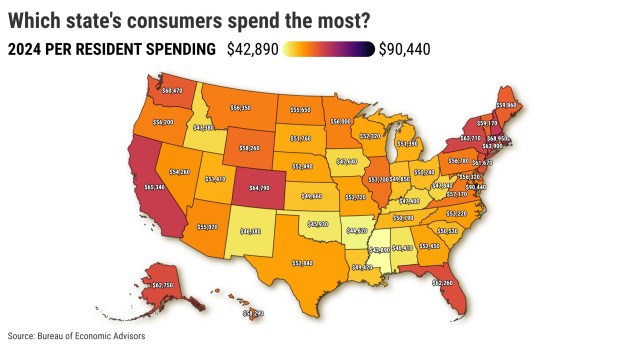
Modest job creation
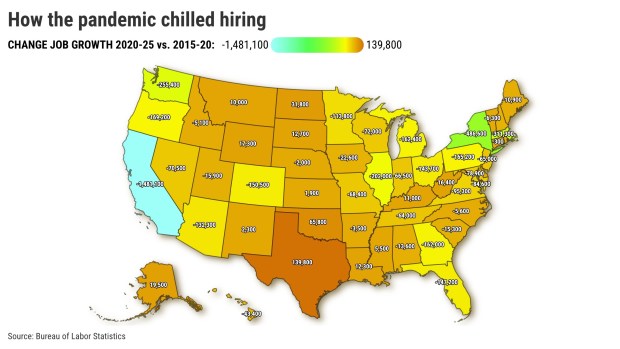 How the pandemic chilled hiring. Changes in 5-year job growth. (Graphic by Flourish)
Hard to buy
California’s elevated housing costs make it tough for folks to buy a home, so homeownership rates are down. The share of Californians who own their homes falls below the long-term trend line in Census data.
 How homeownership swings among the states, from Census data. (Graphic by Flourish)
Loyal residents
Despite all the costs and headaches, Californians tend not to move. Consider the departure rate derived from Census Bureau migration data as the chances you know someone who left for another state. In 2024, the departure rate was 2.1% of all Americans. The same year, 1.7% of Californians left for other parts of the nation.
 Consider this departure rate as the odds that you knew someone who left for another state, with 2.1% of Americans changing states in 2024. That same year, 1.7% of Californians left for other parts of the U.S. (Graphic by Flourish)
Jonathan Lansner is the business columnist for the Southern California News Group. He can be reached at jlansner@scng.com