
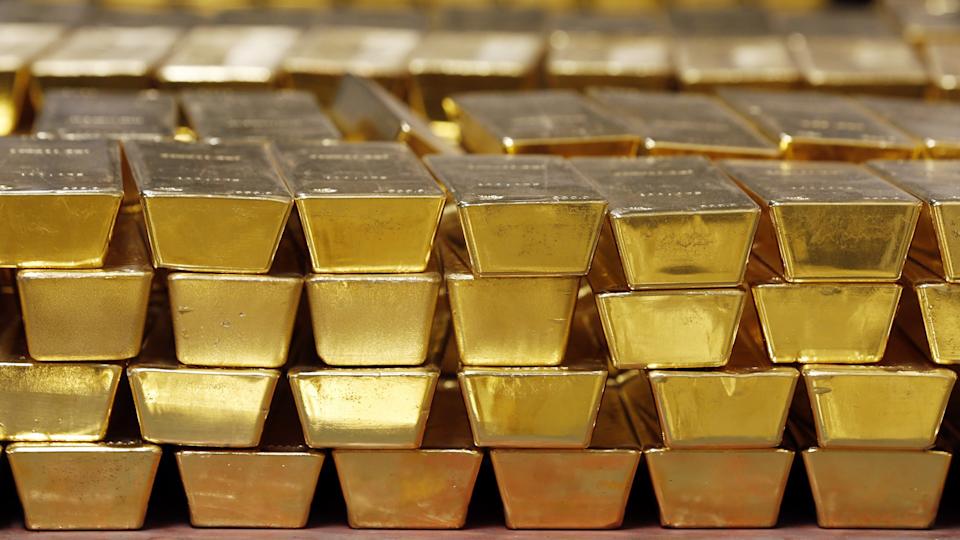
Gold bars stacked in a vault at the United States Mint, in West Point, N.Y., July 22, 2014 (AP photo by Mike Groll)
During times of uncertainty, investors understandably seek the safe haven of sound financial assets. Given the war, economic disruption, and general disarray that increasingly characterizes the world system these days, many observers consider the record highs to which stock markets continue to soar as a gravity-defying prelude to a crash, hence the “flight to safety.”
One asset that often benefits from such flights is the U.S. dollar. Indeed, despite the fact that the U.S. under President Donald Trump is a key cause of the current global uncertainty, the dollar is retaining its status as a safe asset today. It continues to be the most widely held reserve currency, with barely a change in the share and nominal value of dollars held in central bank reserves over the past year. Offshore dollar deposits, too, recently surpassed $14 trillion, with the next closest currency, the euro, far behind, at under $4 trillion. Despite talk of de-dollarization and China seeking to turn the yuan into a rival international currency, all signs point to dollar dominance continuing.
But when it comes to safe-haven status, the dollar is not and never has been the only option. Indeed, there has long been another asset seen as literally the “gold standard” of monetary and financial security: gold. And today is no exception, as illustrated by the surge in the market price of gold over the past year. Until the early 1970s, the price of an ounce of gold was fixed at $35. After then-President Richard Nixon ended the dollar-gold peg, the price of an ounce of the precious metal rose, but more slowly than many economists initially expected. The pace of its rise subsequently picked up, but the price of an ounce remained below $1,000 until the late 2000s and only crossed $2,000 for the first time in 2020.
The pace of gold’s rise has now gone into overdrive. In mid-2025, the price of an ounce broke the $4,000 barrier, and this January it hit a peak of over $5,500. Since then, it has fallen back to around $4,700 per ounce. However, some analysts think it could rise to over $6,000 before the end of the year.
To get more in-depth news and expert analysis on global affairs from WPR, sign up for our free Daily Review newsletter.
Investors aren’t the only ones hoarding gold. Though the dollar remains the supreme currency in international financial transactions, central banks around the world continue to hold and acquire gold in large quantities as well. Notably, 2025 marked the first time in 30 years that the global central bank holdings of gold exceeded their holdings of U.S. Treasury bonds, in large part due to gold’s meteoric rise in value.
Story Continues