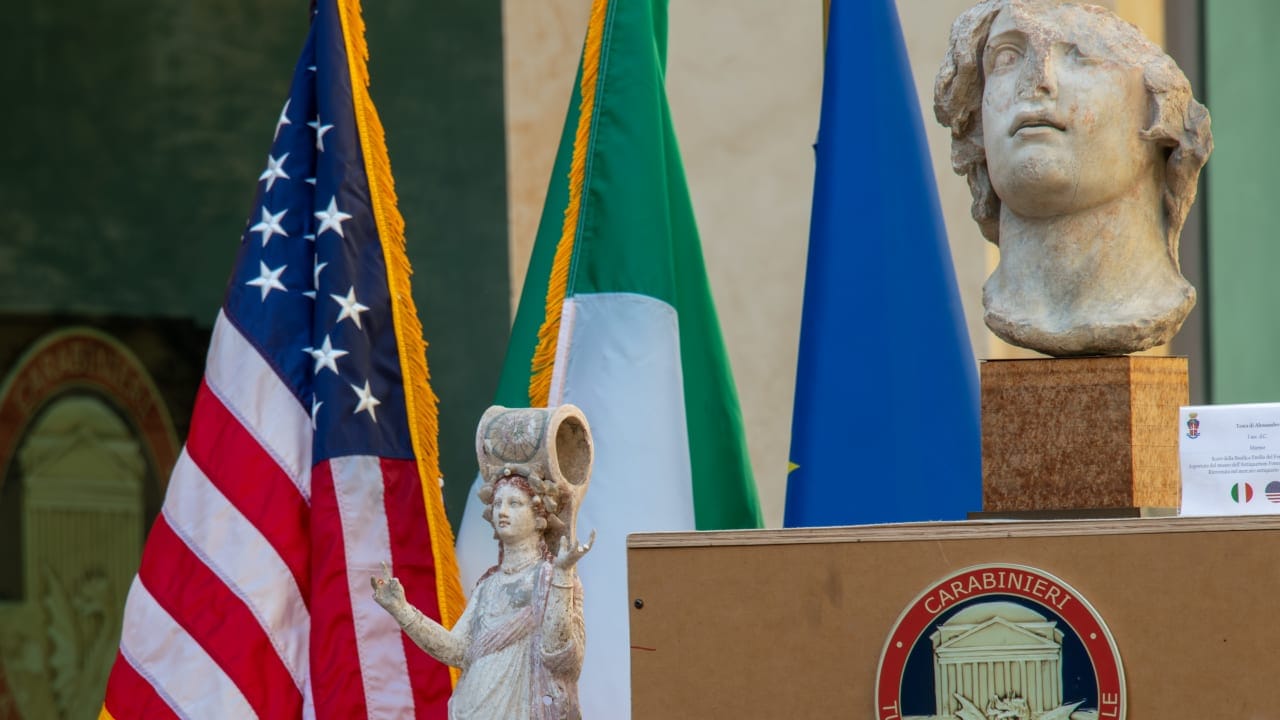
Some 337 stolen antiquities were returned to Italy by the United States on April 29, including two from the Federal Bureau of Investigation (FBI), in one of the largest returns of stolen cultural property to take place recently.
The artifacts, ranging from ancient Roman sculptures to Greek, Etruscan and Egyptian pieces, were presented at the headquarters of Italy’s Carabinieri cultural protection unit following an array of investigations, many centered on New York.
Among the most significant items unveiled at the ceremony were a marble head of Alexander the Great dating to the first century CE, which was stolen from a Rome museum in 1960.
Also recovered were a bronze sculpture looted from the Roman town of Herculaneum, two Egyptian basalt statues, Roman coins, jewelry, ceramics and architectural fragments spanning from the fifth century BCE to the third century CE.
In its own statement on April 30, the FBI announced that one of the two artifacts it returned to Italy in the ceremony was an ancient Roman marble epitaph discovered by a Tulane University professor in her New Orleans backyard in May 2025.
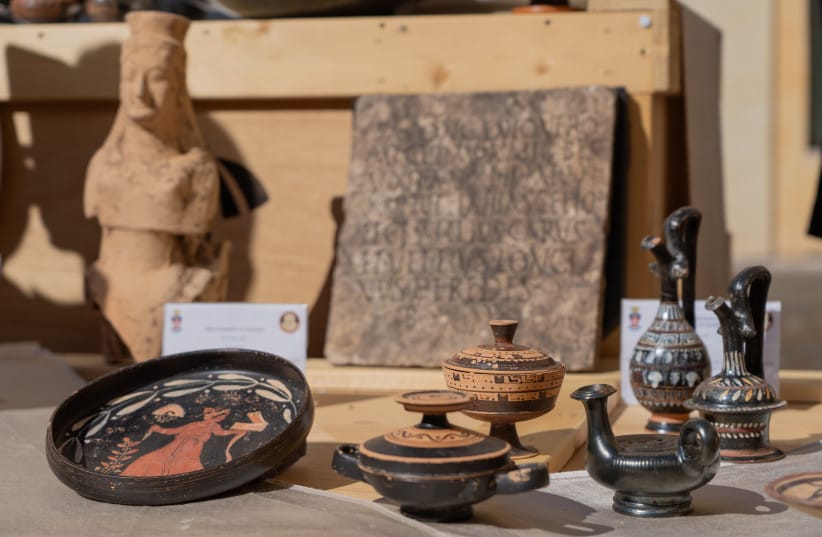 Artifacts repatriated to Italy by the US, including an ancient Roman epitaph discovered by the FBI, April 29, 2026. (credit: Ambasciata USA Italia)
According to Dr. D. Ryan Gray at the Preservation Resource Center of New Orleans, the second century inscription was for a sailor named Sextus Congenius Verus, and had previously been reported as missing from the city museum in Civitavecchia, Italy.
The funerary stone was turned over to FBI New Orleans, who in turn relinquished the relic to the organization’s Art Crime Team in November 2025.
The second artifact returned to Italy by the FBI was located by FBI Boston, though the organization did not detail what it was.
Italy, US strengthen memorandum of understanding on cultural heritage
“There’s no country in the world that has history and culture like Italy, and the United States will always do whatever it takes to help bring these wonderful artifacts back to your very special country,” US Ambassador to Italy Tilman J. Fertitta told reporters at the handover ceremony.
Italian authorities said many of the objects were taken from clandestine excavations or stolen from cultural institutions before being funneled into the international art market.
Italy and the United States last year renewed a memorandum of understanding tightening US import restrictions on Italian archaeological material, strengthening customs controls and expanding information-sharing.
The United States is one of the main markets for global antiquities, with an array of auction houses, private collectors and museums interested in acquiring rare artifacts.
“Sometimes they do not pay enough attention as to why these antiques are up for sale. That can be a very costly mistake,” said an official from the Italian Culture Ministry, who was not authorized to talk to the press.
“We know what is missing and are getting much better at finding it,” she added, predicting more returns in the future.