
A flash of gold in the soil beside a forest track has led archaeologists in northern Denmark to one of the country’s most important Viking-age gold discoveries.
The find, now known as the Rold Hoard, consists of six intact gold arm rings with a combined weight of 762.5 grams. According to Nordjyske Museer, the discovery makes it the third-largest Viking-age gold hoard ever recorded in Denmark, surpassed only by the Tissø ring found in West Zealand in 1977 and the Fæsted Hoard near Ribe in 2016.
A discovery beside a forest road
The first two rings were discovered near Rold in Himmerland by a local man, who noticed them partly visible in the ground beside a field road in a wooded area. He handed the objects to Nordjyske Museer on April 22 for danefæ assessment, the Danish process for evaluating treasure finds of national importance. Museum archaeologists quickly realized that the heavy objects were solid gold arm rings from the Viking Age.
“It is a completely exceptional find. We have simply never experienced anything like it before here at the museum,� said Torben Sarauw, head of cultural heritage and archaeologist at Nordjyske Museer.
After receiving the first rings, archaeologists moved rapidly to investigate the site. A systematic metal-detecting survey revealed another twisted gold arm ring almost exactly where the first two had appeared. About 15 meters away, the team then found three more gold arm rings, lying close together. All six were intact and made of solid gold.
📣 Our WhatsApp channel is now LIVE! Stay up-to-date with the latest news and updates, just click here to follow us on WhatsApp and never miss a thing!!
The final three rings may be especially important. Because they were found stacked on top of one another, archaeologists interpret that spot as the likely original place where part of the hoard was deliberately deposited. The find area lies on private land with no public access, and both the finder and landowner have chosen to remain anonymous.
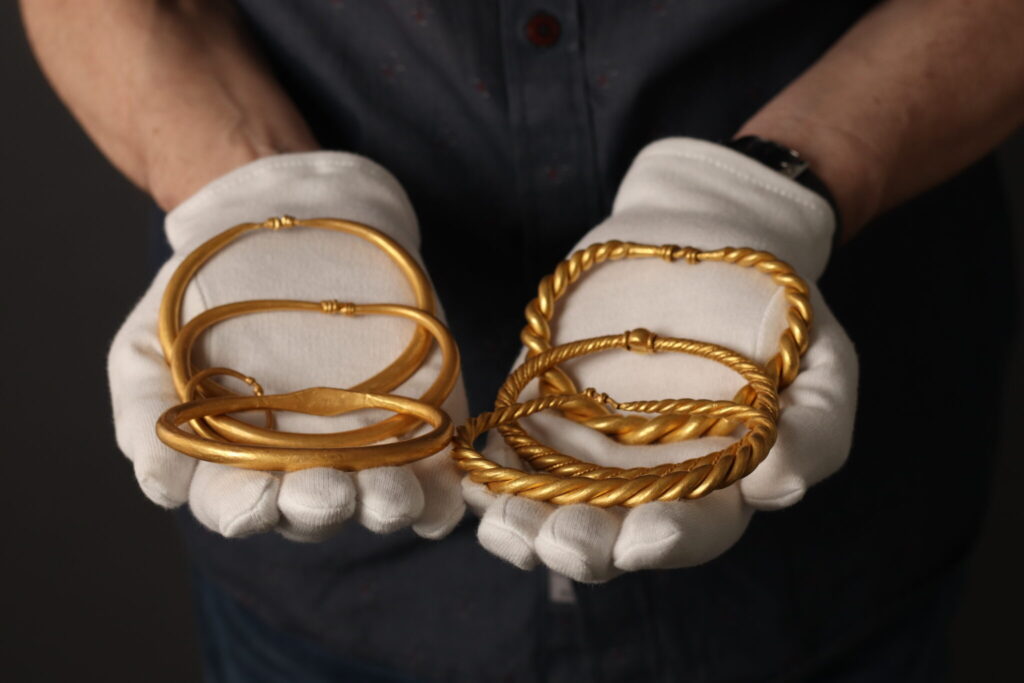 The find, now known as the Rold Hoard, consists of six intact gold arm rings with a combined weight of 762.5 grams. Credit: Nordjyske Museer
Gold, power and the late Viking Age
The Rold Hoard dates to the late Viking Age, around A.D. 900 to 1000, a period when power in Denmark was changing rapidly. During these generations, the Danish realm began to take clearer political shape, a process reflected in the Jelling Stone, where Harald Bluetooth announced around A.D. 965 that he had won all Denmark and Norway and made the Danes Christian.
Gold arm rings of this kind were not simple ornaments. In the Viking world, rings could signal rank, allegiance, wealth and political connection. Their weight and visibility made them powerful statements on the body, but they also carried meanings beyond decoration. They could be gifts from leaders to followers, objects exchanged to mark loyalty, or signs of a person’s place within elite networks.
Sarauw said gold in the Viking Age was concentrated among “society’s absolute elite,� which makes discoveries of this type extremely rare. Similar Scandinavian arm rings are known from the period, but examples in gold are far less common than those made of silver.
 Two of the rings are nearly identical, made from two solid twisted rods and finished with simple wrapped closures known as running knots. A third follows the same basic design but has a bead-like terminal and a thin twisted gold wire set into the groove between the heavier strands. Credit: Nordjyske Museer
A hoard of intact prestige objects
The craftsmanship also stands out. Three rings are twisted from two rods, including one with a thin gold wire inlay and a knob-shaped fastening. The others are smooth rings formed from solid rods or wire. Several have wrapped closures known as running knots, and one ring carries a smaller ring of the same type. Another differs from the rest, with flat-hammered ends decorated with zigzag patterns and triangles.
Taken together, the six objects point to highly specialized goldsmithing. Their intact condition is equally significant. Viking silver and gold are often found cut, weighed or broken into pieces that could be used as bullion. These rings were not treated that way. Their survival as complete objects suggests that they functioned less as ordinary payment metal and more as prestige items, political gifts, or visible signs of power.
When valuable objects were buried together in the Viking Age, archaeologists often consider two main possibilities. They may have been hidden for safekeeping in uncertain times, or deposited as part of a ritual act whose full meaning is now difficult to reconstruct. The Rold Hoard offers a rare glimpse into a world where wealth, belief and authority were closely connected.
The archaeological investigation has now been completed, and all six rings have been submitted as danefæ. They will undergo further analysis before being sent to the National Museum of Denmark.
Nordjyske Museer hopes the arm rings can be displayed at Aalborg Historical Museum before the summer holiday, allowing the public to see one of Denmark’s most remarkable Viking gold finds near the landscape where it lay hidden for more than a thousand years.
Cover Image Credit: Three of the Viking gold arm rings are smooth, while one stands out with zigzag and triangular decoration. Another ring contains a smaller ring of the same type. Nordjyske Museer