
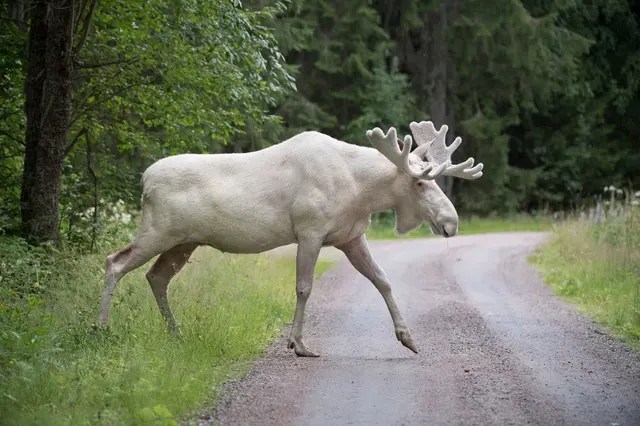
 A white moose is rare, only about 100 are estimated to live in Sweden. | Image: Keystone
A massive, pure-white moose moving silently through a dark Scandinavian forest sounds like something out of a fairy tale. But across Sweden and Finland, it’s very real — and, while rare, sightings have been increasing.
In the forests of Värmland in western Sweden, sightings of so-called “ghost moose” have been increasing. Due to their stunning appearance, footage of these beautiful animals tends to go viral on social media. Every few years, videos circulate the internet of the white, enormous animals calmly foraging through dense woodland, their pale coats glowing ghostly against the greenery.
It is estimate that there are roughly 100 white moose in Sweden, most concentrated in Värmland, with smaller numbers in nearby regions such as Dalsland and Bohuslän. Across the Gulf of Bothnia, southwestern Finland has its own, quieter population — less publicised, but tracked for decades by local hunters and wildlife managers. But it appears that in both Sweden and Finland, white moose numbers have increased in the last two decades.
Not Albino — And That Difference Matters
Despite their white appearance, these moose are not albino. The distinction lies in how their bodies handle pigment.
Albinism occurs when an animal cannot produce melanin at all, often resulting in red eyes and associated health issues. These moose, however, exhibit leucism — a genetic mutation that allows pigment production but prevents it from being properly deposited in the fur.
Jörgen Hermansson, hunting director in Southwest Finland, is clear on the distinction: “It has nothing to do with albinism. An albino is completely pigmentless, has red eyes and often has less vitality. The white moose that occur here are otherwise completely normal moose.” Most white moose therefore have dark eyes, though variation of blue eyed-mosse exists. Swedish game management consultant Gunnar Glöersen has documented individuals with light blue eyes, as well as partially leucistic animals — including a white calf with brown patches. The condition exists on a spectrum: some animals are fully white, others are pale, and some display a mix of normal and reduced pigmentation.
Crucially, unlike albinism, leucism itself does not appear to cause health problems.
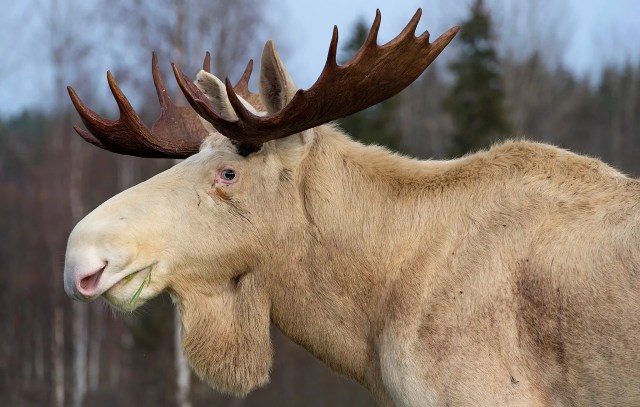 There are variations in the fur, horn, and eye color. | Image: Ingemar Petterson
A Genetic Trait — Shaped by Human Behaviour
The white coat is caused by a recessive genetic trait. For a calf to be born white, both parents must carry the gene — even if neither displays it. That helps explain why the trait persists at low levels across the population. But genetics alone does not explain recent increases.
In Sweden, researchers believe hunting practices are playing a key role. White moose are not legally protected, but many hunters choose not to shoot them because of their rarity. That informal protection allows these animals to survive longer and reproduce, gradually increasing the presence of the gene in the population.
A similar dynamic appears in Finland. While authorities recommend treating white moose like any other animal, Hermansson notes that human behaviour tells a different story. “Almost 90% of moose mortality is due to hunting, not predators,” he says. “And it is often the case that people do not hunt white moose precisely because they are so special.”
The result is a paradox: while a white coat may make the animal more visible in the wild, that disadvantage is largely offset by human protection. This has seemingly resulted in an increase in white moose in these Nordic countries.
Rare — But Not As Rare As You Think
Sweden’s total moose population is estimated at between 300,000 and 400,000 animals. Within that, the number of white moose is typically estimated between 50 and 150, depending on the source and year. In other words, they make up just 0.01-0.05% of the total moose population — a tiny fraction.
Not all are fully white. According to researchers at the Swedish University of Agricultural Sciences (SLU), many leucistic moose are simply lighter than average, rather than the striking, all-white animals that dominate viral videos. Still, even at the higher estimate, they remain exceptionally rare.
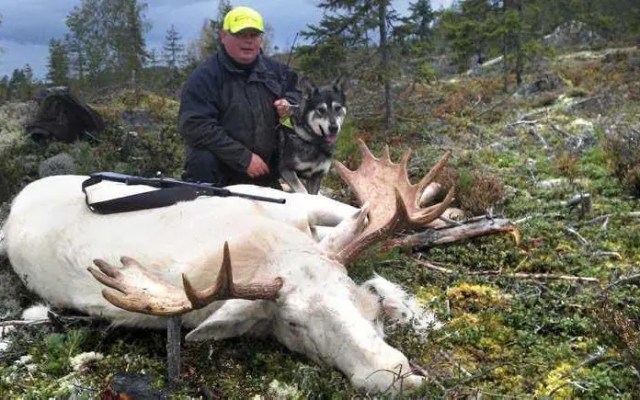 This Swedish hunter did not think twice about shooting this beautiful, white moose, treating it like any other moose. | Image: Göteborg Posten
Science Still Catching Up
While leucism is well understood in general terms, the exact genetic mechanism in moose is still being studied.
Researchers at SLU are currently working to identify the specific mutation responsible by comparing the genomes of white and brown moose. Some experts believe the inheritance pattern may be more complex than a single recessive gene, given the variation seen in coat and eye colour.
For now, the science remains incomplete — adding another layer of intrigue to an already unusual animal.
Why Värmland?
The clustering of white moose in regions like Värmland is no coincidence. Because the leucism trait is recessive, it can spread quietly through a population via carriers. When combined with local hunting practices that favour sparing white animals, certain regions effectively become strongholds for the trait.
Gunnar Glöersen estimates around 50 white moose currently live in Värmland alone, though numbers fluctuate. Not all hunters choose to spare them. “Some believe they should be shot, others think they should be treated like any other moose, and others want to protect them,” he says. That variability means the survival of white moose often comes down to local culture rather than policy.
One side effect of their growing fame is behavioural. In parts of Sweden, white moose have become noticeably more tolerant of humans, likely due to frequent observation by roadside visitors.
The white moose sits somewhere between biology and mythology. It is not albino, not protected, and not entirely unique — yet encountering one still feels extraordinary. “They are so unusual that almost no one can help but stop and look,” Hermansson says.
In Canada, where white moose have also been sighted, indigenous people believe they are a sign of good fortunte. In Ontario, hunting white moose is even prohibited, and Flying Post First Nation in northern Ontario consider “spirit moose” to be sacred.
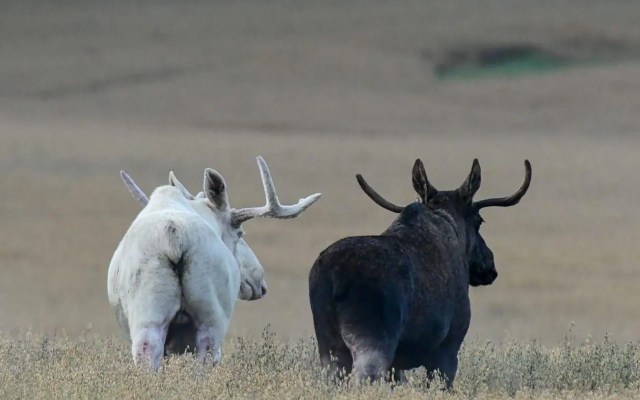 Hobby photographer Lennart Hermansson caught this white moose with a brown buddy in the wild. | Image: Lennart Hermansson