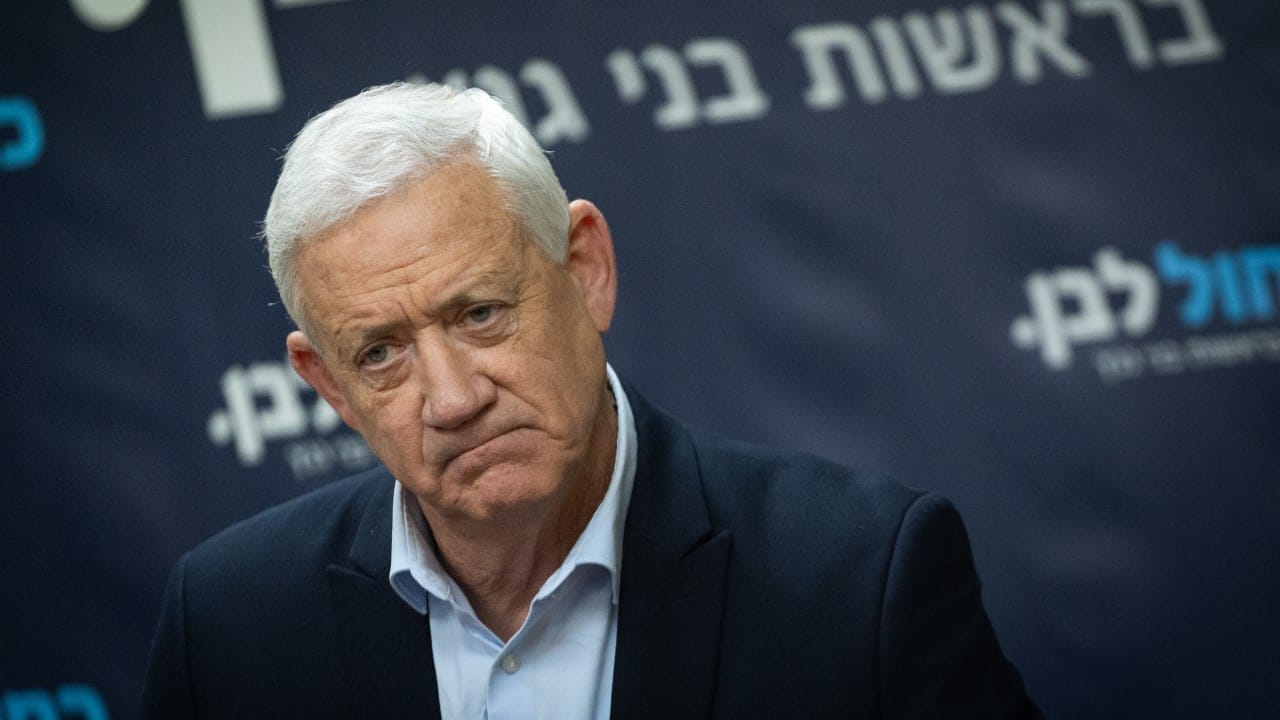
The political tragedy of Benny Gantz continues to strike him time and again. Now, as the anti-Netanyahu bloc begins to take shape ahead of the 2026 elections, Gantz’s political role appears to be fading away.
Gantz’s standing in the polls is dire, with his Blue and White party not even close to crossing the electoral threshold, while members of his party – elected to the Knesset largely because of him – are abandoning him one after another.
The latest was Chili Tropper, perhaps his closest political confidant, a departure that symbolizes the decline of a politician who began as a meteoric figure and now seems to be nearing the end of his political career.
For nearly two decades, the anti-Netanyahu bloc has tried to present a governing alternative to him, an effort that has repeatedly ended in electoral failure. Aside from the farcical “brothers’ alliance” between Naftali Bennett and Yair Lapid after the 2021 elections, no politician has managed to defeat Netanyahu in an election while leading a major party.
The politician who came closest to defeating Netanyahu – and unquestionably challenged him across three election campaigns and again after the October 7 massacre – was Gantz. In the April 2019 election, he led Blue and White to a peak achievement of 35 seats (26.1% of the vote), tying with Likud, an accomplishment that firmly established him as the undisputed leader of the center-left bloc.
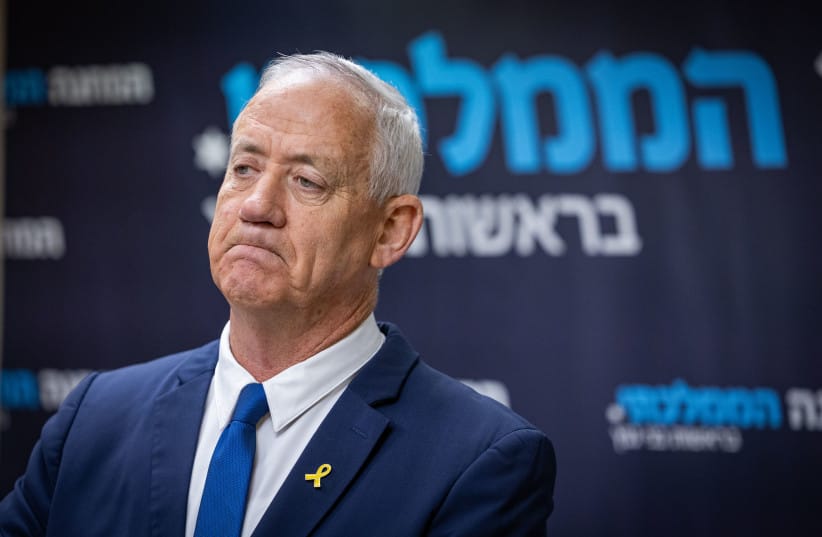 Leader of the National Unity Party MK Benny Gantz leads a faction meeting at the Knesset, the Israeli parliament in Jerusalem, on May 26, 2025. (credit: NOAM REVKIN FENTON/FLASH90)
After Netanyahu failed to form a government, Gantz succeeded in the September 2019 election in making Blue and White the largest party in the Knesset with 33 seats (26%), one more than Likud.
In the 2020 election, after neither side again succeeded in forming a government, Gantz managed to maintain the same number of seats and even increase Blue and White’s share of the vote (33 seats, 26.6%).
However, Netanyahu and Likud finished with three more seats, and Gantz’s achievement ended in disappointment.
Gantz’s political decline
From that point, Gantz’s political decline began. Although he undoubtedly acted with statesmanship and national responsibility when he decided to join a unity government with Netanyahu and Likud while the COVID-19 pandemic was hitting Israel, his voters punished him for it.
Before the 2021 election, most believed Blue and White under his leadership would collapse and fail to cross the electoral threshold, yet Gantz surprised observers by winning eight seats, preserving his position as defense minister in the Bennett-Lapid government.
Gantz hoped that his alliance with Gadi Eisenkot and Gideon Sa’ar in the 2022 election would make him a realistic candidate for prime minister, but the three-way venture ended in bitter disappointment with only 12 seats.
However, thanks to the judicial reform initiative and the protests that erupted in response, Gantz’s statesmanlike conduct restored him to the forefront of politics. Suddenly, Gantz was seen as someone capable of uniting different parts of the nation, something clearly reflected in the polls with a rise of roughly 15 seats.
After October 7, Gantz surged to 37 seats in the polls, largely at the expense of right-wing voters who had lost faith in Netanyahu. Thus, after joining the emergency government, Gantz came to be viewed by many as Israel’s de facto leader.
Yet he quickly succumbed to petty politics and chose to leave the government during wartime, a move that cost him politically. Since then, Gantz has lost not only nearly all of his support in the polls but also his political partners, including Eisenkot, who effectively replaced him as the leading figure of the center-left camp.
In conclusion, the days when Gantz represented a viable governing alternative are over. Other politicians within the bloc have taken his place, while he has been left without electoral support or political allies.
In every politician’s career, there comes a moment for self-reflection and recognition that the time has come to hand back the keys and retire.
For Gantz, that moment has arrived. It would be better for him to accept this quickly before he further humiliates himself.
The writer is a lecturer and research fellow at the University of South Wales, UK. Author of Collapse: Israeli Labor Party 1992-2024.