
Michael “Mickey” Adams, one of Britain’s leading grandmasters for several decades, has a distinctive style over the chessboard. His moves are delicate, rather than brutal, often spinning a subtle web which ensnares the opposition, rather than blasting them from the board, as Kasparov preferred. If Kasparov’s chess style reminds me of Napoleon at his best, then Mickey recalls an earlier French potentate: the devious King Louis II, known as The Universal Spider, due to the ubiquity and profundity of his network of diplomatic and espionage related webs.
For this reason Mickey is often referred to as Spidey. Other nicknames have stuck, as I was reminded while watching the Halo World Snooker Final earlier this week, a combat described as “mental” by the commentators themselves. The games of Chess and Snooker have much in common.
Strategy, tactics, vision, memory and of course nicknames. Hurricane Higgins, Shaun Murphy the Magician, Mikhail Tal, the Wizard from Riga, Steve “Interesting” Davies, The Beast from Baku (Kasparov) and the Leningrad Lip (Korchnoi).
There was on TV much speculation as to an identifying popular sobriquet for Wu, the new World Snooker Champion. Here I make my own modest proposal: Wedgwood Wu, on the basis that the new champion is a great potter.
Magnus Carlsen has attracted description as The Goat (Greatest Of All Time) though I personally believe that Kasparov is more deserving of this title. However that may be, this week Carlsen was involved in a rare foray into classical chess, briefly jettisoning his support for weird time limits or varied baseline heresies to take on the younger generation in the TePe Sigeman & Co tournament at Malmö in Sweden.
Last Thursday, in as tense a finish to the tournament as was possible, the two favourites sat down to face each other in their seventh and final round game. Could Erdogmus, the Turkish prodigy, secure a win with black against Carlsen, the world’s number one player?
Placed second and third respectively as the final round started, if the leader could make any score, at least a share of the title was his. Elsewhere, the young Indian schoolteacher Arjun Erigaisi could clinch the title outright with a win, which would give him an unassailable lead.
And if he lost, a win by fourth-placed Abdusattorov could catapult him into the lead.
With four of the eight players still with a healthy investment in the outcome of this 2700+ super-tournament, a global audience settled in to watch online to see how what has been dubbed as the “Carlsen Kindergarten” tournament would finally play out.
What would happen? Had they come to bury Caesar, or to praise him? Showdown in Sweden!
Even away on the fourth and final board there was a cutting edge. The final two places met one other in an ultimate gambit, the prize being to avoid placement at the foot of the table.
TePe Sigeman & Co Chess Tournament 2026 CROSSTABLE
Player
Rating
1
2
3
4
5
6
7
8
Tot
1. Carlsen (NOR)
2848
X
½
½
1
0
1
1
1
5
2. Erigaisi (IND)
2751
½
X
½
½
1
½
1
1
5
3. Abdusattorov (UZB)
2780
½
½
X
½
½
½
1
½
4
4. Erdogmus (TUR)
2708
0
½
½
X
½
½
1
1
4
5. Van Foreest (NED)
2735
1
0
½
½
X
½
½
½
3½
6. Woodward (USA)
2635
0
½
½
½
½
X
0
1
3
7. Zhu (PRC)
2546
0
0
0
0
½
1
X
½
2
8. Grandelius (SWE)
2662
0
0
½
0
½
0
½
X
1½
As can be seen from the above, the tournament result was eventually decided by a series of tie-break games between the two leaders. However, how we got to this point is a testament to opposing styles. Both leaders played with white.
Erigaisi, the leader from the previous round, needed a win to guarantee the tournament title. He threw caution to the winds, and committed all in a kamikaze attempt to sweep his opponent from the board. He ‘lost’ the game twice before recovering an unlikely draw.
By way of contrast, Carlsen had managed to swap queens by move 6, and proceeded to offer Erdogmus, his 14-year-old opponent, a grinding endgame. When, almost inevitably, Erdogmus stumbled on his 50th move, Carlsen pounced, winning nine moves later.
And so to tie-breaks. After two games played at 3 minutes each and with an increment of 2 seconds per move, the games were shared, one apiece. And so to the tie-break sudden death games. In these, white had 2½ minutes to black’s 3 minutes.
Arjun Erigaisi vs. Magnus Carlsen
TePe Sigeman & Co Tournament, Malmo, 2026, ‘sudden death’ game 1
d4 Nf6 2. c4 e6 3. Nc3 d5 4. cxd5 exd5 5. Bg5 Be7 6. e3 h6 7. Bh4 O-O 8. Bd3 c6 9. Nge2 Nbd7 10. Qc2 Re8 11. O-O a5 12. a4 Nh5 13. Bxe7 Qxe7 14. Rae1 Ndf6 15. Nc1 Ne4 16. f3 Nxc3 17. bxc3 c5 18. e4 cxd4 19. exd5 Qd8 20. cxd4?!
Better is 20. c4 Bd7 21. Ne2 Qg5 22. f4 Nxf4 23. Rxf4 Rxe2 24. Qxe2 Qxf4 25. Rf1 Qh4 26. Qb2.
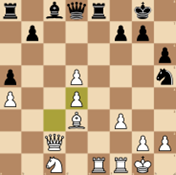
20… Rxe1 21. Rxe1 Nf6 22. Qb3 Bd7 23. Bc4 Ne8 24. Nd3 Nd6 25. Ne5 Qh4 26. Rd1 Be8 27. Bf1 Rc8 28. Qb6 Bxa4 29. Ra1 Qf4 30. h3
White faces serious problems after 30. Rxa4 (certainly not 30. Qxd6 Qxd4+ 31. Kh1 Qxa1) 30… Qe3+ 31. Kh1 Rc1 after which mate must follow)
30… Be8 31. Rxa5?

White had managed to maintain equality up until this point, but the text move is a blunder. Parity is kept after either 31. Kh1 Nf5 32. d6 Rc1 33. Rxc1 Qxc1 34. d7 Ng3+ 35. Kg1 Qe3+ 36. Kh2 Nxf1+ 37. Kh1 Ng3+ 38. Kh2 or 31. Nd3 Qe3+ 32. Kh1 Qe7 33. Qxa5 Qg5 34. Ne5 or 34. Re1)
31… Qe3+ 32. Kh2 Qf4+ 33. Kg1 Nf5?
Black blunders back the entirety of his advantage. The straight and narrow path to plough was with 33… Qe3+ 34. Kh2 Rc1 35. Nd3 Rxf1 36. Qxd6 Rd1 37. Qe5 Rxd3 38. Ra8 Qxe5+ 39. dxe5 Kf8, when black is close to winning.

Ra1?

With no time to spot the past error, white stumbles on in a way that returns a winning advantage to black. Had he spotted 34. d6, the best black could have discovered was with 34… Qe3+ 35. Kh2 Qc1 36. d7 Bxd7 37. Nxd7 Qf4+ 38. Kg1 Qe3+ 39. Kh2 Qf4+ and a draw.
34… Qe3+ 35. Kh2 Nxd4 36. Ng4??
White is lost after this move. Although 36. Rb1 or Kh1 are a little less bad, neither is sufficient to claw back white’s losses.
36… Nxf3+ White resigns 0-1
Postscript: Zhu Jiner was one of only three sub-2700 players in the tournament, and the only one below 2600. She actually gained rating points, beating Andy Woodward and collecting draws against Jorden Van Foreest and Nils Grandelius, the latter under a considerable amount of pressure in her last round game.
Ray’s 206th book, “
Chess in the Year of the King
”, written in collaboration with Adam Black, and his 207th, “
Napoleon and Goethe: The Touchstone of Genius
” (which discusses their relationship with chess) can be ordered from both Amazon and Blackwell’s. His 208th, the world record for chess books, written jointly with the late chess playing artist, Barry Martin,
Chess through the Looking Glass
,
is now also available from Amazon.
A Message from TheArticle
We are the only publication that’s committed to covering every angle. We have an important contribution to make, one that’s needed now more than ever, and we need your help to continue publishing throughout these hard economic times. So please, make a donation.