
Most athletes who buy into carbon-plated running shoes, known as “advanced footwear technology,” have done one calculation: is the gain in performance worth the cost?
At $200 to $300 a pair, the question is practical. And the performance case is hard to argue with – every world record at 5 kilometers and above over the last decade belongs to someone wearing this type of shoe.

What has gone mostly overlooked, however, is what those shoes do to the body’s actual mechanics.
A new study tested that question in a lab for the first time using healthy elite runners, and the answer is more complicated than most buyers assume.
Testing shoe performance
Researchers at Mass General Brigham (MGB) wanted to know whether the same design super shoe design that helps runners go faster also pushes their bodies toward injury.
Studies have shown the shoes can cut the energy cost of running by roughly 4 percent, according to research comparing elite and sub-elite runners.
The question the MGB team set out to answer was whether that efficiency came with a hidden cost to the bones.
Lead author Michelle M. Bruneau, PT, DPT, PhD, is a postdoctoral research fellow at Spaulding Rehabilitation; senior author Adam Tenforde, MD, directs Running Medicine at MGB.
Together they recruited 23 healthy elite distance runners – 11 women and 12 men – each of whom logged at least 30 miles per week and already trained or raced in advanced footwear, the design researchers shorten to AFT.
All had competed at the professional or collegiate level, or qualified for national championships or Olympic trials.
Every runner completed trials in all three shoes in randomized order – a neutral cushioned trainer, a lightweight foam shoe, and the AFT model – running at training pace, tempo pace, and 5-kilometer race pace.
Researchers attached 40 reflective markers to each runner’s body and tracked movement with 10 motion-capture cameras. An instrumented treadmill captured the forces traveling up from every footstrike.
Super shoes and body mechanics
The team focused on seven movement patterns that earlier research had linked to bone stress injuries – overuse damage that can swell into stress fractures and sideline a runner for months.
In the super shoes, runners took fewer steps per minute. A lower running cadence generally means longer strides and more overstriding, a pattern that previous research has tied to higher loading on the lower leg.
The arch also rolled inward more in the super shoes than in the neutral trainer. In plain terms, the foot collapsed sideways a touch more on each landing.
That motion has been linked in previous studies with navicular stress injuries – damage to a small midfoot bone that heals slowly because of its limited blood supply.
An ankle surprise
Not every change pointed toward higher risk. In the super shoes, runners pushed off less forcefully with their ankles. That was unexpected.
Earlier work has linked higher ankle loading with a history of bone stress injuries. Here, the new shoes appeared to ease that force while other variables moved the opposite way.
A few measures didn’t budge at all. The up-and-down bounce of the body, the overall impact force at landing, and how long the foot stayed planted each step looked roughly the same across all three shoe types.
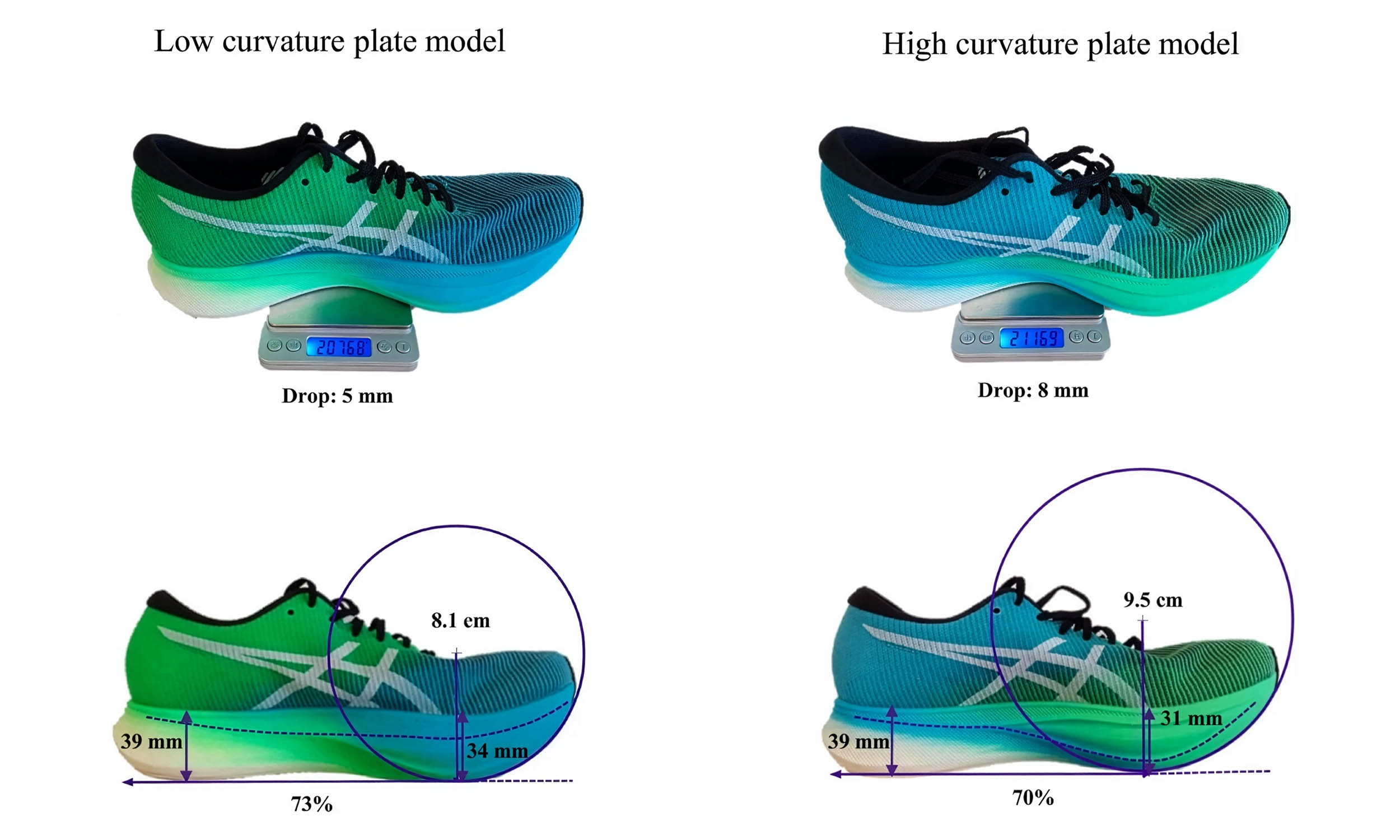 Characteristics of the racing “advanced footwear technology” super running shoe models. Shoe mass: 208 (LCP) vs. 212 (HCP) grams; Rearfoot stack height: 39 mm (LCP and HCP); Forefoot stack height: 34 mm (LCP), 31 mm (HCP); Rocker axis: 73 (LCP) vs. 70 (HCP) %; Rocker radius: 8.1 (LCP) vs. 9.5 (HCP) cm; Stiffness: Extreme resistance (LCP) vs. extreme resistance (HCP). Credit: Sports Engineering. Click image to enlarge.
Concerns from earlier studies
Concerns about these shoes and bone health did not appear out of nowhere. A 2023 report from the same research group described five elite runners who developed navicular stress injuries while training and racing in carbon plate footwear.
That case series could not prove the shoes caused the injuries. Suggestive, though. It raised the question sharply enough to motivate the lab work that followed.
The new analysis captured a single lab session, not weeks or months of training. Only 23 runners took part, and 11 had a prior bone stress injury – useful context, though the team did not analyze them separately.
On the treadmill, 11 participants couldn’t reach their true 5-kilometer race pace. Their fastest trial was capped at 12 miles per hour, so the heaviest loading sometimes went unmeasured.
The shoes also differed in more than the plate alone – foam, stack height, weight, rocker shape. A lot of variables, hard to isolate.
Shoes, performance, and injuries
Until this analysis, the case for super shoes hurting bones had rested on five injured runners and clinical hunches. No one had measured the specific stride changes the shoes produce in healthy elite athletes running in real time.
Now there is a clearer picture. Super shoes alter at least three measurable parts of running form – two in directions tied to higher bone stress risk and one that may reduce a different risk.
That gives sports medicine clinicians something concrete to watch. The Mass General Brigham team suggests rotating between shoe types, gradually adapting to AFT during training, and paying close attention to athletes with prior bone stress injuries.
“AFT improves performance, but runners should balance this benefit with the possibility of subtle changes in loading on the body,” said Bruneau, lead author of the study.
For the recreational marathoner who paid $300 hoping for a faster race, the takeaway is not to retire the shoes. Wear them with eyes open – and probably not on every run.
The study is published in PM&R.
—–
Like what you read? Subscribe to our newsletter for engaging articles, exclusive content, and the latest updates.
Check us out on EarthSnap, a free app brought to you by Eric Ralls and Earth.com.
—–