Bulgaria has a clearly expressed position, which since 2022 is no longer a bilateral issue, but a matter of discussion between the European Union and a candidate country.
“We had a good first meeting with Macedonia’s Foreign Minister Timcho Mucunski. Bulgaria has a clearly expressed position, which since 2022 is no longer a bilateral issue, but a matter of discussion between the European Union and a candidate country. This window for enlargement may open in the coming years, and if they do not use this opportunity, they may truly lose out.”
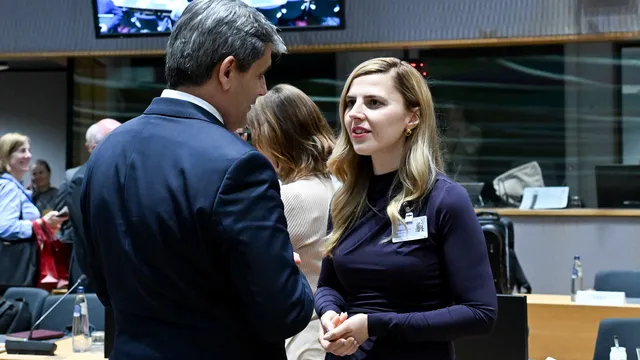
This was stated by Bulgarian Foreign Minister Velislava Petrova-Chamova in Brussels, where she took part in a meeting of the foreign ministers of the European Union member states. An informal working breakfast with the Western Balkan countries was also held earlier in the day.
“This position was reaffirmed today as well. I am glad that there is a very broad political consensus on it in Bulgaria. I also told this to our North Macedonian partners. We expect actions from their side that will show they have the full political readiness to move forward on their European path,” she added.
“Bulgaria remains an extremely supportive factor. It is also important for us to see more activity and stronger action from their side regarding the agreements already reached. They have a unique opportunity. We see that countries such as Montenegro and Albania are making serious progress. This window for enlargement may open in the coming years, and if they do not use this opportunity, they may truly lose out. They should adhere to the 2022 agreement and take the necessary political steps. They should open their own European path,” Petrova-Chamova said.
Earlier today, Timcho Mucunski said that “it is necessary to move away from the bilateralisation of accession criteria”.
BGNES recalls that in June 2022 North Macedonia accepted the so-called “French proposal”, approved by all EU member states. Under the Negotiating Framework, in order for negotiations between Skopje and the EU to begin, Bulgarians must be included in the preamble of the Macedonian Constitution. North Macedonia must also comply with the 2017 Treaty of Friendship, Good-Neighbourliness and Cooperation with Bulgaria, as well as the two protocols to it.
The protocol from the second meeting of the Joint Intergovernmental Commission, signed three years ago by ministers Teodora Genchovska and Bujar Osmani, states that Skopje agrees the next intergovernmental conference with the EU will be held after Bulgarians are included among the state-forming peoples in the preamble and in two articles of its Constitution.
In the same protocol, the government of the Republic of North Macedonia confirms its commitment that nothing in its Constitution can or should be interpreted as a basis for interference in Bulgaria’s internal affairs in order to protect the status and rights of persons who are not citizens of North Macedonia. This clause de facto and de jure means that Skopje will not claim recognition of a “Macedonian minority” in Bulgaria.
The protocol also provides for countering hate speech against Bulgarians and Bulgaria, the rehabilitation of victims of the communist regime in Macedonia and the opening of the archives of the Yugoslav security services. | BGNES