
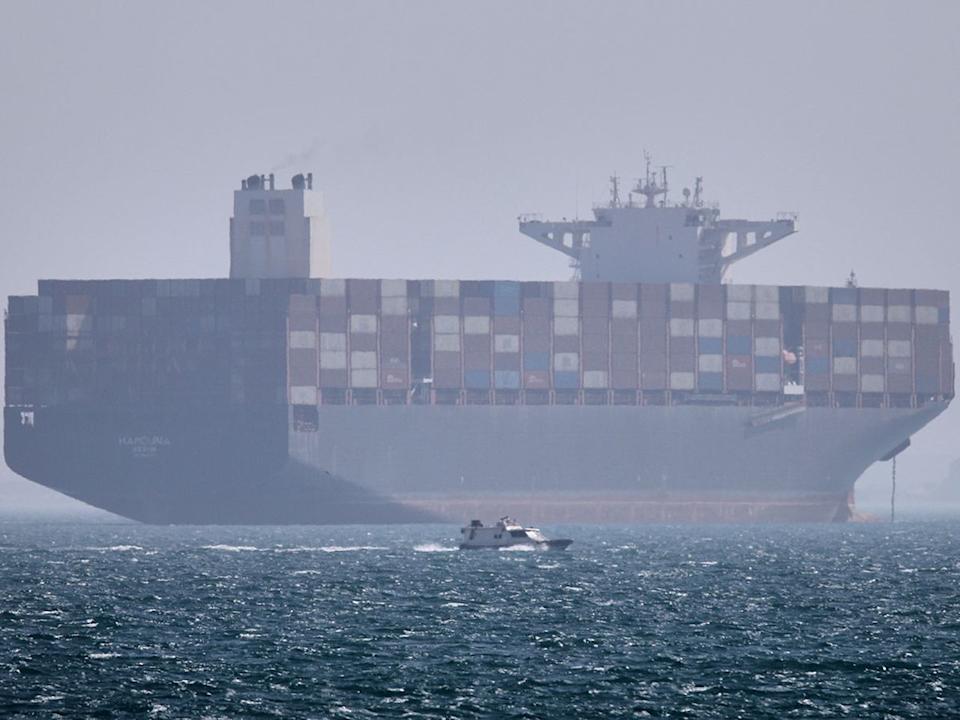
A container ship sits at anchor in the Strait of Hormuz off Bandar Abbas, Iran. Geopolitical events like the conflict in the Middle East are seen as a rising risk to Canada’s economy. (Credit: Amirhosein Khorgooi/ISNA via AP)
Increasing geopolitical risk surpassed rising trade tensions as the top downside threat to the Canadian economy, according to the Bank of Canada’s latest survey of business and financial leaders across the country.
The central bank’s first-quarter Market Participants Survey, released on Monday, gauged the economic outlooks of 28 financial market participants from March 25 to April 1. Participants included dealers and banks, asset and pension fund managers, insurers and researchers.
When asked to identify up to three downside risks to Canada’s economic growth, 82 per cent of respondents put geopolitical risks on their list, while 79 per cent and 57 per cent of respondents listed increasing trade tensions and tightening global financial conditions, respectively.
Meanwhile, 86 per cent of survey participants listed easing trade tensions as a top upside risk to Canada’s economy. Fifty-seven per cent of respondents identified a larger-than-expected fiscal stimulus as a top upside risk, while 43 per cent of respondents listed higher commodity prices and decreasing geopolitical risks.
In the previous survey, which was released in February and showed sentiments from the fourth quarter of 2025, the 30 participants identified increasing trade tensions, tightening global financial conditions and weaker consumer spending as the top downside risks. That survey was conducted prior to the Iran war, which started in late February.
Monday’s survey results come after the central bank’s latest Monetary Policy Report said the conflict in the Middle East, along with U.S. tariff measures and the upcoming Canada-United-States-Mexico Agreement review, have added significant uncertainty to the outlook for the Canadian economy.
Bank of Canada governor Tiff Macklem previously told reporters that, while the Canadian economy is projected to experience some growth in the next three years, the outlook is heavily dependent on the outcome of trade negotiations with the U.S. and the severity of the Iran war.
Macklem has also repeatedly said monetary policy needs to be “nimble” and that the central bank may have no choice but to hike its policy interest rate if inflation and higher energy prices persist.
“There’s no set timeline here. It really depends on the conditions. It’s all going to depend on what we see,” Macklem told reporters at a news conference on April 29.
Monday’s survey results were also published almost two weeks after federal Finance Minister François-Philippe Champagne tabled the spring economic update, which projects a $66.9-billion deficit for the 2025-2026 fiscal year instead of the $78.3-billion deficit that was projected in the fall budget last November.