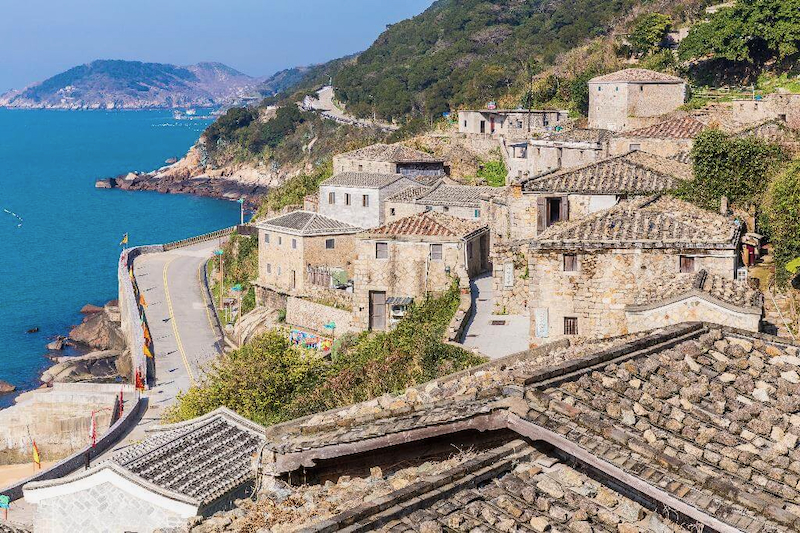
Taiwan’s appeal extends beyond its main island and also includes numerous outlying islands and archipelagos. Lienchiang County, more commonly known as the Matsu Islands, is the northernmost territory of the Republic of China (Taiwan). Some 210 km northwest of Taipei, it also holds the distinction of being the smallest and least populated of the nation’s 22 subnational divisions. Just 5 of the 36 islands and islets have permanent civilian populations.
Travel to Matsu from Taiwan has become much more convenient than before, which involves flying from Taipei Songshan Airport or Taichung, or taking an overnight ferry at Keelung. Flying is much quicker (Taipei-Matsu takes just under an hour) but many prefer to book a spot on the Xintaima ferry, as the overnight voyage accentuates Matsu’s serene distance from Taiwan’s main island and saves booking accommodation for one night. First and business class cabins are available.
Another option is the North-South Star, a high-speed ferry that can get from Taipei to Nangan (home to over half of Matsu’s population) in just three hours. It offers two advantages over flying: A more generous luggage allowance and the ability to sail through the fog that sometimes closes Matsu’s airports.
In terms of transportation on the islands, many tourists rent easy-to-ride step-through scooters. For those who’d rather have someone else do the navigating, there are both conventional public buses and Taiwan Tourist Shuttle routes. The latter offers eight different half-day tours, each of which covers multiple attractions.
Unlike most Taiwanese, who in addition to Mandarin Chinese grew up speaking Taiwanese (Hoklo), Hakka, or an Austronesian indigenous language, Matsu natives use a dialect of the Fuzhou (Eastern Min) language spoken in one part of China’s Fujian province. Those riding the archipelago’s public buses will hear on-vehicle announcements in the Matsu dialect, as well as Mandarin Chinese and English.
Humans have lived on the Matsu Islands for over 8,300 years, but they remained remote until 1949, when the Chinese Communist Party took mainland China. The Kuomintang then recognized the islands’ strategic value because of their closeness to the mainland. Since the 1990s, military presence has declined, though many fortifications remain, giving Matsu a distinct identity. Once restricted to VIPs and journalists, Matsu is now popular with tourists, birdwatchers, and history lovers. Its shift from military stronghold to Cold War heritage site shows how defense infrastructure can be reused to support the local economy.
One of Matsu’s most popular attractions is the sea-level Beihai Tunnel on Nangan, the busiest of the islands. In the late 1960s, soldiers used pickaxes and explosives to hack out this cave-like 640m-long docking point, so that boats could resupply the outpost in the event of bombardment. It never functioned as planned, however, because high tides washed in so much silt that it became unusable. The opening to the ocean was sealed and it wasn’t until decades later, once floodlights had been installed, that visitors could enjoy the granite chambers of what some compare to a European cathedral. The interplay of light on rock and the echoing acoustics make for a soul-nourishing experience, especially if you join a gondola tour or rent a kayak. The tunnel’s opening times are determined by the tides. Details can be found on the website of the Matsu National Scenic Area Administration.
Beihai Tunnel is one of a number of locations where visitors may see Matsu’s famous “blue tears,� bioluminescence emitted by a tiny marine organism. This phenomenon often occurs close to Nangan’s western and southern shores, and peaks between April and June.
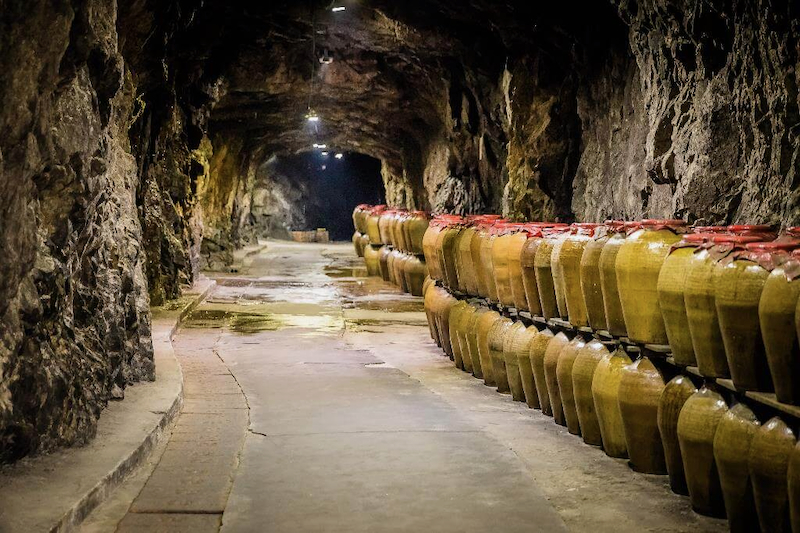
Another of Nangan’s manmade subterranean features is Tunnel 88. So named because it was completed on Chiang Kai-shek’s 88th birthday, and originally dug to hide armored vehicles, it was later transferred from the military to Matsu’s distillery. The reliably cool temperatures inside the tunnel have proved ideal for aging premium kaoliang, a strong liquor distilled from sorghum.
Matsu’s second largest population center is Beigan, a 20-minute boat ride northeast of Nangan. In addition to sites of military interest like the War and Peace Memorial Park (which includes a small yet worthwhile museum), the island is known for the semi-abandoned villages of Qinbi and Qiaozai. The former is a cluster of sturdy yet appealing stone cottages, some of which have been turned into atmospheric B&Bs. On many of these photogenic homes, the roof tiles aren’t cemented in place but held down by stones. So many of Qiaozai’s residents have moved away that some now joke that those who remain are outnumbered by the deities they worship in the village’s gorgeously colorful temples.
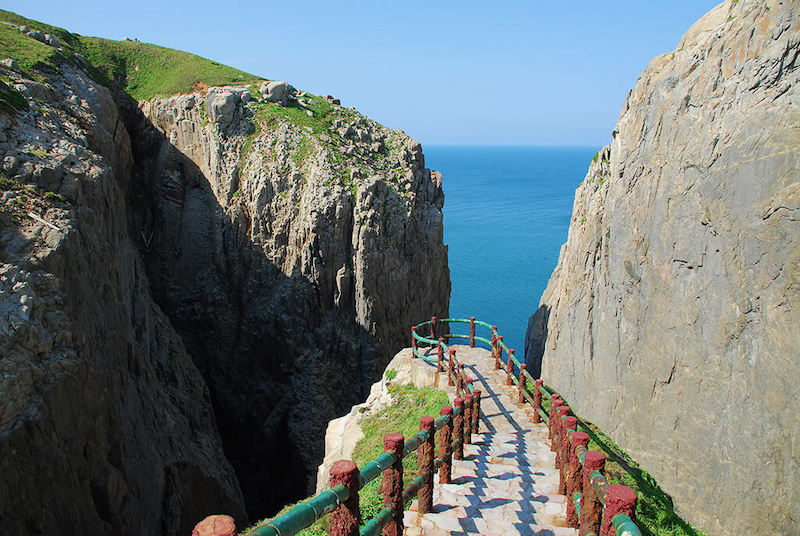
In addition to Nangan and Beigan, Matsu includes Dongyin Township, two hours by ferry to the north, and Juguang Township, a similar distance to the south. Both deserve to be explored. For travelers who adore quiet authenticity, however, Dapu in Juguang is a must-see. The village’s yellow-granite architecture embodies generations of local know-ledge, the location and design shielding residents from wet winter weather.
After the fishing industry declined, and military downsizing meant fewer dollars were being spent locally, most of Dapu’s original inhabitants sought opportunities elsewhere. This gem teetered on the edge of becoming a silent ruin until government intervention came to its rescue. Working with the county authorities, the Matsu National Scenic Area Administration has promoted artist-in-residence programs, attracting artists to participate and thereby revitalizing community life. This has also encouraged entrepreneurs to convert some of the village’s stone houses into locally distinctive guesthouses, helping the settlements regain vitality.
The 2026 Matsu Glow Festival is organized by the Matsu National Scenic Area Administration and features four main themes: Buddhist Light, Music Light, Laser Light, and Dawn Light — that connect the four seasons. The event highlights religious blessings (Matsu’s Grand Birthday Celebration), Tipsy Music Festival, Laser War Game, and Welcome the Sunrise. It offers a comprehensive showcase of the religious, military, and ecological landscapes across the four townships and five islands. A glow market and lucky draw will also be held simultaneously. For more details, please visit the official website of the Matsu National Scenic Area Administration. Alongside a wealth of other information in multiple languages, the scenic area’s website carries details of more than 200 licensed accommodation businesses around the archipelago. Each profile includes a photo and a map, making it easier than ever to find an ideal retreat among the stone cottages and sea mists that make this corner of the country a truly special place.
TOURIST INFORMATION
Travelers interested in exploring the Matsu Islands can gather additional information from the following websites:
Matsu National Scenic Area (multilingual)
Matsu Tourism Union (multilingual)
Taiwan Tourist Shuttle (multilingual)
Tourism Administration (Ministry of Transportation and Communications) (multilingual)
The 24-hour tourist information hotline (0800-011-765) is toll-free within Taiwan and staffed by speakers of English, Japanese, and Chinese.
The central government’s Tourism Administration and International Trade Administration are collaborating to encourage international travelers attending MICE events in Taiwan to explore the country through the Travel Incentive Program. In 2026, the program provides travel incentives of up to NT$2,000 per person per visit, with a maximum of NT$600,000 per proposal. The program aims to promote the development of both the MICE and tourism sectors, thereby supporting economic growth.
通部觀光署與經濟部國際貿易署æ£æ”œæ‰‹å�ˆä½œï¼Œé€�é�Žã€Œæœƒå±•ç�Žå‹µæ—…é�Šè¨ˆç•«ã€�(Travel Incentive Program)鼓勵來臺å�ƒåŠ MICE 活動的國際旅客延伸旅é�Šã€�探索全臺。2026年該計畫æ��ä¾›æ¯�人æ¯�次最高新臺幣 2,000 元的旅é�Šç�Žå‹µï¼Œæ¯�案最高ç�ŽåŠ©æ–°è‡ºå¹£ 60 è�¬å…ƒã€‚æ¤è¨ˆç•«æ—¨åœ¨ä¿ƒé€²æœƒå±•ç”¢æ¥èˆ‡è§€å…‰ç”¢æ¥çš„é›™å�‘發展,帶動整體經濟æˆ�長,å�Œæ™‚æ��å�‡è‡ºç�£ä½œç‚ºåœ‹éš›å•†å‹™èˆ‡è§€å…‰ç›®çš„地之å�¸å¼•åŠ›ã€‚
Learn more from MEET TAIWAN