
Two regenerative medicine products made with induced pluripotent stem cells (iPS cells) have received conditional, time-limited approval for manufacture and sale in Japan. A government panel has now begun discussing how they should be priced.
Because regenerative medicine products require advanced technology, they tend to entail high development costs and high prices. Whether they will be covered by public health insurance is also a key question.
Before these products can receive full approval and become widely available as standard medical treatments, they must clear two major hurdles: gathering sufficient data to demonstrate their effectiveness and reducing costs.
The two products are ReHeart, developed by Cuorips, an Osaka University startup, and Amschepri, developed by pharmaceutical giant Sumitomo Pharma.
ReHeart is intended to treat severe heart failure caused by ischemic cardiomyopathy, a condition in which blood flow to the heart muscle is impaired, weakening the heart’s function.
Amschepri targets Parkinson’s disease, an intractable illness caused by a decline in dopamine, a brain chemical involved in movement. The disease can lead to symptoms such as hand and foot tremors and difficulty walking.
Both products are raising hopes for treatments that address the underlying causes of these diseases.
The Next Test
In clinical trials, both showed results suggesting they may be effective. The wording is cautious because the number of transplant patients studied was small: eight for ReHeart and six for Amschepri.
Regenerative medical products made from living cells are difficult to control for quality, and it takes time to gather sufficient data to demonstrate their effectiveness. To give patients earlier access to such treatments once efficacy can be reasonably inferred, Japan introduced a conditional approval system under the Act on Pharmaceuticals and Medical Devices, which took effect in November 2014.
For now, the two products are at what might be called the “learner’s permit” stage. Within seven years, ReHeart must gather data from 75 cases and Amschepri from 35 before applying for full approval.
If the companies cannot back up the products’ effectiveness with sufficient data during the re-examination process, their approvals will lapse.
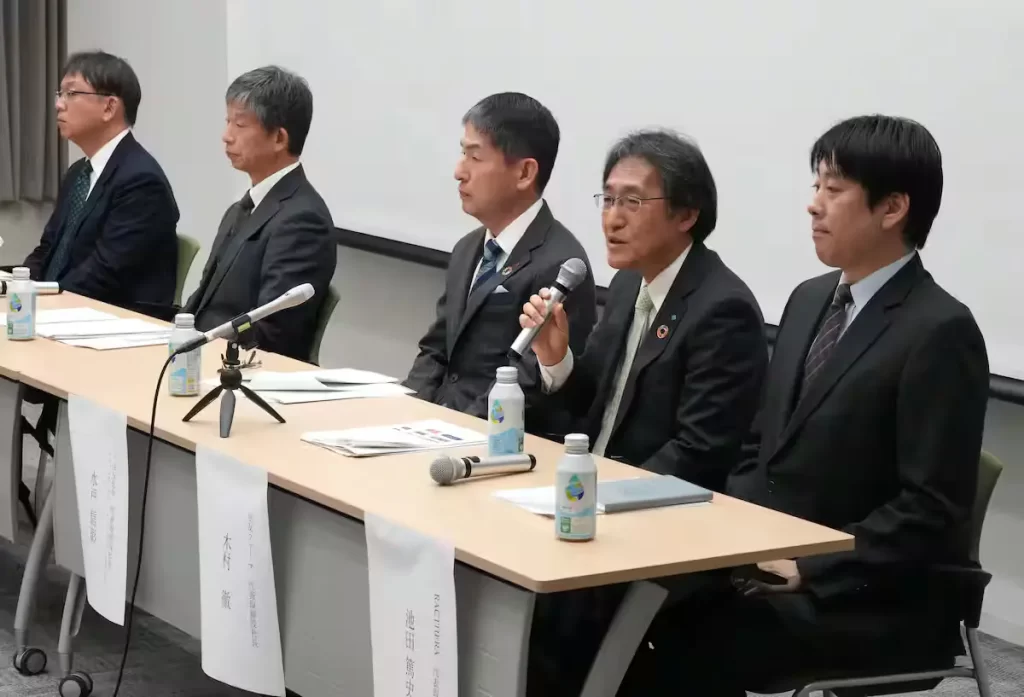 Sumitomo Pharma President Toru Kimura, second from right, and others attend a press conference after receiving manufacturing and sales approval for Amschepri. March 6 in Chuo Ward, Osaka. (©Sankei/Shigetaka Doi)
No Full Approval Yet
Nearly 11 years have passed since the conditional approval system was introduced. Of the eight iPS products approved under the system, none has yet advanced to full approval. Two other products, separate from ReHeart and Amschepri, lost approval after failing to gather sufficient data.
Hiroaki Mamiya, an associate professor of health economics at Ritsumeikan University, described the conditional approval of ReHeart and Amschepri as “the entry point for bringing them into society.” Companies, he said, must take responsibility for collecting the required number of cases and verifying the products’ effectiveness.
ReHeart and Amschepri are expected to go on sale by the end of the year. The companies plan to assess their effectiveness against government evaluation criteria, including case numbers and the objectivity of assessment items. They will also set benchmarks for success in advance.
“What matters for full approval is whether the companies can draw up a proper plan,” a health ministry official said.

Pricing and Insurance Questions
Pricing discussions began at an April 8 general meeting of the Central Social Insurance Medical Council, an advisory body to the health minister. The council agreed to classify ReHeart as a medical device and Amschepri as a pharmaceutical product.
Specialist panels will now review the proposed prices and decide whether the products should be covered by public health insurance, taking into account their impact on healthcare finances. Final decisions will be made at a general meeting of the council.
If insurance coverage is approved, patients would generally pay 30% of the cost out of pocket. For very expensive treatments, Japan’s high-cost medical expense benefit system would cover the amount above the patient’s monthly out-of-pocket limit.
Previous regenerative medical products granted conditional approval, though not derived from iPS cells, have been priced high. Stemirac, a treatment for spinal cord injury patients submitted for full approval last November, costs ¥15.23 million ($96,700). Elevidys, a gene therapy for Duchenne muscular dystrophy, an intractable disease that gradually weakens muscles, is priced at ¥304.97 million ($1.94 million).
Basic pricing guidelines for conditionally approved regenerative medical products were set in January. In principle, prices will be calculated by comparing them with those of drugs or other treatments with similar effects. When there is no comparable product, the price will be based on costs.
Because conditional approval is granted while efficacy is still only presumed, decisions on additional premiums, such as usefulness-based add-ons, will be left until the products apply for full approval.
“These products are costly to develop and target relatively small patient groups, so high prices are to some extent unavoidable,” Mamiya said. “But at this stage, they are unlikely to receive add-on premiums that would significantly boost company profits.”
Aiming to Automate Cell Production
Lowering costs will require a production system capable of cultivating large volumes of high-quality iPS cells. Industry-academia collaboration is beginning to make that possible.
Panasonic Holdings has partnered with the CiRA Foundation, affiliated with Kyoto University’s iPS cell research center, to develop automated equipment for cell production. The foundation currently produces cells manually with several staff members. If automated, the system could operate around the clock and produce high-quality cells more consistently.
Panasonic aims to commercialize the equipment in fiscal 2028.
According to people involved with the foundation, manual cell production is costly because it requires a highly sterile environment. The cost is said to reach tens of millions of yen per patient. Automation is intended not only to reduce labor costs but also to improve cell quality by collecting and analyzing production data.
Kiyoshi Okada, executive director of the Japanese Society for Regenerative Medicine and a specially appointed professor at Osaka University’s Graduate School of Medicine and University Hospital, stressed the importance of industry-academia collaboration.
“If companies can use their respective strengths to help overcome challenges such as mass-producing iPS cells and establishing stable manufacturing methods, it will open the door to broader industrialization,” he said.
Okada also noted that Japan needs systems to attract overseas investment if regenerative medicine is to become a full-fledged industry. At the same time, he said, basic research must not be neglected.
“To continue producing high-quality regenerative medical products, we must value not only practical application but also basic research, and preserve the foundation from which new innovations can emerge,” he said.
RELATED:
(Read the article in Japanese.)
Author: Shinichi Kiyomiya, The Sankei Shimbun
Continue Reading