
Israeli authorities on Monday denounced as a “blood libel” a New York Times opinion story alleging widespread rape of Palestinian prisoners in Israeli jails, noting that it relied on sources that have alleged ties to the Hamas terror group or have praised it.
“Today, The New York Times chose to publish one of the worst blood libels ever to appear in the modern press,” the Foreign Ministry said in a statement, referring to the column.
“In an unfathomable inversion of reality, and through an endless stream of baseless lies, propagandist Nicholas Kristof turns the victim into the accused,” it said, noting the Hamas terror group’s sexual crimes against Israelis on October 7, 2023, and against hostages abducted during that attack throughout their subsequent captivity.
The ministry also claimed Kirstof’s column was “part of a false and well-orchestrated anti-Israel campaign aimed at placing Israel on the UN Secretary-General’s blacklist.” UN chief Antonio Guterres in August placed Hamas — and put Israel “on notice” of being placed — on the UN’s “blacklist” of countries and groups credibly suspected of committing patterns of sexual violence in armed conflict.
Kristof acknowledged the Foreign Ministry’s reaction, sharing it on X with the caption “Critical take from Israel’s Foreign Ministry on my column about sexual assaults of Palestinian men, women and children,” and offering an un-paywalled link to the piece.
The column, entitled “The Silence That Meets the Rape of Palestinians,” which appeared on Monday, alleged “a pattern of widespread Israeli sexual violence against men, women and even children — by soldiers, settlers, interrogators in the Shin Bet internal security agency and, above all, prison guards.”
Among the cases Kristof cited was the alleged 2024 sexual abuse of a Gazan inmate at the Sde Teiman prison, which led to the arrest of several reservist guards and the subsequent storming of the base by a right-wing mob. The charges against the suspects were dropped earlier this year.
Kristof also quoted testimony from Palestinians who said they’d been regularly stripped naked in prison and groped, forcibly penetrated with various objects, or been mounted and raped by specially trained dogs. The latter claim, circulating in anti-Israel media for some time, has recently been amplified by the Euro-Mediterranean Human Rights Monitor, which was also a key source for Kristof’s report.
The Israel Prison Service, responding to a request for comment on the column, said: “The allegations raised are false and entirely unfounded.”

Journalist Nicholas Kristof speaks during the Goalkeepers Conference, on September 20, 2017, in New York. (AP Photo/Julio Cortez)
“The Israel Prison Service is a security organization that operates in accordance with the law and under the strict oversight of numerous official inspectors,” the IPS told The Times of Israel.
“All prisoners are held in accordance with the law, while safeguarding their basic rights and under the supervision of a professional and skilled prison staff,” it said.
Israel highlights photo of NGO leaders with Hamas officials
Israeli Ambassador to the US Yechiel Leiter also responded to the article, posting a short video statement to X and charging that Kristof and the Times “count on you not pulling the curtain back on their lies.”
“Let me be clear: Any complaint of unlawful conduct by Israeli authorities should be submitted to investigative bodies and, as is customary in a democratic society, those complaints will be reviewed thoroughly,” Leiter said.
But the ambassador continued: “Whose evidence is Mr. Kristof leaning on to wield his accusations? A principal NGO quoted in Mr. Kristof’s piece is Euro-Med Monitor. Sounds impartial, right? Balanced, so stately.
“But lo and behold, its leaders Ramy Abdu and Mazen Kahel have been repeatedly found to have links to Hamas,” he said.
The @nytimes and @NickKristof count on you not pulling the curtain back on their lies.
Don’t buy into their blood libels – watch and find out who’s really behind this narrative. pic.twitter.com/Rf94hYlIFw
— Ambassador Yechiel (Michael) Leiter (@yechielleiter) May 12, 2026
Leiter highlighted a photo from 2011, in which Abdu and Kahel could be seen posing in a group photo directly behind senior Hamas official Ismail Haniyeh, whom Israel has since killed.
The photo was originally posted to Facebook in 2012, and was credited in Leiter’s video to NGO Monitor, a pro-Israel watchdog whose website also shows a photo of Abdu alongside Hamas official Osama Hamdan in 2013.
Euro-Med itself has shared conspiracy theories about the October 7 attack, alleging the crime scene was “doctored” and that some of the Palestinians seen dead in Israeli territory with assault rifles after the attack were in fact civilians whose killing had been a war crime.
The NGO has also described the people taken hostage by Hamas during the attack as having been “arrested and moved to the Gaza Strip.”
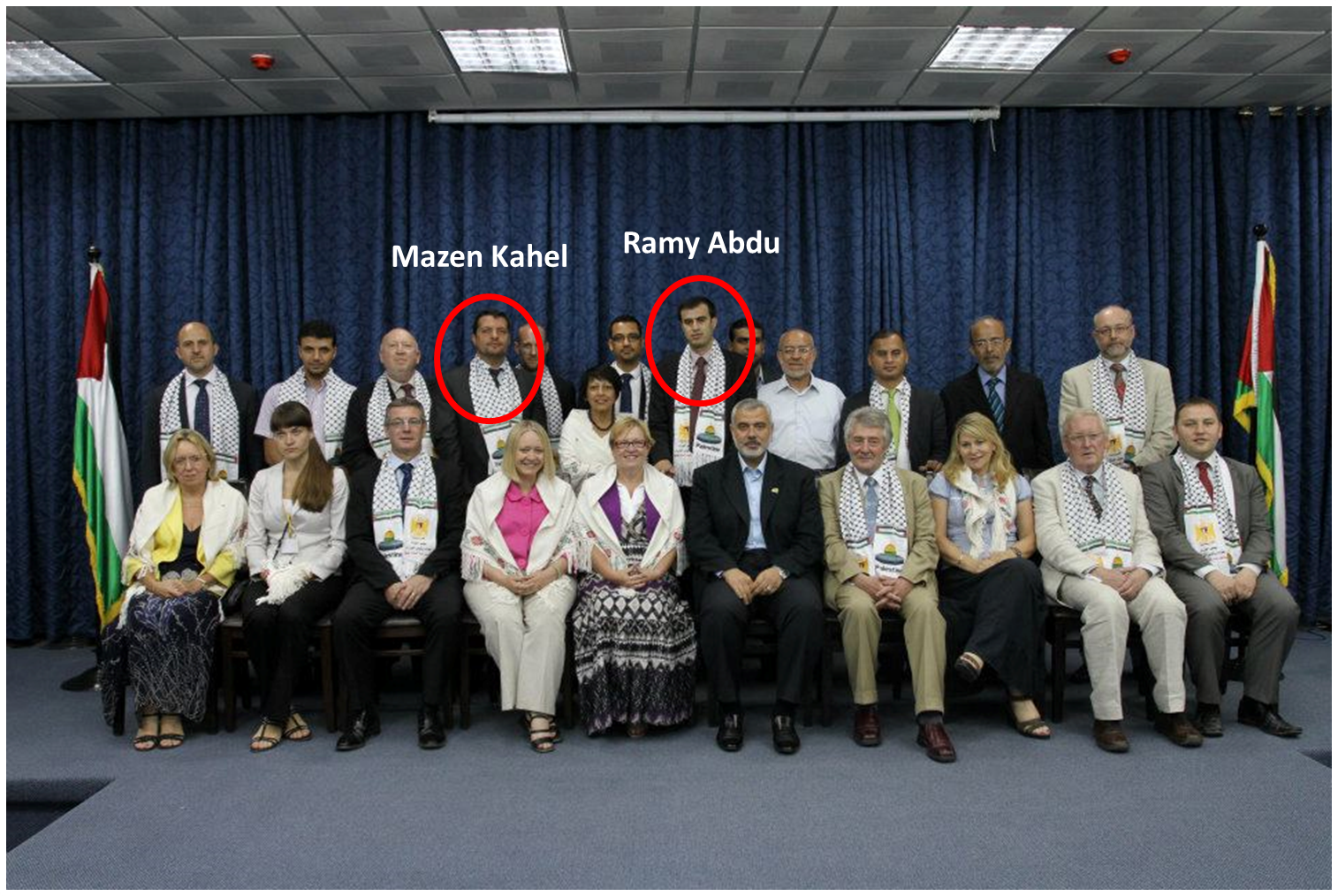
Mazen Kahel and Ramy Abdu, among the leadership of the Euro-Mediterranean Human Rights Monitor NGO, are seen posing with Hamas officials, including Ismail Haniyeh, in Gaza, in 2011. (NGO Monitor)
In his column, Kristof also cited personal accounts from Palestinian journalist Sami al‑Sai and Hebron-based activist Issa Amro, as well as 12 other unnamed men and women who said they’d been sexually assaulted by Israeli settlers or security forces.
The columnist said he “found these victims by asking around among lawyers, human rights groups, aid workers and ordinary Palestinians themselves.”
“In many cases it was possible to corroborate the victims’ stories in part by talking to witnesses or, more commonly, to those whom the victims had confided in, such as family members, lawyers and social workers; in other cases it was not possible, perhaps because shame left people reluctant to acknowledge abuse even to loved ones,” he wrote.

Palestinian activist Issa Amro speaks to Israeli activists in the West Bank city of Hebron, on December 2, 2022 (AP Photo/Maya Alleruzzo)
Kristof acknowledged: “Some may wonder whether Palestinians fabricated accusations of sexual assaults to defame Israel,” but he added: “To me that seems far-fetched, because none of those I interviewed sought me out or knew who else I was speaking to, and they were reluctant to speak.”
Named sources’ stories have gotten more lurid over time
In a series of posts on X, the pro-Israel media watchdog HonestReporting challenged Kristof’s journalism, noting that the most explosive accounts came from unnamed sources, while the stories of those named had grown “steadily more lurid over time, with dramatic new details added years later.”
The watchdog noted that Sami al-Sai had taken to social media on October 8, 2023, to praise the Hamas onslaught one day after it occurred, and that he’d eulogized the leader of a West Bank terror cell as “our martyred prince.”
It also noted that about a year ago Sai spoke to Israeli human rights group B’Tselem about his alleged assault, but did not mention several specific, graphic details that he provided to Kristof, including being sodomized with a carrot, having his genitals grabbed by a female guard, and discovering “other people’s vomit, blood and broken teeth” in his skin.
1/
The @nytimes just published one of the most serious sets of allegations imaginable against Israel – claims of systematic sexual violence, including a bizarre story about carrots and trained rape dogs. We checked the sources.
What we found is journalistic malpractice. ???? pic.twitter.com/vBbLy0Lp0J
— HonestReporting (@HonestReporting) May 11, 2026
It also pointed out that Issa Amro, who’d told Kristof in 2024 that he’d been assaulted on the day of the Hamas attack, had earlier told The Washington Post he’d been “threatened with sexual assault” on that day, not that he’d been assaulted.
Kristof’s column was published the same day as a 300-page study produced by the Civil Commission on October 7 Crimes by Hamas against Women and Children, an Israeli NGO established to document the October 7 atrocities.
The report, based on 430 formal and informal interviews and more than 10,000 photographs and video segments, detailed 13 types of sexual violence committed by the Hamas-led invaders during the attack and against hostages, including rape, gang rape, sexual torture and mutilation, executions linked to sexual violence, postmortem sexual abuse, and sexual assaults carried out in the presence of family members, among other acts.
“The scale, coordination, and repetition of the conduct demonstrate a widespread and systematic attack against civilians in which sexual violence was deliberately used as a method of terror,” the report said.