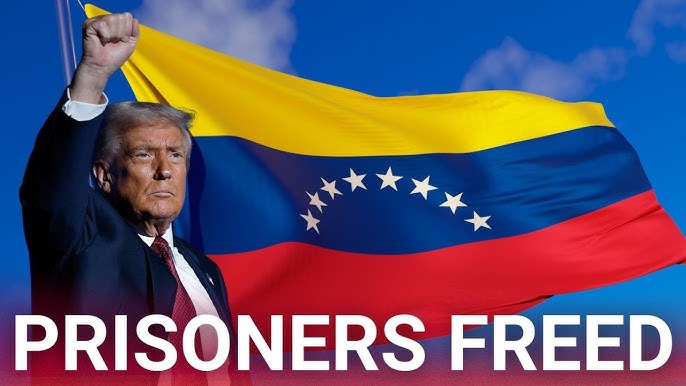
U.S. President Donald Trump has said that all remaining political prisoners in Venezuela will eventually be freed, signaling that Washington intends to continue applying pressure on Venezuelan authorities until more detainees are released. His remarks came during a period of major political transition and international attention surrounding Venezuela’s internal situation.
Trump stated that many prisoners had already been released and claimed that efforts were ongoing to secure the freedom of those still being held. The issue has become one of the most closely watched human rights and political developments in Latin America because it is tied directly to the future direction of Venezuela’s political system, democratic reforms, and international relations.
The announcement drew immediate reactions from governments, human rights organizations, opposition movements, and Venezuelan families who have spent years demanding the release of detained relatives.
Who are considered political prisoners in Venezuela?
Political prisoners are people detained because of their political beliefs, opposition activities, journalism, activism, protests, or criticism of the government. In Venezuela, the term has been widely used by international organizations and rights groups to describe opposition figures, activists, journalists, military officers, and civilians accused of crimes linked to political dissent.
For years, Venezuelan authorities have denied accusations that prisoners were being held for political reasons. Officials often argued that those detained were involved in criminal conspiracies, violence, terrorism, or attempts to destabilize the state. However, human rights groups repeatedly challenged those claims and insisted many cases involved politically motivated prosecutions.
The issue became especially controversial after repeated waves of anti government protests, during which large numbers of demonstrators and activists were arrested.
Why has Venezuela’s political prisoner issue become globally important?
The political prisoner question evolved into an international symbol of Venezuela’s wider political and economic crisis. Over the past decade, Venezuela experienced severe economic collapse, hyperinflation, shortages of food and medicine, political polarization, institutional instability, and mass migration.
Millions of Venezuelans left the country as living conditions worsened. At the same time, opposition groups accused authorities of dismantling democratic institutions and suppressing dissent.
As a result, governments across the Americas and Europe increasingly focused on the treatment of political prisoners as a key indicator of whether Venezuela was moving toward democratic reform or deeper authoritarianism.
International organizations repeatedly called for the unconditional release of detainees and urged Venezuelan authorities to restore judicial independence and political freedoms.
What changed in Venezuela in 2026?
The political landscape shifted dramatically in 2026 after major developments involving the Venezuelan leadership and increasing international pressure. The country entered a period of uncertainty and transition that reshaped both domestic politics and foreign relations.
Following major political upheaval, Venezuelan authorities began announcing the release of numerous detainees. The releases were presented as part of broader reconciliation efforts and attempts to reduce tensions with the international community.
These developments also coincided with renewed discussions about economic stabilization, sanctions relief, and possible re engagement between Venezuela and Western governments.
For many observers, the prisoner releases became one of the clearest signs that the country might be entering a new political phase.
How many political prisoners have reportedly been released?
Human rights organizations and monitoring groups say hundreds of prisoners have been released in recent months, although exact numbers vary because different organizations use different verification methods.
Some groups estimate that before the release process began, Venezuela held hundreds of political detainees, including opposition activists, journalists, protest organizers, and military personnel accused of conspiracy related offenses.
Authorities announced multiple rounds of releases, and reports suggested that several hundred individuals regained their freedom. However, rights organizations insist that a significant number of detainees still remain imprisoned.
The process has also been criticized for lacking transparency because official prisoner lists have not always been fully published and families often struggle to obtain reliable information.
Why are human rights groups still concerned?
Although many detainees have reportedly been freed, human rights organizations argue that serious concerns remain unresolved.
One major criticism is that some released prisoners continue facing restrictions after their release. These restrictions may include travel bans, regular reporting requirements to authorities, limitations on political participation, or warnings against speaking publicly.
Rights groups also warn about what they describe as a revolving door system in which some detainees are released while new arrests continue to occur.
Another concern involves the judicial system itself. Critics argue that without reforms to courts, prosecutors, and security institutions, future politically motivated arrests could continue even if current prisoners are freed.
Families of detainees also complain about poor communication from authorities and uncertainty surrounding the legal status of many prisoners.
Why is the United States deeply involved in the issue?
The United States has played a central role in Venezuela’s political crisis for years through sanctions, diplomatic pressure, and support for opposition movements.
Washington has repeatedly argued that political reforms in Venezuela must include the release of detainees, restoration of democratic institutions, and guarantees for free political participation.
Trump’s recent comments suggest the United States intends to remain actively involved in monitoring Venezuela’s political transition and human rights situation.
At the same time, economic interests are also becoming increasingly important. Venezuela possesses some of the world’s largest oil reserves, and changes in the political environment could affect global energy markets and foreign investment opportunities.
The United States appears to be balancing both political and economic priorities as relations with Venezuela evolve.
How is Venezuela’s economy connected to the political prisoner issue?
Economic recovery and political reform have become closely linked in Venezuela.
For years, sanctions, economic collapse, declining oil production, corruption, and infrastructure deterioration severely damaged the country’s economy. Oil exports, once the backbone of Venezuela’s national income, fell dramatically.
Now, signs of political stabilization and prisoner releases are being interpreted by some investors and governments as possible indicators that Venezuela may gradually reopen economically.
Foreign energy companies have shown renewed interest in Venezuela’s oil sector, especially if sanctions are eased and political conditions improve.
Supporters of engagement argue that economic recovery could improve living standards and reduce social tensions. Critics, however, warn that economic normalization should not occur without lasting democratic reforms and accountability for past abuses.
How has the Venezuelan opposition reacted?
Opposition movements generally welcomed the release of prisoners but remain cautious about declaring victory.
Many opposition leaders argue that the release process must continue until all detainees are freed unconditionally. They also insist that broader democratic guarantees are needed, including independent courts, free elections, freedom of speech, and protections for political participation.
Some activists fear that limited prisoner releases could be used primarily to improve Venezuela’s international image rather than produce genuine systemic reform.
Others stress that political reconciliation cannot succeed unless victims of repression receive justice and institutional changes prevent future abuses.
Despite these concerns, many families and activists view the releases as an important humanitarian step after years of suffering and uncertainty.
What role do families of prisoners play in the movement?
Families of detainees have become one of the most visible and emotional forces in the campaign for prisoner releases.
For years, relatives organized protests, public campaigns, vigils, and international advocacy efforts to draw attention to prison conditions and alleged human rights violations.
Many families described severe emotional and financial hardships caused by long detentions. Some relatives spent years traveling between prisons, attending court hearings, and searching for information about loved ones.
Even after some releases began, many families continued waiting outside detention centers hoping their relatives would also be freed.
Their activism helped keep international attention focused on the issue and increased pressure on Venezuelan authorities.
What is the proposed amnesty process?
Authorities in Venezuela have discussed amnesty measures intended to reduce political tensions and encourage national reconciliation.
Supporters of amnesty proposals argue that they could help stabilize the country politically, improve diplomatic relations, and encourage economic recovery.
The proposals reportedly cover political cases stretching back many years and could potentially affect hundreds of individuals.
However, critics question whether the process is comprehensive enough and whether all prisoners will actually benefit equally. Some rights organizations also argue that amnesty alone is insufficient unless accompanied by structural reforms and accountability measures.
There are ongoing debates about whether the releases represent a temporary political strategy or the beginning of a broader democratic transition.
How has the international community responded?
International reactions have been mixed but closely attentive.
Some governments welcomed the releases as encouraging developments and expressed hope that Venezuela could move toward greater political openness.
Countries whose citizens or residents were among those released praised the decisions and called for additional progress.
At the same time, international rights organizations remain cautious. They continue monitoring reports of arbitrary detention, restrictions on political activity, and alleged abuses within the judicial system.
Many observers believe Venezuela remains at a critical crossroads where future decisions could either deepen reform efforts or reverse recent progress.
Could prisoner releases improve Venezuela’s global standing?
The release of political prisoners could significantly improve Venezuela’s international image if broader reforms continue.
Possible consequences include improved diplomatic relations, increased foreign investment, reduced sanctions, and greater economic cooperation with international partners.
Political stabilization could also encourage the return of some Venezuelans who left the country during years of crisis.
However, analysts warn that symbolic measures alone will not be enough to fully restore international confidence. Governments and investors will likely continue evaluating whether democratic institutions are genuinely strengthening and whether civil liberties are being protected consistently.
Long term trust will depend on whether reforms become permanent rather than temporary.
What challenges still remain inside Venezuela?
Despite signs of political change, Venezuela continues facing enormous challenges.
The economy remains fragile and many citizens still struggle with inflation, low wages, infrastructure problems, and shortages in key sectors.
Political divisions also remain deep after years of confrontation between authorities and opposition groups.
Human rights organizations continue documenting concerns involving freedom of expression, judicial independence, and political participation.
At the same time, rebuilding public trust in institutions may take years because many Venezuelans became deeply skeptical after repeated cycles of political conflict and unfulfilled promises.
The release of prisoners may ease some tensions, but broader national reconciliation will likely require sustained political dialogue and institutional reform.
What could happen next?
Much depends on whether Venezuelan authorities continue releasing detainees and whether broader reforms follow.
Several key questions remain unresolved. Will all remaining political prisoners actually be freed? Will new politically motivated arrests stop? Can democratic institutions regain credibility? Will economic recovery improve daily life for ordinary citizens? Can Venezuela rebuild stable relations with the international community?
Trump’s comments have increased expectations that additional releases could occur soon, but human rights groups continue insisting that concrete actions matter more than political statements.
For many Venezuelans, the prisoner issue is not only political but deeply personal. Families who spent years separated from loved ones are waiting to see whether promises of freedom become a lasting reality.
The coming months may determine whether Venezuela is entering a genuine period of political transformation or simply another temporary phase in its long running crisis.