
Polish defense company Polska Grupa Zbrojeniowa (PGZ) is showcasing the export configuration of its Universal Modular Tracked Platform (UMTP) the base platform for the Polish Borsuk infantry fighting vehicle for the first time at the IDEB Defence & Security 2026 exhibition, running May 12–14 in Bratislava, Slovakia.
In the export variant, the Polish IFV has been fitted with the unmanned Turra-30 turret from Slovak company EVPU a.s., offering a choice of cannon from either Slovak manufacturer ZTS Special or American firm Northrop Grumman, a coaxial 7.62 mm machine gun, and SPIKE LR/LR2 anti-tank guided missiles. PGZ describes its IFV as built for the modern battlefield and appears to be targeting the Slovak military as a primary customer as had been reported previously.
Read more: Almost No One Makes Anti-Ballistic Missiles — for Ukraine, Realistic Options Come Down to One  Export version of the Polish Borsuk IFV with the Slovak turret / Photo credit: Polska Grupa Zbrojeniowa (PGZ)
Defense Express has note, this is a somewhat puzzling choice, given that Slovakia is already deep into a rearmament program for new IFVs. Four years ago the country ordered the modern and combat-proven Swedish CV90 in the MkIV configuration from BAE Systems Hägglunds 152 vehicles for nearly €1.7 billion.
Earlier this year, Bratislava also expressed interest in procuring CV90120 light tanks to complement its T-72 fleet, though no firm contract has been signed in that case. There, the Swedish platform will face competition from at least the Turkish CFL-120 Karpat light tank from FNSS Savunma Sistemleri, which was presented at the same IDEB exhibition alongside CSG Group with an offer of local production.
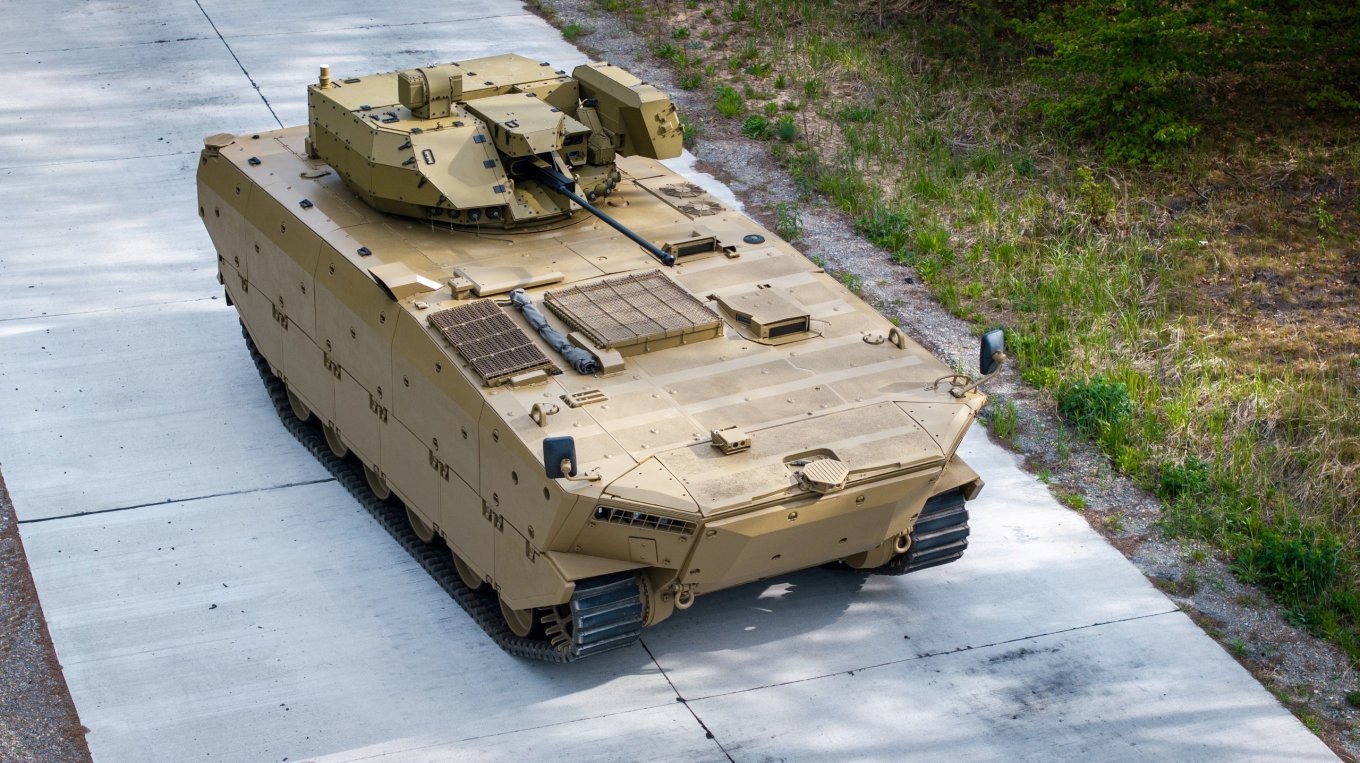 Export version of the Polish Borsuk IFV with the Slovak turret / Photo credit: Polska Grupa Zbrojeniowa (PGZ)
It would therefore be genuinely puzzling if Poland were primarily targeting Slovakia with its Borsuk export variant. It is true that some Polish commentators on social media have suggested Bratislava might abandon the CV90 contract in the same way Estonia pivoted toward reinforcing its air defenses though in Slovakia’s case, this involves a firm contract signed in 2022, under which the first vehicle produced for the Slovak military was already presented in February of this year. The scenario in which Bratislava suddenly tears up its CV90 contract to buy the Polish Borsuk looks far-fetched.
Poland may be calculating that Slovakia could decide to procure a second IFV type for its armed forces particularly given that the Borsuk is an amphibious platform though this too seems unlikely.
 Export version of the Polish Borsuk IFV with the Slovak turret / Photo credit: Polska Grupa Zbrojeniowa (PGZ)
The more realistic scenario is that Poland and Slovakia are jointly promoting the export variant with the Turra-30 turret to third-party customers, as had previously been reported. The vehicle’s camouflage scheme is also a fairly clear nod toward the Asian market.
Even so, the Borsuk export variant faces stiff competition in a market currently offering a wide selection of modern IFVs some of which already carry the advantage of being battle-proven. It is also worth noting that the Borsuk only recently entered series production, and Poland will need further time to reach acceptable production rates.