Thank you for reading! Letters from Leo is a reader-supported publication. If you find value in my work, please consider becoming a paid subscriber or making a one-time donation.
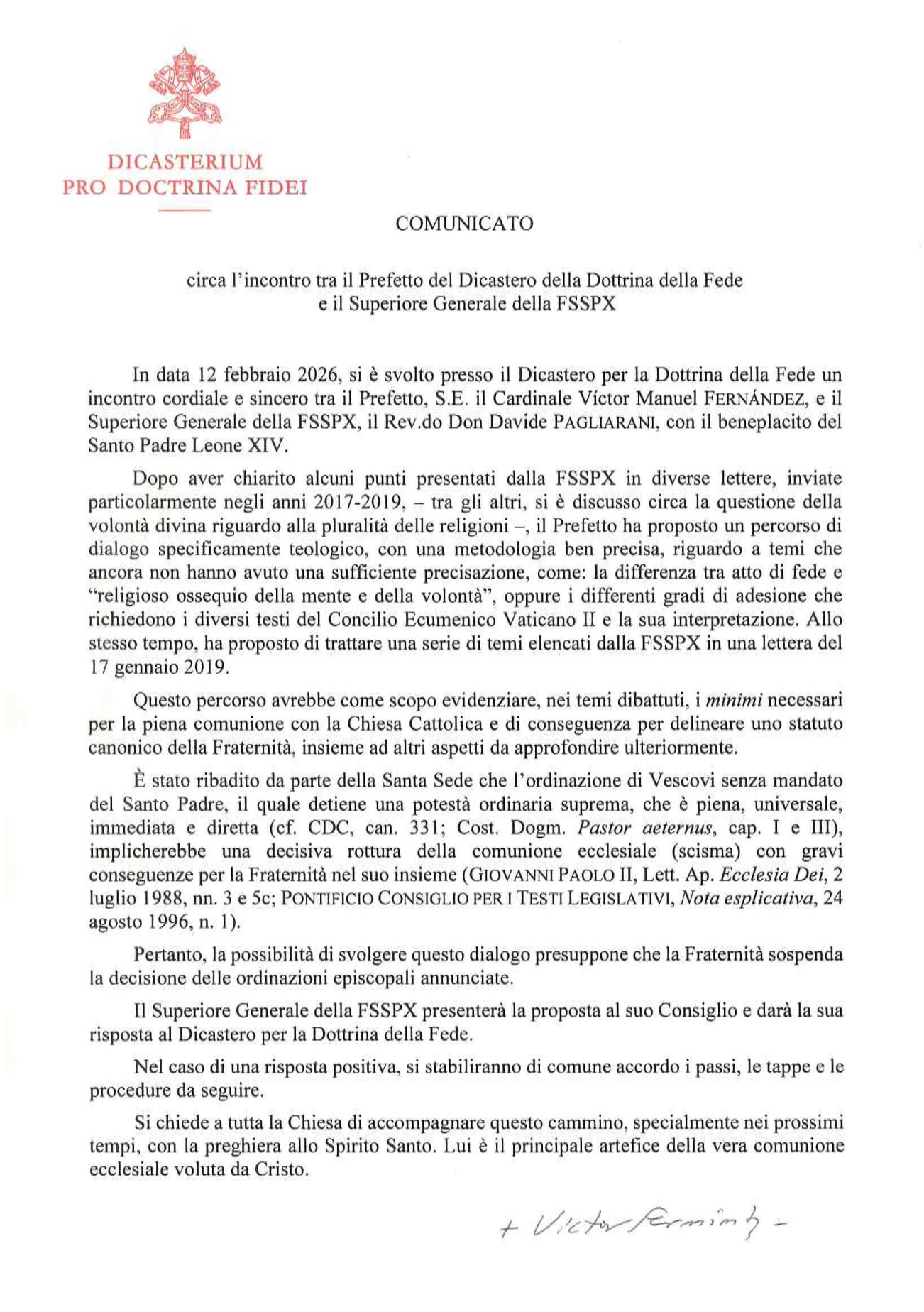
Cardinal Víctor Manuel Fernández — the Argentine theologian who runs the Vatican’s doctrinal office — issued a statement on Wednesday warning the right-wing ultratraditionalist Society of Saint Pius X that its planned July 1 consecration of four new bishops in Écône, Switzerland, would constitute “a schismatic act” and trigger automatic excommunication under canon law.
The Italian-language statement, released by the Holy See’s Press Office, ended any remaining ambiguity about where this pontificate stands on the Second Vatican Council.
Fernández wrote that a “formal adhesion to schism would constitute a grave offense against God,” and reported that Pope Leo “continues in his prayers to ask the Holy Spirit to enlighten the leaders of the Priestly Fraternity of St. Pius X so that they may reconsider the extremely grave decision they have taken.”
Reconsider is the last word before the door closes.
This fight has been a year in the making, and the road to Wednesday’s statement runs back to May 10, 2025 — two days after the conclave — when Leo sat down with the cardinals who had elected him and delivered the speech that would set the direction of his pontificate.
“I would like us to renew together today our complete commitment to the path that the universal Church has now followed for decades in the wake of the Second Vatican Council,” he said. He then named the document that would govern his interpretation of that path: Pope Francis’s 2013 apostolic exhortation Evangelii Gaudium.
Leo went on to list the principles he intended to carry forward — the primacy of Christ in proclamation, missionary conversion of the Christian community, collegiality and synodality, attention to the sensus fidei in popular piety, loving care for the least and rejected, and courageous dialogue with the contemporary world.
That paragraph, delivered at the moment a new pope is most carefully read by his curia and his enemies, was the founding charter of the Leo papacy. Vatican II is not up for renegotiation under his pontificate, and Francis’s Evangelii Gaudium would be the lens through which it is read.
The traditionalist wing of the Church should’ve heard him as clearly as anyone else.
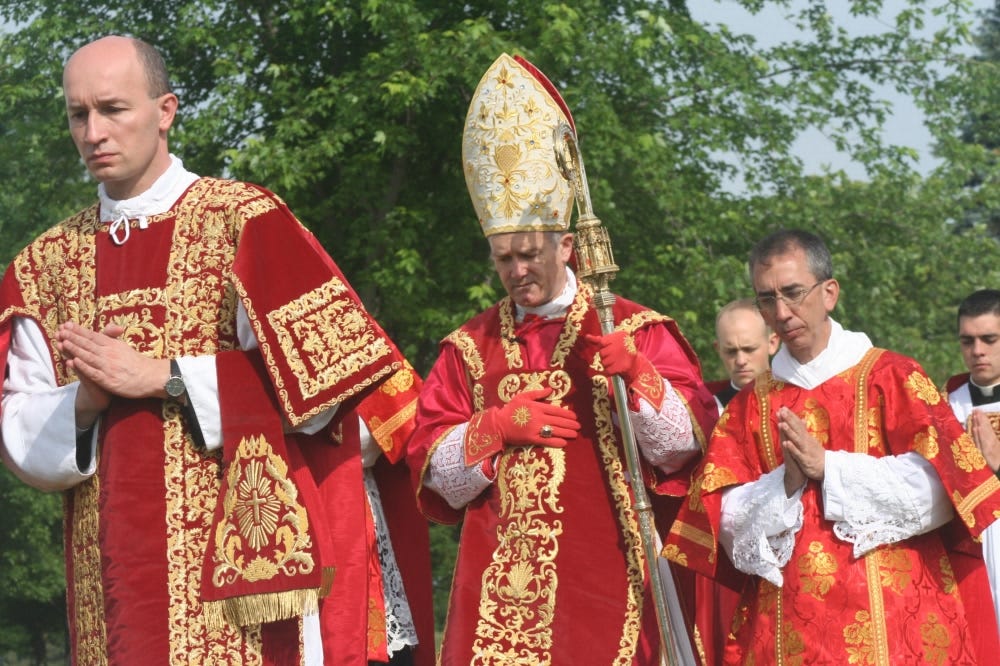
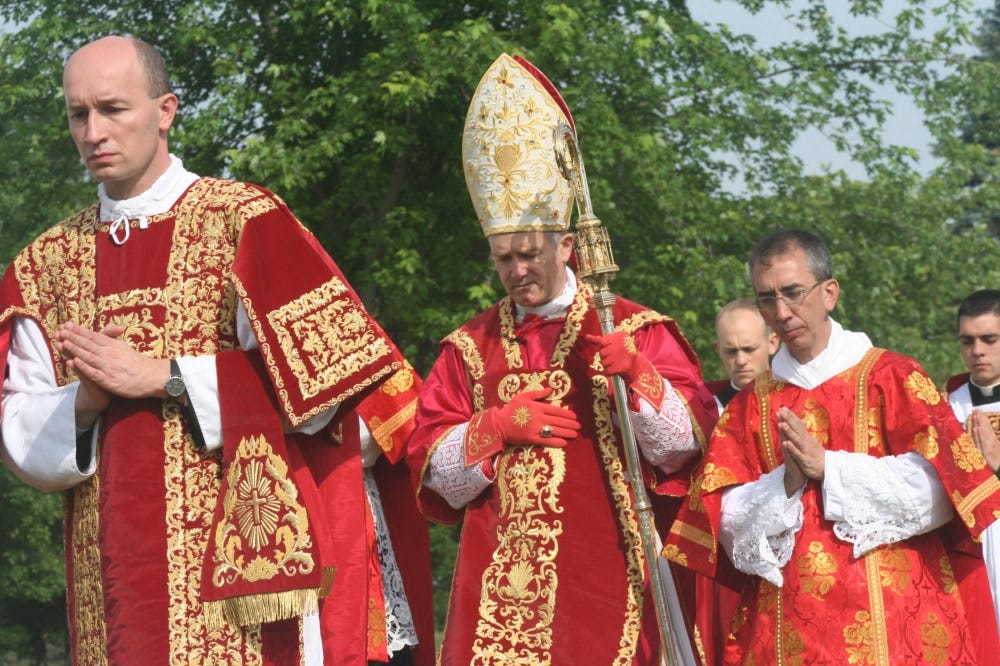
The SSPX has spent more than half a century arguing that the Second Vatican Council itself was a mistake — that its teachings on religious liberty, ecumenism, interreligious dialogue, and the liturgy departed from the perennial teaching of the Church.
Archbishop Marcel Lefebvre founded the society in 1970 to preserve what he called the Mass of all time. In 1988, after years of failed negotiations with Rome, Lefebvre consecrated four bishops without papal mandate. John Paul II declared him excommunicated within hours.
The two surviving bishops Lefebvre consecrated in 1988 — Bernard Fellay and Alfonso de Galarreta, whose excommunications Benedict XVI lifted in 2009 — are the men expected to lay hands on the four new bishops at Écône on July 1. If they proceed, the canon kicks in automatically.
Both consecrators and consecrands incur the same penalty Lefebvre did. The society would tip into a formal schism that could pull more than half a million members, two existing bishops, more than seven hundred priests, and roughly two hundred seminarians across sixty countries out of canonical communion with Rome.
For decades, Rome has tried to find a way to keep the SSPX inside the tent. Here’s the background.
John Paul II opened talks in the 1990s; in 2007 Benedict XVI broadened permission for the Latin Mass through Summorum Pontificum, and in January 2009 he lifted the 1988 excommunications; and even Francis, no friend of the society’s theology, allowed SSPX priests to validly hear confessions and witness marriages. Each accommodation was one-sided — Rome moved, the society did not.
Wednesday made the cost of that posture explicit.
The chain of events that brought us to this week is worth following.