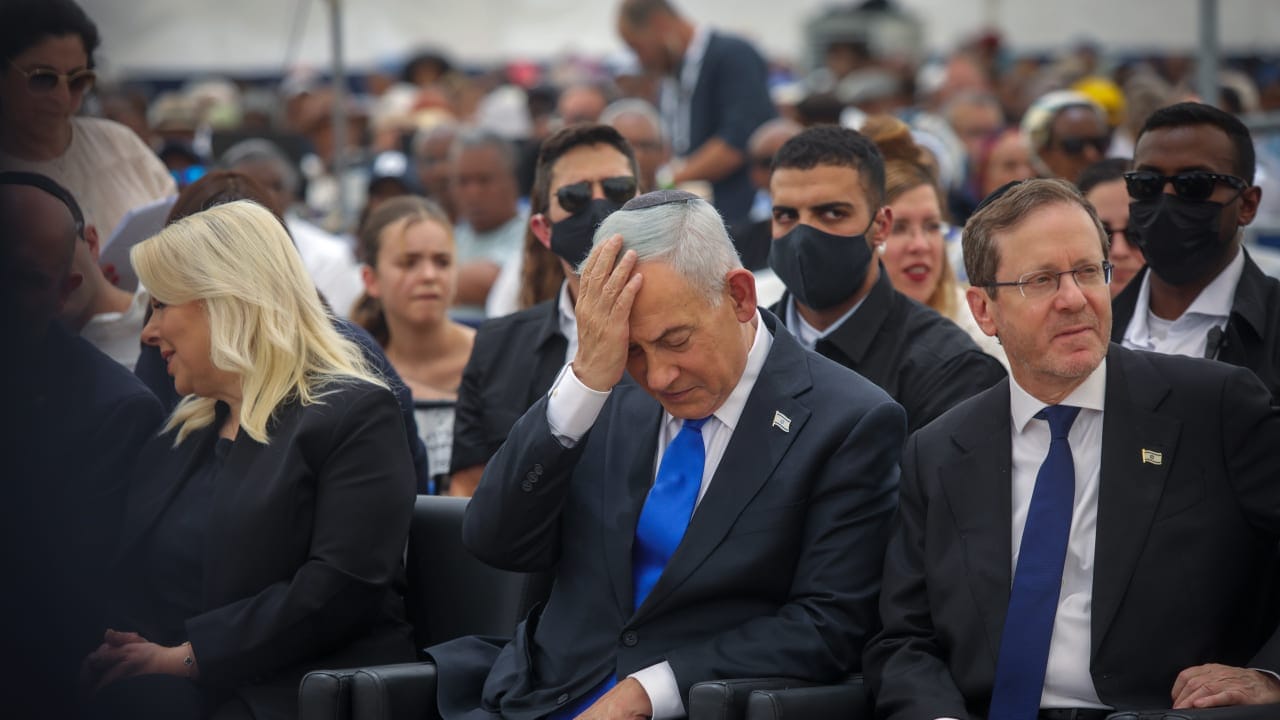
Prime Minister Benjamin Netanyahu testified Thursday that his medical condition was “proper” and “excellent,” as he took the stand in the defamation suit he filed against attorney Gonen Ben Itzhak and journalists Uri Misgav and Ben Caspit over publications concerning his health and fitness.
The testimony, held before Ramle Magistrate’s Court President Judge Menahem Mizrahi but moved to the Tel Aviv District Court building for security reasons, was cut short after roughly half an hour when Netanyahu left for a ceremony. Mizrahi allowed him to leave and said that another date would be set to continue his testimony.
“My medical condition is proper, and some say excellent,” Netanyahu said. “I did not suffer from pancreatic cancer. If that were the case, I would no longer be here.”
Netanyahu said he exercises, undergoes medical tests, and that his indicators were “completely normal.”
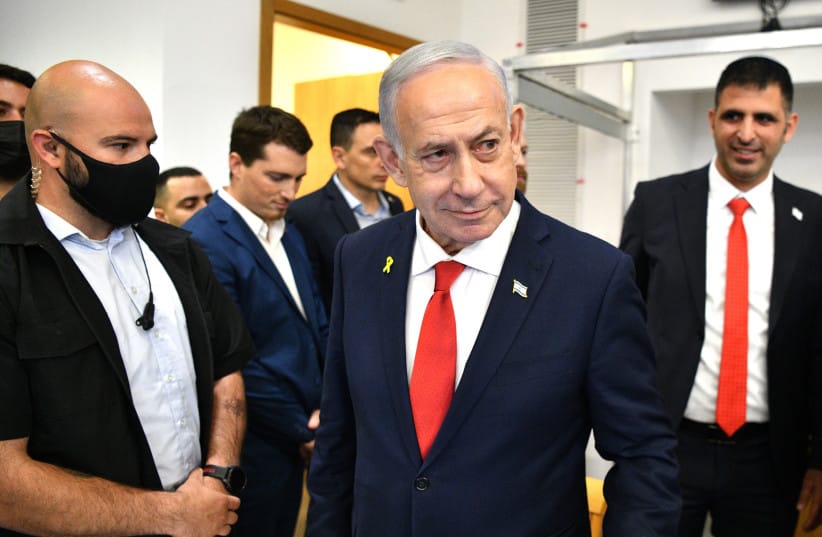 Israeli Prime Minister Benjamin Netanyahu arrives to the courtroom at the District Court in Tel Aviv, in the trial against him, October 15, 2025. (credit: REUVEN KASTRO/POOL)Netanyahu says his pacemaker was never activated
He said he had suffered for years from an enlarged prostate, which had been benign, including after an operation to reduce it. Toward the end of 2025, however, an additional test showed the beginning of an early-stage cancerous growth in the prostate, he said.
“It was eight millimeters,” Netanyahu said, adding that doctors told him the condition was common among men his age and that he could either live with it or treat it.
Netanyahu said he underwent five radiation treatments in January and February, after which a test showed the lesion had been fully removed and had not metastasized. He added that the matter was reported publicly last month.
He also addressed his pacemaker, saying it had never been activated because of his good condition.
The lawsuit, filed for NIS 500,000, concerns publications from May 2024. Ben Itzhak wrote on X.Twitter that, following reports and a Netanyahu visit to Hadassah-University Medical Center in Jerusalem’s Ein Kerem, he had received information that Netanyahu had been treated for pancreatic cancer. Misgav published posts questioning Netanyahu’s appearance, speech and medical condition. Caspit published an item concerning an alleged meeting between Maj.-Gen. (res.) Amiram Levin and Netanyahu, in which Levin was said to have left disturbed and to have formed the view that Netanyahu was unfit and dangerous to the state.
Netanyahu denies that he had pancreatic cancer and argues that the publications were false and defamatory.
Under cross-examination by Ben Itzhak’s attorney, Roni Kashles, Netanyahu was asked why he filed a lawsuit rather than issuing the same statement two years earlier.
“There was malice here,” Netanyahu responded.
Asked what he had done to refute the claims beyond filing the suit, Netanyahu said he had published a denial.
“I did not see any denial,” Kashles said.
“A lawsuit is the best denial,” Netanyahu answered.
Netanyahu denies activating Shin Bet to act against Ben Itzhak
Netanyahu denied a report alleging he had sought to have the Shin Bet (Israel Security Agency) act against Ben Itzhak. He also said he had not known about Ben Itzhak’s approach to Shlomit Barnea Farago, then the legal adviser in the Prime Minister’s Office, regarding his medical condition.
Netanyahu said the important facts appeared in the medical file submitted to the court. Kashles argued that there had been a selective choice of what to present.
“No,” Netanyahu said. “What the medical team that treated me thought was appropriate to present regarding all the serious treatments I received. The central treatments were reported to the public.”
Kashles cited an interview that Netanyahu’s physician, Dr. Zvi Berkovich, gave to Misgav, in which Berkovich did not deny that cancer specialists, including pancreatic cancer specialists, participated in Netanyahu’s hernia operation.
“There is no chance that I had pancreatic cancer and they did not tell me,” Netanyahu said.
The hearing came after Mizrahi last week ordered Netanyahu to submit his updated medical file to the court in a sealed envelope, for the judge’s review only, so the court could examine when the prostate cancer was diagnosed.
In that decision, Mizrahi wrote that the timing of the diagnosis was a critical point in the dispute, after a public medical report from April 20 said an additional examination had confirmed that the cancer was discovered incidentally and at an early stage. The judge noted, however, that the report did not make clear when that additional examination took place.
The defendants deny that their publications constitute defamation.
Ben Itzhak has argued that he published his remarks after receiving no response from the Prime Minister’s Office regarding Netanyahu’s health, amid public rumors on the matter. Misgav has argued that it is permissible to raise questions regarding the medical condition of an elected official and that Netanyahu is seeking to silence a critical journalist. Caspit has argued that he did not address Netanyahu’s medical condition, that he reported on Levin’s view, and that the suit is meant to chill criticism of the prime minister.