
The leaders of the US and China agreed during their May 14 summit to build a relationship based on “constructive strategic stability,” a formulation that also hinted at the possible arrival of a new G2 era in which Washington and Beijing share global hegemony.
During the talks, Chinese President Xi Jinping strongly cautioned against US involvement in the Taiwan issue. Xi also appeared to recognize that President Donald Trump is being distracted by military operations in Iran and is eager to secure economic achievements ahead of the November midterm elections.
The G2 Temptation
“Can China and the United States overcome the Thucydides trap and create a new paradigm of major country relations?” Xi asked his American counterpart during the summit on Thursday.
The “Thucydides Trap,” a theory rooted in ancient Greek history, argues that rising powers and established hegemonic states are prone to war due to mutual distrust and fear.
Chinese leaders’ invocation of the influential theory advanced by an American political scientist likely intended to emphasize the need to manage points of contention to avoid conflict.
Trump, before departing for China, remarked, “We’re the two superpowers. We’re the strongest nation on Earth in terms of military. China’s considered second.”
The comment seemed to echo the logic of the so-called G2 concept—the idea that Washington and Beijing should jointly manage the world’s major issues, while offering a revealing glimpse into Trump’s current view of China.
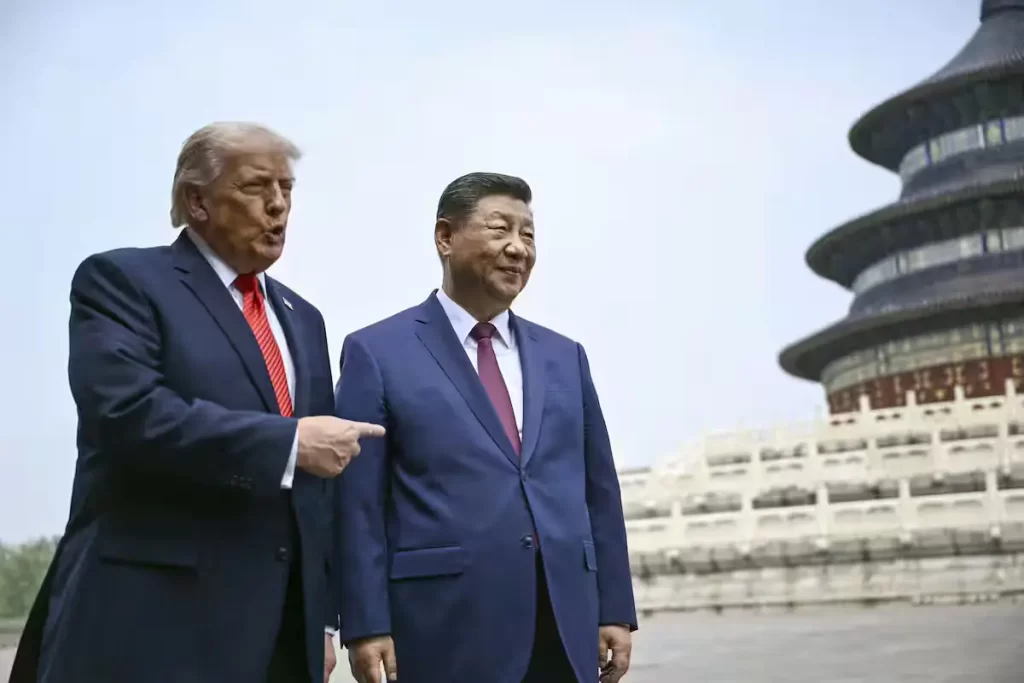 US President Donald Trump, left, and Chinese President Xi Jinping visit the Temple of Heaven in Beijing on May 14. (©Reuters/Kyodo)
From Tariffs to Tradeoffs
During his first term, Trump focused on imposing steep tariffs on Chinese goods and preventing the outflow of advanced technology to China, driven by growing concerns over China’s rise.
The succeeding administration of Joe Biden largely maintained that approach, strengthening export restrictions on semiconductors and other technologies that could contribute to China’s military modernization.
In his second term, Trump adopted an even tougher stance, slapping ultra-high tariffs on Chinese products. Beijing retaliated with tariffs of its own while also tightening export controls on rare earths, of which China accounts for roughly 70% of global production and nearly 90% of refining capacity.
While the two sides agreed to a temporary truce in their tariff war during a summit last October, it illustrated that Beijing still wields significant economic leverage over the US.
Visiting Beijing for the first time in roughly nine years, Trump brought along numerous heads of major American corporations. The administration placed priority on finding common ground in trade and investment during the summit and translating that into tangible economic gains.
Despite mounting concerns over China’s internal economy, including a prolonged real estate slump and weak domestic demand, the latest trip demonstrates that the allure of the Chinese market remains enormous for American businesses.

The Cost of Détente
Following the tariff tit-for-tat, a growing number of observers believe the US and China have entered a phase of what former US Ambassador to Russia Michael McFaul describes as “Detente 2.0.”
But the US launched a military operation against Venezuela in January and followed it with a large-scale attack on Iran in February. According to former Trump administration officials, the operations were also intended as a “strategic signal” to counter China, which has cultivated close ties with both countries.
Washington has yet to chart a clear path to ending the war with Iran. That leaves China—Iran’s largest oil buyer—as an important player in the broader equation.
Against this backdrop, concerns remain strong that Trump could make concessions to Xi on the Taiwan issue. Before heading to China, Trump explicitly stated that US arms sales to Taiwan—which Xi opposes—would be discussed during his Beijing trip lasting through Friday.
The Six Assurances presented by the Ronald Reagan administration to Taiwan in 1982 stipulated that Washington would not consult Beijing in advance regarding arms sales to the self-governing island.
The US and Chinese leaders are expected to meet three more times before the end of the year, meaning Trump’s handling of relations with Beijing is likely to have major consequences for the broader Asian region, including Japan.
RELATED:
Author: Nagahisa Shiobara and Shohei Mitsuka, The Sankei Shimbun
(Read this article in Japanese)
Continue Reading