There is a shared sense of unease among Europeans. Before starting the interview with the executive vice-president of the European Commission, I was talking to a member of the European University Institute (EUI) who lived in Florence itself. He was 30; I was 25. Our conversation quickly moved towards one issue: the difficulty of accessing housing. Because if there is one thing that unites a young person in Berlin, Brussels, Florence or Madrid, it is this problem, which I felt compelled to ask Commissioner Roxana Mînzatu about.
The context was fitting: we were at the celebration of the EUI’s 50th anniversary and, two days earlier, the European Commission had announced the first European-level anti-poverty strategy, led by Mînzatu herself. She is fully aware of the parallel challenges —”Europe has to catch up in industry, the economy and technological sovereignty”, she explains—, but sees them as routes towards a legitimate and necessary goal: “a European social model that benefits people, and all people, not just an elite or some parts of Europe”.
Mînzatu speaks with ease and naturalness, and knows that her portfolio is not a simple one: it touches on highly sensitive issues, with ambitious objectives —”to reduce the number of people at risk of poverty and social exclusion by 15 million by 2030″—, but one that, in terms of resources and competences, may be pushed into the background. The conversation starts there: how Europe can talk about competitiveness or strategic autonomy without leaving aside the social promise that has defined the European project.

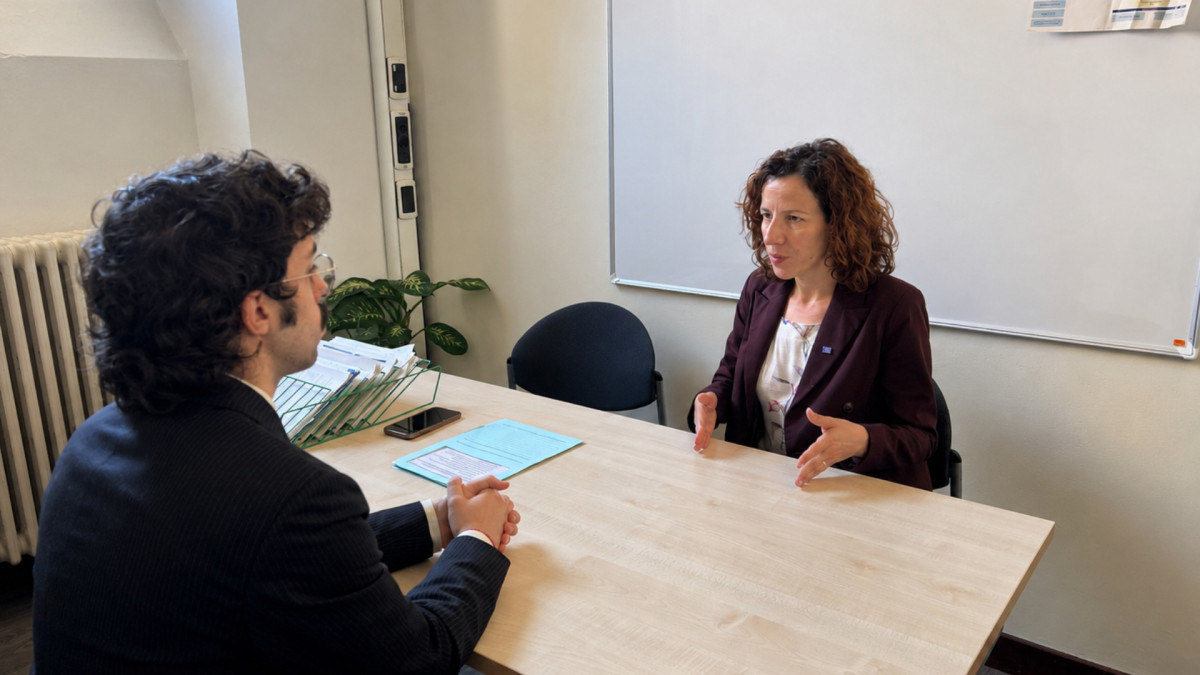
Mînzatu and de Diego discuss the EU Anti-Poverty Strategy. Photo: Agenda Pública. All images have been adjusted with AI to improve their lighting.
In Europe, we talk a lot about competitiveness, industry, defence and strategic autonomy. How does the social agenda fit into that conversation?
The European social model is an asset for our economic model. In fact, it should be one of its unique selling points. In the end, why do we want more competitiveness and more prosperity? To make sure people have opportunities, protection and a dignified life.
Europe has to catch up in industry, the economy and technological sovereignty. To do that, we need to invest in technology and capital, create a more agile environment for industry, reduce the fragmentation of the single market, remove barriers and improve state aid rules.
But within all this, we have to make sure that the final destination is a European social model that benefits people, and all people, not just an elite or some parts of Europe. That, for me, is what a truly European economic model means: one that includes its social assets.
In that context, you have presented the European anti-poverty strategy. In concrete terms, what should change for a person in the European Union once this strategy is in place?
There are 93 million people at risk of poverty or social exclusion in Europe. And we do not know how that figure may evolve after the energy shocks and recent crises.
The anti-poverty strategy takes a life-cycle approach and a multidimensional approach. We ask what we should do for children in poverty, for young people at risk of exclusion, for people who work or are looking for work but still experience poverty, and also for those outside the labour market. That includes many women, older people and people in different vulnerable situations.
Income is an important part, but it is not the only one. Someone may have a salary and still not have enough to live on. They may not have access to proper services, or their children may not have access to the healthcare or education they need. We are also talking about energy poverty and transport poverty.
“What we propose is an integrated approach. We need to look at each person in a vulnerable situation, understand their different needs and offer support that combines several services”There are three central elements in the strategy. The first is a possible legal tool to improve the activation of people who are outside the labour market. We are not talking about unemployed people in the strict sense, but about people who are not looking for a job. Around 50 million Europeans are in that situation. Some are studying, others consider themselves retired, but there are also many people, especially women or single parents, who cannot work because they do not have the right support.
Think of a woman who cannot take a job because she does not have access to childcare or to a safe environment for her children. Or maybe she does not have the right skills, or she pays rent that is higher than the salary she could earn. She might receive some support for rent, or in some countries have access to childcare facilities, but in a fragmented way.
What we propose is an integrated approach. We need to look at each person in a vulnerable situation, understand their different needs and offer support that combines several services: income support, training to access a job, childcare or other resources. We are talking about personalised and integrated services.
The strategy does not go into this level of detail, but it does mention a possible legal tool to improve the activation of people outside the labour market. We will consult social partners on its content. For us, this is one of the strongest elements of the strategy, because we believe access to quality jobs for everyone is the best way out of poverty and into a dignified life.
“We have to take collective responsibility in Europe for tens of millions of people who could be part of the labour market”There will be debates with member states, and it also requires investment. But we cannot speak to people at risk of poverty only in terms of benefits, or simply tell them to find a job. We have to take collective responsibility in Europe for tens of millions of people who could be part of the labour market.
Many of them are women. That is why they often face career gaps because of the lack of childcare and later have lower pensions. So this is also a question of gender equality. In other cases, we are talking about people with disabilities who could work if they had sufficient personalised assistance or if employers adapted the workplace.
The tool could potentially take the form of a directive setting minimum standards in member states for this kind of service. The other two major elements are tackling child poverty and housing exclusion, with different initiatives in both areas.

De Diego asks the European commissioner about the objectives of her new anti-poverty plan. Photo: Agenda Pública
Some people welcomed the plan, but expected an increase in funding. Do you think these resources will be enough to meet the objectives?
There is already a commitment from member states and at EU level to reduce the number of people at risk of poverty and social exclusion by 15 million by 2030. We also have a broader ambition: to support member states in eradicating poverty by 2050.
When we look at the 2030 targets, we see that we are not doing well. Out of the 15 million we set as an objective, we have managed to support around 3.7 million, almost four million people, out of that situation. In the next few years, we would have to reach 15 million, and that will be very complicated.
Helping people out of poverty requires financial resources, and the European Union already invests, especially through the European Social Fund Plus. But money is not enough. How you invest it also matters.
If you give vouchers to compensate for energy prices, but a single mother also needs a job, training and childcare support, that isolated help will not lift her out of poverty. That is why we want to combine European financial support with a new way of delivering services: integrated, personalised and more effective.
In the proposal for the next multiannual financial framework, member states will receive an allocation through a national plan. At least 14% should go to social objectives, to investment in people. Is that enough? No. But each member state has different challenges in skills, poverty or inclusion, and it can allocate more resources in a flexible way.
“Fighting poverty is a collective social responsibility. The business sector, philanthropic organisations and international financial institutions also need to join us”The budget is now under intense negotiation between the European Parliament and the Council. We are facilitating those discussions and offering support. But in the strategy we also say something important: fighting poverty is a collective social responsibility. The business sector, philanthropic organisations and international financial institutions also need to join us.
That is why we will launch a coalition against poverty. The idea is not to place all expectations on the EU budget or on national budgets. The European budget can support member states in competitiveness, social Europe or technology-driven transformation, but eradicating poverty requires a whole-of-society commitment.
Member states have very significant competences in this area. How can the Commission help them focus their policies on this objective?
It is true that member states have the main competence. The Commission has several tools. The first is EU funding, cohesion policy and the European Social Fund. These instruments have often helped shape national policies.
For example, when the Child Guarantee was adopted, member states with high levels of child poverty were asked to guarantee every child access to basic services: housing, education, medical care, one meal a day and other forms of support. They were also offered funding from the European Social Fund Plus. That changed national policies: governments became more active, more efficient and invested their own resources. It did not completely solve the problem, because child poverty is still very present, but it shows that the European Union does shape member states’ policies through funding and soft tools such as recommendations.
The second tool is the European Semester. Traditionally, it is known as a process to align member states’ fiscal and economic trajectories with the European Union. But we have recently introduced a social dimension. Every year, each member state is also assessed from a social perspective.
Adjusting budgets and avoiding excessive deficits is important, but not at the cost of our social fabric. That is why we assess risks of social divergence: poverty, school leaving rates, employment rates, gaps and unemployment. Then country-specific recommendations are issued.
“We also propose that each member state should have an anti-poverty strategy. If it already has one, it should update it; if not, it should design one”Those recommendations matter a lot. The 2027 European Semester recommendations, if negotiations progress, will be used in discussions with each member state on their budget for 2028-2034. The way they design their plans will have to reflect how they propose solutions and how they invest in the challenges identified through the European Semester.
We also propose that each member state should have an anti-poverty strategy. If it already has one, it should update it; if not, it should design one. And we believe coordination should be placed at the centre of government: with the president, the Prime Minister or the President of the Council of Ministers. This cannot be only the responsibility of the minister of labour or social affairs.
Poverty is an economic and social issue. It is also about investing in vulnerable people so they can become economically independent and contribute to the economy. That reduces future pressure on the budget. And investing in children is certainly one of the investments with the best returns.

Mînzatu explains how housing and social policy are intertwined. Photo: Agenda Pública
Let’s talk about housing. It is a central problem in almost all member states and you have said that the anti-poverty strategy also addresses this issue. How does social policy connect with housing?
Housing is a very complex issue. In some member states, including my own country, the problem has to do with the cost of mortgages and loans. It is a property-based model, but young people or young couples cannot afford to buy a home in big cities, even with good salaries.
In Western Europe, rents in big cities are skyrocketing, and that creates exclusion, especially among younger generations. That is why the Commission, coordinated by Dan Jørgensen, commissioner for housing, presented a European affordable housing plan with measures for different categories of beneficiaries. It is not only about vulnerable people.
In the anti-poverty package, I focus more on people who are homeless, at risk of homelessness, at risk of eviction or victims of eviction. In other words, I look at the social dimension of housing and access to social housing, including for young people.
We have proposed a Council recommendation. It is a legal tool, although a soft one. But it is the first of its kind to put in writing a political direction on how member states should align their efforts in fighting housing exclusion.
“It is essential to identify as early as possible people affected by homelessness, at risk of homelessness, in emergency shelters or at risk of eviction”The first element is data. It is essential to identify as early as possible people affected by homelessness, at risk of homelessness, in emergency shelters or at risk of eviction. Then we propose early-warning systems, debt counselling and mechanisms placed where they are most effective.
This can be part of social services, but it can also go beyond that. In universities, for instance, it may be possible to assess the situation of young people before it is too late, before they leave their studies or lose their housing. We also need to look at people starting or already in their working lives and offer efficient debt counselling and financial education. This is the preventive side of the approach.
Then there is the housing first approach. If a person has no roof, it is not enough to give them clothes or hot food. First, they need a roof over their head, and then the other services they may require. If they are already in a shelter, we need to design the transition to temporary housing and then to a long-term solution. Housing should always be the first level of intervention, accompanied by the necessary services.
We also address high rents and evictions, within the limits set by the Treaties. At European level, we cannot impose certain legal solutions because this is a member state competence. But we can say that it is important for member states, through incentives, to encourage owners to move towards long-term rentals instead of short-term rentals.
We do not want to distort the market, but it is not sustainable to avoid this debate. Many large cities are affected by short-term rentals.
The recommendation also includes measures on evictions and relations with banks to better protect tenants and achieve a more balanced approach. We also argue that public investment, whether through state aid or EU funds, should prioritise affordable and social housing projects. The sustainability of construction is important, but affordability should be part of the award criteria whenever public money is involved.
“We need a protection mechanism that allows us to act as early as possible against different forms of housing exclusion”For me, the most important point is prevention: early-warning capacity, early detection and action before a situation deteriorates. It does not solve the whole problem, but it can be a decisive change. We need a protection mechanism that allows us to act as early as possible against different forms of housing exclusion.
Many thanks.