What comes to mind when you think of the country of Panama?
For many, it’s the famed canal. For those paying attention to the news in the 1980s, it’s the “Noriega years.” For others, it’s an exotic vacation destination, newly kitted out with affordable kosher restaurants.
And it is all of those things. But given Israel’s increasing proximity to Latin America as a strategic ally – in the face of increasing daylight between previous European allies – this country on the isthmus linking Central and South America is so much more.
President Isaac Herzog’s visit to the region earlier this month, which included Israel’s historic first-ever meeting with a Panamanian president, attests to the burgeoning potential of diplomatic, business, and cultural exchanges with Latin America.
And, as we discovered in our lively conversation with Panama’s charismatic Ambassador to Israel, Ezra Cohen – an observant Jew – the country hosts a thriving, long-established Jewish community.
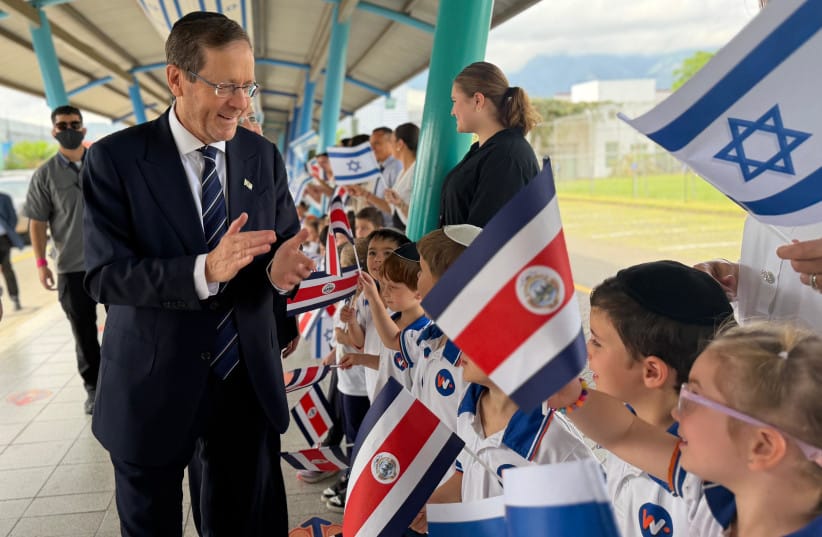 Herzog greets Jewish schoolchildren and staff at the Dr. Jaim Weizman school in San José, Costa Rica, May 7. (credit: Costa Rica: President’s Office Spokesperson)Ezra Cohen, the man
We sat down with Cohen, 66, in his well-appointed Jerusalem home just prior to Herzog’s Panama visit. With expansive views of the cityscape and the Knesset, it is situated close to the Mahaneh Yehuda market – which Cohen enthused he loves to stroll around. We admired the decor, which included bottles of “Panama” from the Psagot Winery, and multiple flags.
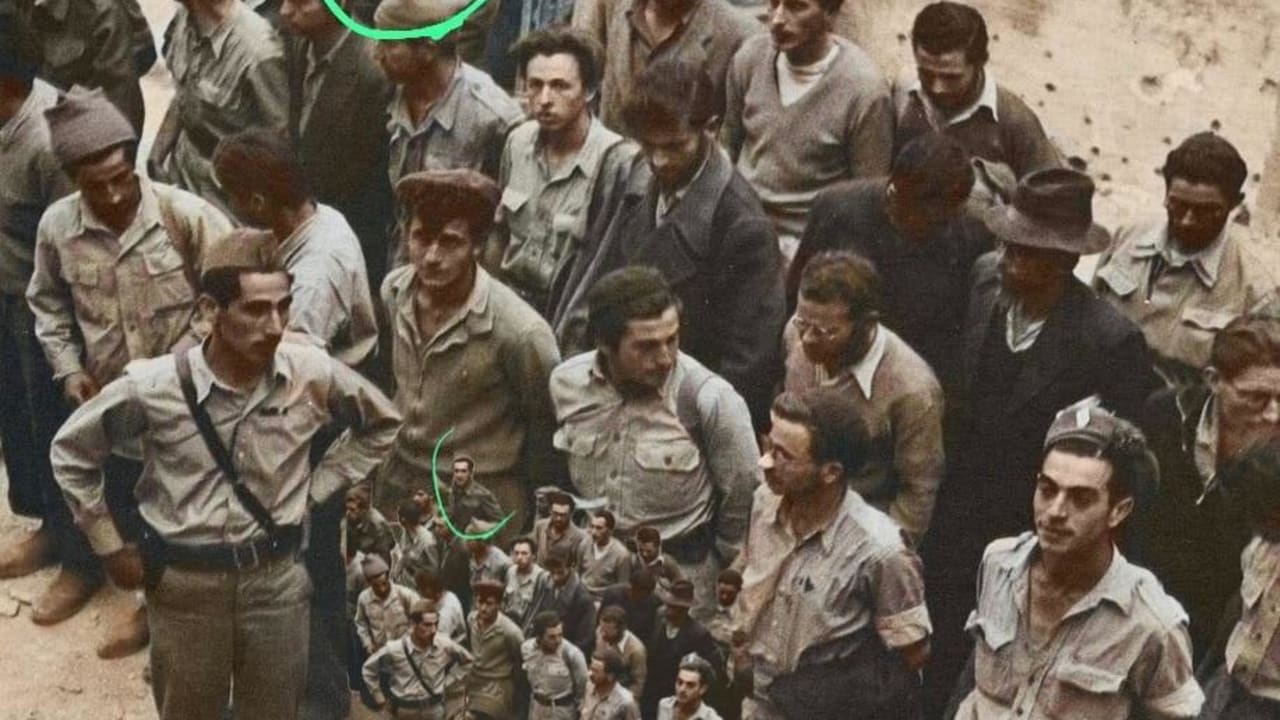
It seems inevitable that Cohen would return to serve Israel. His parents lived in the very Jerusalem neighborhood he resides in now. His father fought in the 1948 War of Independence and was taken captive as a prisoner of war by Jordan, held for nine months, subsisting on worm-infested food, and finally released in a prisoner exchange. In the 1950s, Cohen recounts with clear delight, his father and uncle both worked at The Palestine Post (now The Jerusalem Post) in the archives department.
Shortly thereafter, he went to Panama, found work, but came back to Israel to find a wife. That took him two weeks. They married three months later, and he took his bride to Panama. Cohen said his mother cried when she saw Panama and asked, “When are we going home?” But eventually they made a happy life there.
After growing up in Panama, Cohen founded 26 public and private companies, which included the first Panamanian company to be listed on the NASDAQ. His extensive experience in the private and public sectors includes consumer electronics distribution, logistics, and fostering kosher food initiatives.
“Seventy-four years later, I came back to Israel as the ambassador during the war, during the winter, to close the circle here in Panama,” he said.
Cohen and his wife, Linda, a real estate broker, make time every day to Facetime with their children and grandchildren, and they enjoy vacation visits twice a year in Israel and three times in Panama.
The ambassador’s excitement and sense of being honored to take part in pivotal events shaping the Jewish state colored our entire discussion. In May-June 1959, then-foreign minister Golda Meir visited Panama as part of a broader Latin American tour to strengthen diplomatic ties with supportive countries in the region. Sixty-seven years later, it’s more timely than ever.
First stop for President Herzog – the Panama Canal
“The president is going directly from the airport to the Panama Canal,” noted Cohen. “Of course, it’s going to be a VIP tour, so he is going to be able to go to the chamber where they control the locks – and he’s going to be able to open the locks.”
Indeed, one of Herzog’s first stops was to the Miraflores Locks of the Panama Canal, which is known as one of the most significant engineering achievements in human history and remains one of the world’s most vital strategic waterways.
“This is a beautiful example of how to lead and enable freedom of navigation and maritime freedom, as opposed to what we see in the Straits of Bab al-Mandab in the Red Sea or in the Strait of Hormuz in the Gulf,” the president said at the Panama Canal, calling the situation with Iran at the Strait of Hormuz “the antithesis.”
“This is the other example,” he said. “We must all stand up firmly against any blockage of maritime capability and movement around the world.”
He also noted that Panama “understands, perhaps better than anyone, the vital importance of freedom of navigation and why it is worth fighting for.”
The canal opened on August 15, 1914, connecting the Atlantic (via Limón Bay) to the Pacific (near Panama City). With approximately 14,000 annual transits, the canal shortens routes dramatically (e.g., New York to San Francisco saves about 8,000 nautical miles vs Cape Horn) and is vital for US trade, grain, containers, and auto shipping. It is also a moneymaker for Panama; in 2025, it generated a record $5.7B in tolls.
According to the ambassador, 7% of world commerce traverses the canal.
After the red-carpet airport welcome, Herzog, and wife, Michal, were taken to the Presidential Palace (Palacio de las Garzas) for an official meeting with Panamanian President José Raúl Mulino, his wife, Maricel de Mulino, and government officials.
Then it was on to Panama City, where he met with leaders and members of Panama’s Jewish community (which, not counting Mexico, has Central America’s largest community of Jews).
The US and Panama first established diplomatic relations in 1903, after Panama separated from Colombia, with US support. The Hay-Bunau-Varilla Treaty granted the US rights to build and control the Panama Canal and a surrounding Canal Zone in perpetuity. Under presidents Jimmy Carter and Omar Torrijos, the Torrijos-Carter Treaties (Panama Canal Treaty and Neutrality Treaty) transferred full control of the canal to Panama on December 31, 1999.
Just 10 years before, the US launched Operation Just Cause, invading Panama and removing military leader, drug trafficker, and de facto dictator Manuel Noriega, to protect US citizens and restore democracy to Panama. Free elections have been held in Panama ever since. (There is a deeper story involving the CIA unseating Noriega, Cohen noted, and interested readers may listen to one of many podcasts on the subject.)
A major geopolitical and commercial dispute surfaced in 2025 over control of two key container ports at the entrances to the Panama Canal – Balboa on the Pacific side and Cristóbal on the Atlantic side, which had operated for decades by a subsidiary of Hong Kong-based CK Hutchison Holdings.
In early 2025, US President Donald Trump claimed China was “running the Panama Canal” and vowed to “take it back.” He put pressure on Panama to reduce perceived Chinese involvement with the ports.
The Supreme Court of Panama eventually ruled the concession contracts with CK Hutchison unconstitutional and annulled them. Panama then took back control of the ports and granted temporary (18-month) operating contracts to Maersk (Balboa) and MSC (Cristóbal).
The situation is yet unresolved and still highly contentious – a proxy battle in the US-China rivalry over strategic maritime infrastructure and delaying inspections to slow international commerce. Panama has tried to balance relations with both superpowers while asserting sovereignty.
Panama and Israel – friends from the beginning
The friendship between Panama and Israel began in November 1947, with Panama’s vote in favor of the UN Partition Plan (Resolution 181). On June 18, 1948, just one month after Israel declared independence on May 14, Panama was one of the first countries in Latin America to offer support to the nascent country, issuing Resolution No. 1856, which recognized Israel as a “sovereign state, fully invested with international personality.”
During the 1948 War of Independence, Panama also facilitated the transfer of aircraft to Israel.
“I think this trip sends an even stronger message,” Cohen observed. “Israel, due to the [recent war with Iran], has realized who its real allies and friends are, as many of them turned their back during these last days. Panama, from Israel’s inception as a state, today and tomorrow will always be an ally to Israel.” While Cohen stressed that Panama prides itself in its neutrality, he noted that it has never supported the Palestinian Authority, and never will.
History of Jewish Panama
Jews arrived in Panama shortly after Spanish colonization in the early 1500s. The first arrivals, fleeing the Spanish and Portuguese Inquisitions, were conversos and marranos (crypto-Jews) – Jews forcibly converted to Catholicism but secretly practicing Judaism.
“Jewish members were part of the foundation of Panama,” Cohen said. “They were part of the designing of the flag of Panama, and were part of the establishment of the firefighters unit in Panama. So Panama and the Jewish community go back… way, way back.
“Do you know which year the first Jew arrived in Panama? 1501,” he noted. “We have the Panamanian Jewish Museum, which tells you the story about Panamanian Jewry in those days.”
Cohen said it’s documented that at 4 a.m., during the High Holy Day season, a man would walk the streets in the Jewish neighborhood, shouting, “Selihot, Selihot!”
Panama had three waves that brought Jews to its shores, according to Cohen. “First, were Jews escaping the Spanish Inquisition, the second were Jews fleeing Europe during World War II, and the third influx were Syrian Jews.”
Cohen estimates there are currently 14,000 Jews living in Panama: 10,000 Sephardi; 2,000 Ashkenazi; and 2,000 Reform.
Other estimates differ slightly, estimating between 10,000 and 12,000 Jews living in Panama. Either way, Panama is the clear leader, with the largest Jewish population in Central America (many do not count Mexico, which has around 40,000, as Central America). Costa Rica, for its part, has around 3,000 Jews, primarily in San José.
In South America, the Jewish population is more robust. Argentina leads with approximately 180,000 Jews, according to population estimates, followed by Brazil with around 120,000, Uruguay with 16,000, and Chile with 15,000-20,000. (These figures are from sources such as the American Jewish Year Book / demographer Sergio Della Pergola estimates.)
“Panama and Israel are two nations, very small in size, but very big in heart,” Cohen said. “They are looking to cooperate and work together for the betterment of the entire world.”
He said Israel’s policy this year is to strengthen its relationship with Latin American countries. “We have seen the result of the last elections, and countries like Bolivia and Chile, which were against Israel, now, with their new governments, are looking to establish very strong relationships with Israel.”
As a businessman, he understands Panama’s potential as a Jewish destination. With 52 kosher restaurants and 16 synagogues, Cohen pointed out, Panama is not only warm and welcoming to its resident Jewish communities – with Punta Paitilla its largest neighborhood – but is also an easy-to-access vacation paradise.
With its beautiful beaches, lakes, and parks, and a short plane ride from Miami, Cohen would like to see his country become “the next Thailand” for Israelis looking for a beautiful – and secure – place to visit. Moreover, Anglos will be happy to know that about 80% of Panamanians are fluent English speakers.
Herzog’s office agrees, stating that the country has “tremendous tourism potential.”
The beachside Playa de Nado – Deer Beach – is, in fact, home to about 300 Israelis, Cohen said, and has become the most expensive place to live in Panama, at $6,000 per square meter.
The restaurants in Panama, according to Cohen, are of high quality, with outstanding kashrut standards – not to mention outstanding steak at affordable prices that would put Israelis in happy sticker shock. “When you have 52 restaurants for a population as small as the Jewish community in Panama, you realize that 70% of the customers are not Jewish but still patronize these restaurants. So they have very high culinary and cuisine standards, with low prices because of the competition.”
While Panama is primarily a Christian country, it is also home to about 15,000 Muslims, who, according to the ambassador, are peaceful neighbors.
Mutual interests
Cohen is forging more than just tourism exchanges between Israel and Panama. He said there are numerous opportunities to share interests and many opportunities for cooperation.
“Israel, for example, doesn’t have water,” he explained, “yet it’s excellent at managing water, so we must combine the two elements. Also, in terms of security, we have the canal, which we need to protect, so we’re looking for ways to ensure that it is safe, not only from imminent attacks but also from cyberattacks.
“These are areas that Israel is expert at, and we look forward to working with Israel’s expertise. We are signing a G-to-G [government-to-government] agreement.
“Each government will assist the other in different areas,” he elaborated. “For example, Israel needs workers for agriculture and construction. We have many workers in those fields.
“At the moment, we have less than 50 people working in Israel. We want to extend that to a substantial number.
“We are also trying to look for solutions for the administration of the hospitals in Panama, administrative systems of medicines, inventory level, logistics, etc.,” he said. “Israel is an expert. So those are some of the areas we are looking to discuss during this trip.”
Drones, doctors, and dairy: the ultimate exchange
“Four months ago,” the ambassador said, “the Minister of Education of Panama, Lucy Molinar, came [to Israel] for an AI conference, and we took her to meet educators at some universities in Israel. She forged relationships with Ben-Gurion University and the University of Ariel, where they will be conducting exchange programs and creating scholarships in the fields of medicine and technology.”
Israel has also arranged fellowships for Panamanian doctors at Hadassah-University Medical Center and Ichilov Hospital.
“Israel and Panama are both active and doers,” Cohen added. “There are a lot of things we have in common, and much we can do together.”
Panama is also interested in inviting Israeli technology companies, cybersecurity, and drone companies to explore opportunities for mutual trade.
“We share two borders with Colombia and Costa Rica, with lots of coastal waters, and surveillance is important, so it’s very much necessary to have drone surveillance systems, which Israel is an expert at,” he noted.
With Panama playing in the 2026 FIFA World Cup, the countries have arranged for the Panama soccer team to visit Israel. And they are working on more campaigns to encourage tourism in both directions. “As of now, we lack a direct flight,” the ambassador conceded. But he is hoping to change that, so what should be a 13-hour flight isn’t longer with stopovers.
As for the general temperature of the Panamanian public, Cohen said, “Since the Oct. 7 war, Israel has been in the headlines every day. Unfortunately, Israel is losing the media war because of the numbers, but in general the atmosphere in Panama is that Israel has always been an ally to Panama. And Panama has been an ally to Israel. So, there is a good feeling toward one country
to the other. And it goes in both directions.”
Unlike Jews in other countries rushing to make aliyah, the ambassador said Panama’s Jews are not leaving in huge numbers, since Panama has a healthy economy and very little antisemitism. Still, he noted, some Panamanians are buying vacation apartments in Israel.
President Herzog’s trip to Costa Rica
“The future of Israel-Latin America relations is looking very bright,” a spokesperson for President Herzog’s office volunteered.
After the Panama visit, President Herzog concluded his official visit to Central America after attending the inauguration ceremony of President Laura Fernández Delgado of Costa Rica on Friday, and meeting with a series of world leaders in San José. His trip also included a visit to the Centro Israelita Sionista de Costa Rica, or Israelite Zionist Center of Costa Rica, where Herzog treated the warm community to a reading of the weekly haftarah portion.
“From the president’s point of view, his trip recognized a very strong momentum in Latin America,” the spokesperson continued. He said Herzog was welcomed with cheers and received an extremely warm welcome when his name was announced and as he entered the stadium for the inauguration.
This trip comes on the heels of Argentinian President Javier Milei – known for his vocal support for Israel – becoming the first head of state and first non-Jew to receive the Genesis Prize (often called the “Jewish Nobel”), a $1 million annual award from the Genesis Prize Foundation. It recognizes outstanding achievements and contributions to the Jewish people or humanity, inspired by Jewish values. Herzog presented him with the award.
Milei donated the $1 million to launch the Isaac Accords initiative, which he models after the Abraham Accords, to boost diplomatic, security, financial, and technology ties between Israel and Argentina. Hopefully, other Latin American countries will join the initiative.
Can you spare a grand for a Panamanian Geisha coffee?
Another promising development: Panama has been known for growing coffee, but in the last decade coffee growers discovered a new seed, according to Cohen. “They tried it and industrialized this seed, and named it Geisha. The taste of this coffee is more fruity and not as bitter as regular coffee. The Asians discovered this taste and went crazy for it.”
He pointed out that Asians typically don’t drink coffee because they don’t like the bitter taste, so they drink tea, but Geisha coffee is a tea-flavored coffee.
“The problem is that the demand exceeds the supply,” he said. “Last year, at the Dubai Coffee Conference, we sold a kilogram for $30,000. So Dubai coffee shops are offering Geisha coffee for $1,000 per cup, which is bringing the coffee industry in Panama to a higher and different level.
Coffee growers have a very nice experience of visiting and explaining how is it done, and it’s very interesting.”
He added that he strongly recommends that Israelis visit Panama and tour its coffee-growing industry (even if you can’t afford to purchase a cup of Geisha coffee).
As for Israeli coffee? The ambassador enjoys a strong cup but drinks it with Remilk – and, much in character, is trying to bring the lactose- and cholesterol-free dairy milk company to Panama’s shores.