
Have you ever driven in thick fog? It’s not something Israelis encounter often, but anyone who has knows how dangerous and disorienting it is – much like the current ceasefire, where no one can see what lies ahead.
For the past few weeks, since the truce with Iran, Israelis have been navigating a reality defined less by what is known and more by what is unknown. The questions dominating conversations are not abstract policy debates; they are immediate and deeply personal.
Will the conflict reignite in full force? Will more reservists be called up, and for how long? Will the home front face another wave of ballistic missiles or cluster munitions? Will the region’s nuclear ambitions be contained? Will political leadership – here and abroad – provide clarity, or will ambiguity remain the default?
Most Israelis understand that the war with Hamas is not over – it is simply paused while the confrontations with Hezbollah and Iran continue. Many commentators have noted that Israel’s stated goals include dismantling Hezbollah’s military capabilities and securing the surrender of Tehran’s nuclear materials. Yet as I write this, reporting and analysis widely suggest that the Iranian leadership shows no indication of stepping back from its nuclear ambitions.
In the North, Israel agreed to a temporary ceasefire with Lebanon under pressure from the Trump administration. One condition was that if Hezbollah violated the ceasefire – which was made with the Lebanese government – Israel could respond as long as its actions remained south of the Litani River. Violations are occurring daily, and despite the IDF’s responses, soldiers and civilians in northern Israel continue to live with significant danger.
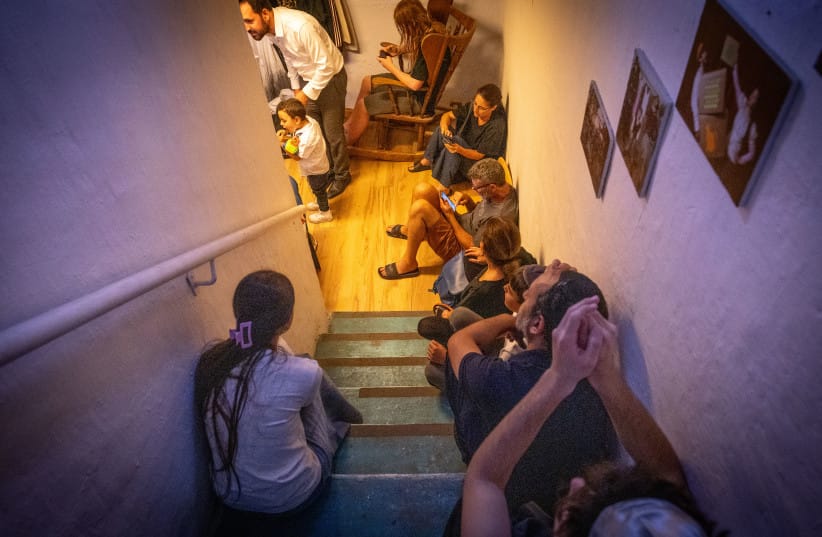 Israelis take cover in a public shelter in Jerusalem, during a ballistic missile attack fired from Iran into Israel June 13, 2025. (credit: NOAM REVKIN FENTON/FLASH90)
Part of the emotional strain comes from the dissonance between the constant flow of statements and the scarcity of real clarity. Israelis listen to pronouncements from Washington, Jerusalem, military officials, analysts, and foreign leaders – and yet the picture remains blurred. Some Israelis are trying to interpret signals that come from the local and foreign media in an attempt to figure out what is going on, while others prefer to live as normally as possible and minimize focus on the media. Israel’s emotional state is a mix of anxiety, fatigue, and confusion about where the events are heading.
A country holding its breath
Perhaps the most accurate description of the national mood is that Israel is holding its breath. Not in fear, but in anticipation. Not because people expect catastrophe, but because they know the coming months will be consequential. The uncertainty is not paralyzing, but it is pervasive. Israelis are not waiting for perfect clarity – they know better than to expect that. Until things become clearer, the emotional state of the country will remain what it is now: a blend of vigilance, fatigue, resilience, and a quiet longing for a future that feels less like a fog and more like a horizon.
Coping with today’s uncertainty
During this time of not knowing, the most beneficial way to cope is to narrow the focus to what is within our reach – daily routines, family and community, and the small things that create a feeling of stability and staying grounded. Although it will not change anything, having something close to you that is a solid foundation to stand on helps us cope with the uncertainty that lies ahead. For many Israelis, that means focusing on familiar rhythms: going to work, checking in on neighbors, keeping family rituals intact, and finding moments of normalcy even when the broader situation feels anything but normal. And, my advice is to take a break from the news and all those podcasts.
Emotional strength is reinforced by making connections. Talk with others. Sharing feelings can help other people feel less alone in the fog. Sharing worries, comparing interpretations, or simply acknowledging the strangeness of the moment creates a sense of collective steadiness. And while no one can control the geopolitical landscape, individuals can still choose how they show up for one another: with patience, with empathy, and with the quiet reassurance that uncertainty is easier to handle when it is carried together.
Coping, in this sense, is not about ignoring the fog or pretending it isn’t there. It is about finding a way to move through it – one step at a time, one day at a time, until the fog begins to lift and the sky becomes visible again. I hope that we can help one another by supporting each other, listening to each other, and trying to believe that there will be a positive outcome to all of this craziness.■
The writer is a senior psychotherapist with over 40 years of experience helping individuals, couples, and families cope with stress, trauma, and the emotional impact of crisis and war. He sees clients in his Ra’anana clinic, also offering online therapy in Israel and worldwide. drmikegropper@gmail.com; facebook.com/drmikegropper