 Listen to this article
 The current legal challenge to the independence of the Board of Governors of the Federal Reserve System recalls the work of a Massachusetts senator, John Wingate Weeks, who played a quiet but important role in the birth of the Fed.
The Supreme Court recently heard argument in Trump v. Cook, which tests the president’s power to fire members of the board. The history of the Federal Reserve System may loom large in the court’s review of the removal issue.
In the heated debate over the creation of the Fed from 1908 to 1913, Weeks served as a bridge between progressive and conservative factions in the Senate. While supporting a new central banking system, Weeks sought to retain features of private banking. The private features of the current system may support a ruling by the Supreme Court that protects the board from unlimited presidential control.
Weeks was born in 1860 on a farm near Lancaster, New Hampshire, in the heart of the White Mountains. He graduated from the U.S. Naval Academy in 1881 and served in the Navy for three years.
After moving to Boston, he co-founded the investment firm Hornblower & Weeks in 1888. The firm grew in wealth and influence, first with offices at 51 and 53 State St., then 60 Congress St., in Boston, and then across the country.
According to the Bulletin of the Business Historical Society, “From the first, the firm carried on a commission business, buying and selling on order, but it also soon began to participate in the underwriting and original distribution of new securities. … [It] managed the consolidation of many small lines to form the Boston & Maine Railroad. In the 1890’s it was very active in the copper share market, for which Boston was a center. After the turn of the century the firm took the leading part in bringing about the merger (in 1903) of the old Massachusetts National Bank and the First National Bank of Boston.”
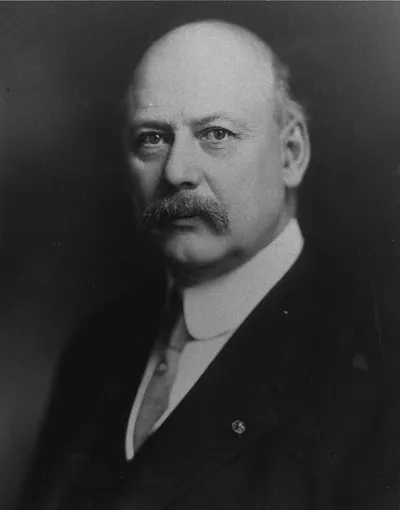 John Wingate Weeks | 1860-1926 (U.S. SENATE HISTORICAL OFFICE)
Meanwhile, Weeks and his family settled in a house on Lenox Street in West Newton. He became an alderman (1902-1903), then mayor (1903-1904). In 1904, Weeks was elected to Congress as a Republican. His investment and banking acumen led to work on the pressing financial issues between the Panic of 1907 and the adoption of the Federal Reserve Act in 1913.
After the Panic of 1907, Weeks made several proposals to avoid similar panics in the future. He delivered a major congressional speech in 1908 on the subject. Weeks favored the creation of private bank associations that could issue emergency currency in the form of certificates, with the approval of the secretary of the Treasury, based on its holdings of securities, including commercial paper. The resulting act, known as the Aldrich-Vreeland Act, codified the concept of private associations of banks to be known as “National Currency Associations.”
Another part of the same act promised a continuing role for Weeks: It established a “National Monetary Commission” to continue the study of currency reform and consider the establishment of a central bank. Weeks was named to the commission.
The commission issued a plan proposing a central bank known as the National Reserve Association with 15 branches, all owned by private banks within the system, and a flexible currency based for the first time on commercial assets of banks.
Weeks had a particular interest in the relationship between government and the proposed “central bank.” In his unpublished dissertation “The National Career of John Wingate Weeks (1904-1925),” Benjamin A. Spence writes that Weeks was “wary of too much government involvement in or control of the new system, lest the dictates of politics become all-pervasive. … Weeks did not object to the Governor of the Association being chosen by the President of the United States, but agreed with the stipulation that the selection would be made from a list submitted by the Board of the Association, the majority of directors of which would be chosen by the banks in the system. That is, this was to be a centralized banking structure mainly controlled by private banking interests subscribing to its stock.”
Spence quotes Weeks: “If the powers especially conferred in the Act, … were reserved to Congress, it would do exactly what we have been endeavoring to prevent; that is, it would be likely to keep the bank and its operations in politics.”
Weeks, did, however, support the placement of Cabinet members on the board of the association and the power of the president to remove its governor. This melding of public and private interests became a key battleground two years later in debates over the creation of the Fed.
The election of 1912, however, which placed the Democrats in control of the House and Democrat Woodrow Wilson in the White House, would greatly affect the politics of the debates.
In 1913, Congressman Weeks was elected to the U.S. Senate by the Massachusetts Legislature, the last person to be elected by the Legislature before the direct election of senators required by the 17th Amendment.
One hundred and thirteen years later, the quasi-private features retained in the 1913 design of the Fed may now be keys to pending judicial questions regarding the independence of the board and the Federal Reserve System.
Spence details the work of Weeks on the issue of a central bank in that pivotal year. Spence explains that much of Weeks’ work took place behind the scenes, while the leading figures — Congressman Carter Glass, Sens. Nelson Aldrich and Robert Owen, and, later, President Wilson and Treasury Secretary William G. McAdoo — battled over different bills.
In the final debates, however, Weeks played a more public role, speaking in the Senate on nine different days. On the final vote, Weeks was one of only five Republicans who voted in favor of the Federal Reserve Act.
Spence summarizes Weeks’ role as follows: “He did not approve of some of its essential features but realized that it was far superior to the national banking system with its lack of monetary and credit flexibility. Although the final measure was essentially like the Glass-Owen bill which Weeks had criticized in the summer of 1913, literally hundreds of amendments had strengthened the Federal Reserve Act. … His insistence on hearings … most likely provided the time to make changes, many of which he himself suggested. … Weeks had shown once more that a conservative could indeed play a constructive role in the age of progressive reform.”
One hundred and thirteen years later, the quasi-private features retained in the 1913 design of the Fed may now be keys to pending judicial questions regarding the independence of the board and the Federal Reserve System.
To this day, the Fed retains a quasi-private character reflected by its 12 regional Federal Reserve Banks, in which private member banks hold stock and elect some of the directors of each.
In its May 2025 order in a case involving the removal of a member of the National Labor Relations Board, the Supreme Court stated: “The Federal Reserve is a uniquely structured, quasi-private entity that follows in the distinct historical tradition of the First and Second Banks of the United States.” This statement echoes its 2020 decision in Seila Law, in which the court stated that “financial institutions like the Federal Reserve” may be able to “claim a special historical status.”
These statements suggest that the dogged work of Sen. Weeks and others to preserve some private aspects for the Fed may inform the court’s review of the Fed’s current relation to the president.
Weeks received votes at the Republican presidential convention of 1916 but lost the party nomination to Charles Evans Hughes, who lost to Wilson in the general election. Two years later, Weeks was defeated for re-election to the Senate by popular vote.
He returned to office, however, serving from 1921 to 1925 as secretary of war. He died in 1926 at his summer home in Lancaster, now the Weeks House Museum on Mount Prospect in Weeks State Park.
He is best known today for the Weeks Act of 1911, which authorized the federal government to purchase land for the creation of national forests such as the White Mountains National Forest, an evergreen legacy from Weeks to all who love hiking New Hampshire’s peaks.
Soon after his death, the John W. Weeks Bridge over the Charles River was dedicated. The span was funded by friends of Weeks including his former partner, Henry Hornblower. It is a favorite perch for spectators at the Head of the Charles Regatta, though also the bane of coxswains as they navigate their shells between its piers.
It is fitting that Weeks is honored in this way, as he was a “bridge” between the Democrats and Republicans who forged the final plan for the Fed. The quasi-private features of that plan may yet preserve for the Fed a measure of independence from unlimited presidential control.
Thomas A. Barnico teaches at Boston College Law School. He is the author of “War College,” a novel set in the Vietnam War era.