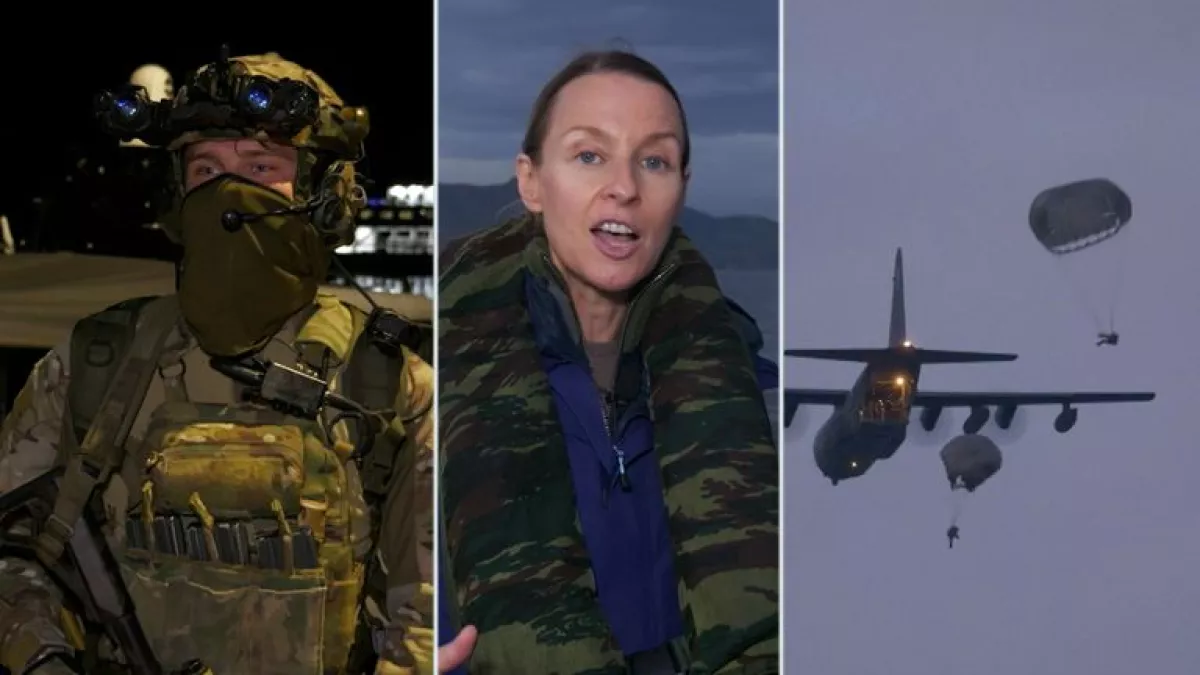
A 10-day NATO special forces exercise involving 10 countries is underway across Europe, with NATO special forces parachuted onto Greece’s coastline, even as US President Donald Trump reduces military support for allied deployments.
The exercise, spanning land, sea and air operations across 10 countries, is NATO’s largest special forces drill in Europe and is designed to test responses to so-called “grey zone” threats — including sabotage, cyber operations and covert infiltration by an unnamed adversary, widely understood to be Russia, Caliber.Az reports, citing foreign media.
Some 3,000 elite troops from the United States, the United Kingdom and 22 other nations are taking part in the drills, which simulate responses to attacks below the threshold of full-scale war.
The significant US participation underscores Washington’s central role in European defence, even as concerns grow among allies over the long-term reliability of American commitments.
During one maritime training scenario observed by Sky News off the coast of Greece, US personnel launched inflatable boats from a military aircraft before parachuting into the sea alongside Greek special forces. The teams then retrieved their equipment, reached shore and conducted a simulated covert assault on a naval facility occupied by suspected hostile forces.
The exercise, part of the wider operation known as “Trojan Footprint 2026”, also involves British troops from the British Army Ranger Regiment, alongside forces from partner nations including Switzerland and Georgia.
Participants are tasked with locating and neutralising a “high-value target” in a simulated hostile environment, using drones and other advanced systems to support operations.
A Greek special forces participant, speaking anonymously, described the training as valuable preparation for real-world missions and said cooperation with US forces felt seamless.
Asked whether European forces could conduct such operations without US support, he said: “Yes of course.”
The exercise comes amid growing uncertainty among European allies about Washington’s future defence posture. The Pentagon has already cancelled a planned deployment of 4,000 US troops to Poland and reduced other rotational deployments in Europe, including planned movements affecting the Baltic states, Romania and Germany.
US officials have also confirmed plans to withdraw 5,000 troops from Germany over the next year, moves that have intensified debate within NATO over burden-sharing and long-term deterrence.
By Bakhtiyar Abbasov