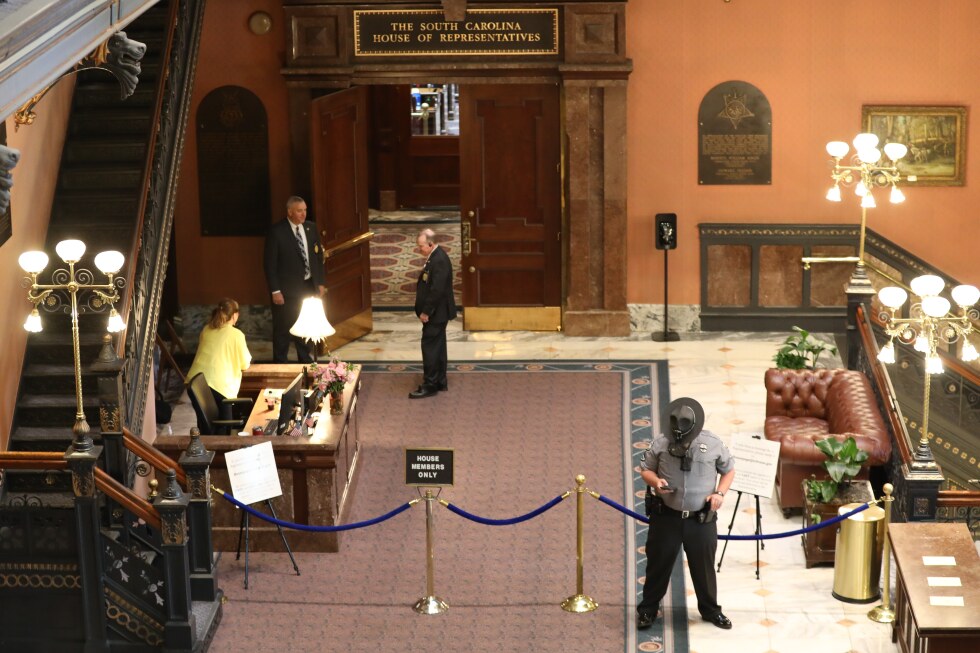
COLUMBIA, S.C. (AP) — An effort to reshape South Carolina’s congressional districts will get its first full airing Monday in the state House, as lawmakers launch a lengthy and potentially testy discussion on whether to accede to President Donald Trump’s desires for a U.S. House map that could yield a clean sweep for Republicans.
Tense debates already have played out in Tennessee, Alabama and Louisiana as Republicans push aggressively to leverage a recent U.S. Supreme Court ruling that weakened Voting Rights Act protections for minority districts. The ruling has opened the way for Republicans to redraw districts with large Black populations that have elected Democrats.
In South Carolina, that means targeting a seat long held by U.S. Rep. Jim Clyburn, the only Democrat among the state’s seven representatives in the House.
Clyburn has said he has no intention of retiring, even if his district gets changed. He told reporters last week in Washington that he has addresses in Columbia, Charleston and Santee, adding: “I live in three districts. I’ll decide which one to run in.”
“It ain’t about Jim Clyburn’s district,” he said. “This isn’t about voting. This is about turning the clock back to Jim Crow 2.0.”
Early voting is scheduled to begin May 26 for South Carolina’s statewide primaries on June 9. In addition to redrawing congressional districts, legislation pending in the state House would move the U.S. House primaries to August. If it clears the House, the legislation then must go to the Senate.
Republican Gov. Henry McMaster, who called lawmakers into a special session on redistricting, said it is important for South Carolina to send as many Republicans to Washington as possible to try to prevent Democrats from taking control of the House and attempting to impeach Trump.
But some Republicans have expressed concern that an attempt to draw 7-0 House map for the party could spread Republican voters too thin, making some existing Republican-held districts susceptible to Democratic victories.
Republicans are ahead in the national redistricting battle thus far. Since Trump urged Texas Republicans to redistrict last year, Republicans think they could gain as many as 15 seats from new House maps in Texas, Missouri, North Carolina, Ohio, Florida, Tennessee and Alabama. Democrats, meanwhile, think they could gain six seats from new maps in California and Utah. But litigation is ongoing in some states, and voters will have the final say on who wins.
___
Lieb reported from Jefferson City, Missouri. Associated Press writer Lisa Mascaro contributed from Washington.