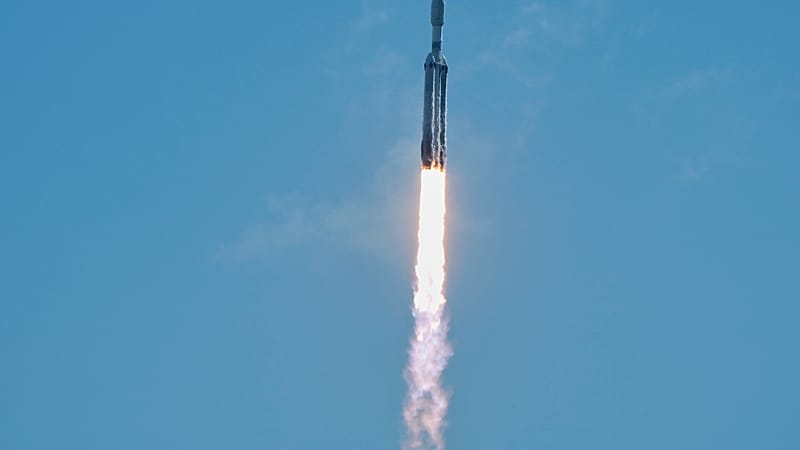
SpaceX founder Elon Musk announced plans on Wednesday for one of the biggest stock sales ever, by taking a space company public that is currently losing billions of dollars a year.
A filing shows that SpaceX lost $2.6 billion (€2.24bn) from operations last year on $18.7 billion in revenue, and the losses continued at the start of this year.
The prospectus did not put a dollar figure on the amount Musk hopes to raise, but various reports have estimated it at around $75bn (€64.5bn). An offering of that size would easily surpass the current title holder, Saudi Aramco, the oil giant that went public seven years ago and raised $26bn (€22.4bn).
SpaceX, formally known as Space Exploration Technologies Corp., said the money will help finance projects to put people on the Moon and Mars, as part of its goal to make humans an interplanetary species in the face of existential threats that could wipe out civilisation.
Related
“We do not want humans to have the same fate as dinosaurs,” the filing states.
The prospectus reads, in part, like a Hollywood-style vision of the future, detailing in one section that part of Musk’s compensation will be granted only if he maintains “a permanent human colony on Mars with at least one million inhabitants.”
Short of that, the stock sale alone could make Musk — the founder and a major shareholder of SpaceX — the world’s first trillionaire. Forbes currently estimates his net worth at $839bn (€722bn), roughly equivalent to Poland’s annual GDP.
Losses mount despite strong revenue and Starlink growth
In addition to making reusable rockets to send astronauts into orbit, SpaceX has other businesses, some successful and others struggling, with plenty of question marks.
The document shows that Starlink, the world’s largest satellite communications company, is a major source of cash, generating $4.4bn (€3.8bn) in operating income last year. The business uses 10,000 satellites in low orbit to provide internet service to 10 million people in 150 countries and territories.
Among the struggling businesses are two Musk ventures recently acquired by SpaceX — his social media platform X, formerly Twitter, and his artificial intelligence firm xAI. Those purchases were criticised by some SpaceX investors as bailouts, as both are significant loss-makers.
The prospectus said its AI business lost $6.4bn (€5.5bn) from operations last year.
The original SpaceX business — building rockets and conducting launches — has benefited from major government contracts, raising questions that could come back to affect the company. Given Musk’s close ties to the Trump administration, government ethics lawyers and watchdogs have questioned whether he received preferential treatment in securing taxpayer-funded contracts, and whether that support will continue once Donald Trump leaves office.