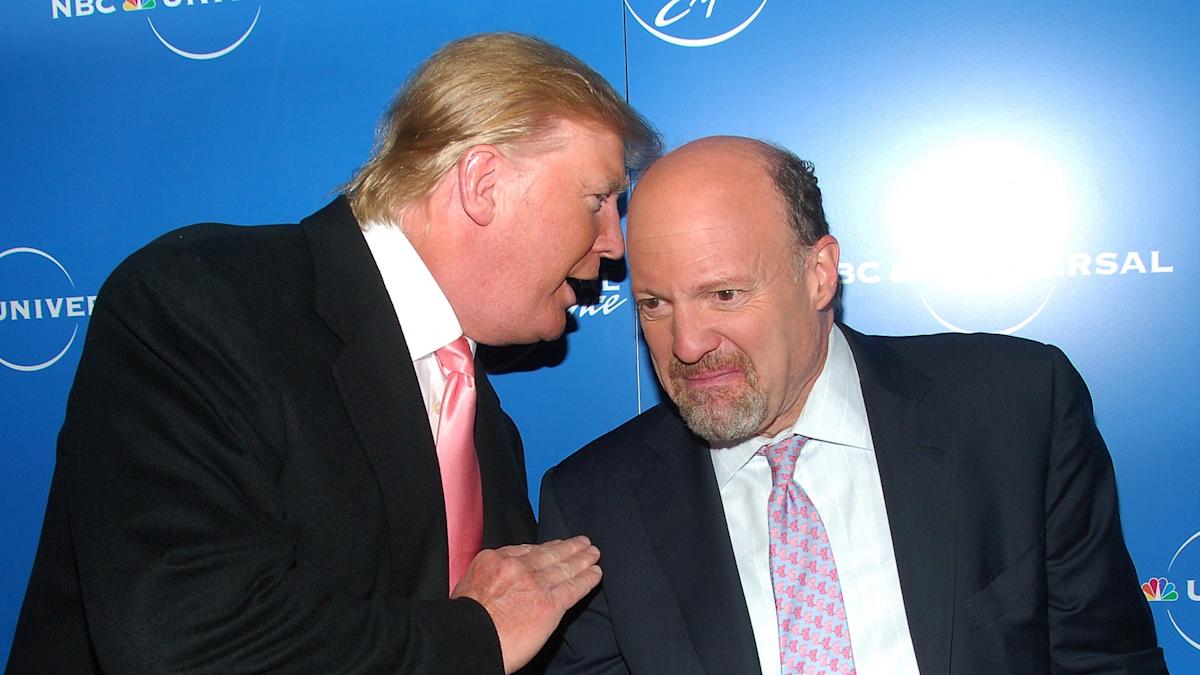
Jim Cramer has an opinion on nearly everything. But on Monday, for the first time in recent memory, he didn’t. On CNBC’s Squawk on the Street (1), co-host Carl Quintanilla noted President Donald Trump had been personally trading Intel stock in the first quarter — the same company the U.S. government took a 10% stake in last August. Cramer started to say the government might sell Intel shares to benefit Americans, but suddenly stopped talking, and said nothing coherent for 10 seconds straight.
Co-host David Faber then filled the air: “Got nothing to say?” And with Cramer still stuttering, Faber told the audience “We’re not having technical difficulties here, everybody but we gotta go.”
Cramer never really answered.
Must Read What ethics filings actually show
Last week, the U.S. Office of Government Ethics (OGE) published (2)two Form 278-T (2) disclosure reports covering Trump’s personal financial activity from January through March 2026. The documents, more than 100 pages, show more than 3,700 individual stock transactions (3). That’s more than 40 trades per market day across a three-month period.
The cumulative value of the trades is listed in broad ranges, as required by federal ethics rules, rather than exact figures. At the low end, the total exceeds $220 million. The ceiling approaches $750 million. The filings don’t specify who directed the trades, and they don’t disclose exact prices, timing within the trading day or profit-and-loss figures. The president’s assets are held in a trust managed by his children, and some transactions indicate a broker acted as an agent.
The White House said Trump’s assets are held in a trust managed by his children. “There are no conflicts of interest,” White House spokesman Davis Ingle said in a statement to CNBC (4). “President Trump only acts in the best interests of the American public.”
No charges have been filed. Under current law, presidents are not banned from trading stocks; they are only required to disclose transactions above $1,000 through OGE filings.
The companies — and the timing
What’s drawing the most scrutiny isn’t the volume of the trades, but the overlap between what Trump’s account was buying and what his administration was doing.