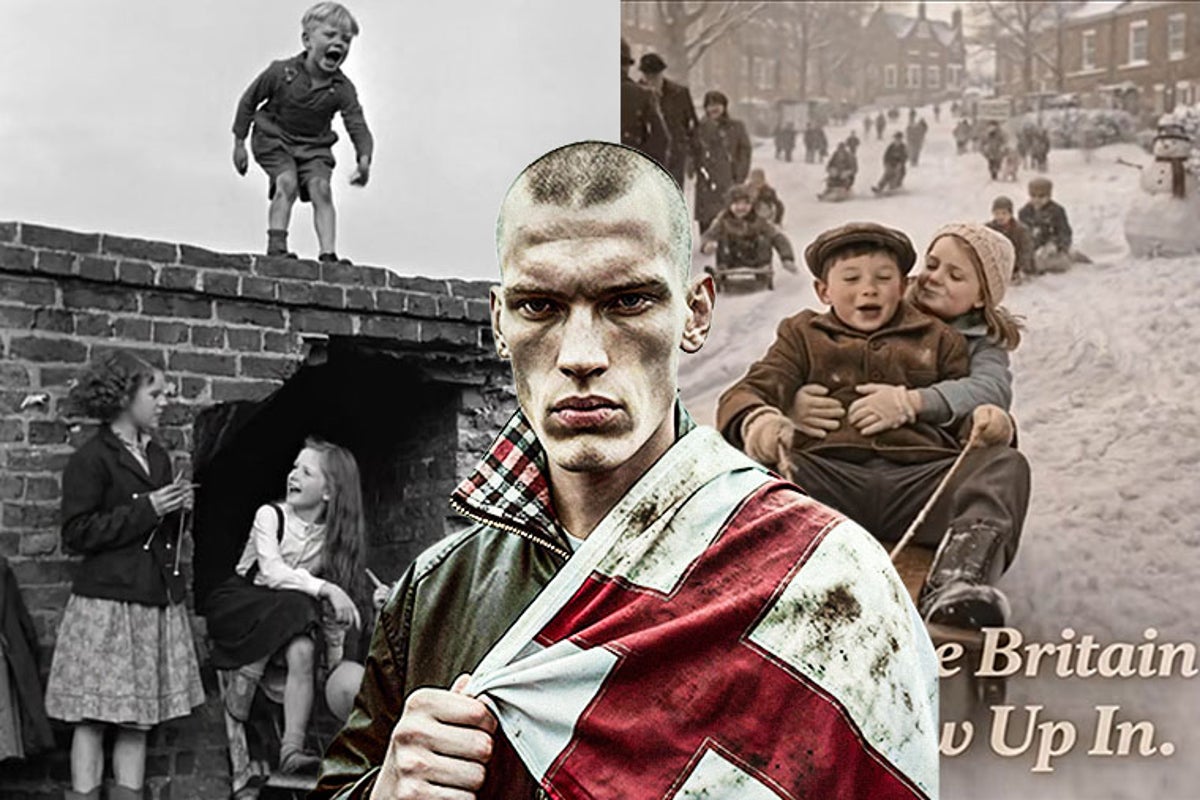
Many of the marchers at the recent Tommy Robinson’s Unite the Kingdom rally were looking backwards, not forwards.
“I want the country to go back to how it used to be,” one woman interviewed said.
It’s a common nostalgic notion that political parties – most recently Nigel Farage’s Reform UK – have been able to weaponise in their messaging. The last “A” in the Maga movement is dedicated to it as well.
Nostalgia is a powerful force in the modern world, and has found a lucrative place in the social media sphere. There is the cultural nostalgia surrounding the pre-millennium era of the Eighties and Nighties, often including clips of arcades and children playing in the street; a rosy pre-tech era ironically fed to scrollers via technological algorithms, and made using generative AI.

Keep calm and reminisce: many of the protestors at last week’s march want the country to return to its past ‘glory’ (Reuters)
But in Britain, a different type of nostalgic content emerges.
“No mobile phones. Just a thick wool coat … somehow we survived on nothing but playground games and tap water,” a dramatic voiceover reads as greyscale footage shows kids laughing and playing in a schoolyard. “No apps. No algorithms. If you remember these days, you’re one of the lucky ones.”
This clip fits nicely into the growing genre of “AI slop” and is posted on a Facebook page called “Across the UK”. Ironically, many of the people making such patriotic content aren’t from the UK to begin with. A brief look into some of the accounts show people from all over the world managing them. For instance, this UK-based page is managed from Italy, starting its life as a page called “Wanderlust Nature”. A page called “Make England Great Again” is managed from the UK. “British Aura” is run from Sri Lanka and started out as “Kitty pretty”.
The reason for such patriotism from these places? It has more to do with Meta’s monetisation scheme than their love of the UK. Facebook paid out nearly $3bn to creators last year, 65 per cent of that amount given due to engagement on reels. These pages build a following in the hopes they can meet the criteria for monetisation.
But the videos coming from such far-flung locations doesn’t stop users from reminiscing in the comment section. “We didn’t need snacks as we had good, hearty puddings,” one woman comments. “We laughed all day playing out, now most kids sit indoors on their tablet,” another writes. These people are no doubt part of the 52 per cent of Brits who Ipsos found would rather have been born in 1975 than now.

Nostalgia-slop: greyscale and sepia videos are flooding social media (Facebook)
Despite the video’s poor quality and uncanny look, in isolation, it feels somewhat harmless. It carries the hallmark characteristics of nostalgic content, sepia tones, vague allusions to the past, pulling at the viewers’ emotional connection to their childhood or past.
Agnes Arnold-Foster encountered similar tropes when writing her book Nostalgia: The History of a Dangerous Emotion. “It’s nostalgia porn,” she says of the clips, “It’s giving vague notions of what British character is,” she says, adding that vagueness is helpful when creating such content. “Nostalgia is a feeling, so it doesn’t necessarily need a lot of detail.”
Such nostalgic sentiment may make someone feel warm, but largely it relies on feelings rather than facts, with standards of living having improved. For one, life expectancy in the UK has gone up by 10 years since the 1970s. Only 37 per cent of households had central heating. Many of the videos seem to call back even further, to the notoriously hard life during wartime, but as Arnold-Foster explains, the vagueness is part of the design.
It’s hard to believe that people are consuming this material and not recognising the rhetoric at play
Agnes Arnold-Foster, author of ‘Nostalgia: History of a Dangerous Emotion’
Arnold-Foster refers to “The Bike”, the Hovis advert of a boy delivering bread, the style of which these AI videos seem to mimic. The advert is itself a glowing touchstone in UK nostalgia. “It makes older generations reminisce about simpler times. And younger generations reminisce about when they would see it on TV.”
But back on the nostalgia-slop page, and another video turns the dial up past harmless nostalgic platitudes. A boy stands in what looks more like frontier-time America than the UK. “Stand tall for the flag and do your duty,” a child says, standing alongside a grizzled man in a proud position that calls to mind old wartime posters. “It’s hard to believe that people are consuming this material and not recognising the rhetoric at play,” says Arnold-Foster.
When you see or interact with these videos, it’s not long before the algorithms serve up content more direct in its messaging. One, still warm and nostalgic, bemoans when the UK was “quieter” and had “strong borders”. In one of thousands of AI-generated “man on the street” videos that many of these “patriotic” British pages produce alongside the nostalgia-slop, a milkman – an occupation often associated with old values – moans that he’s been doing his job for 30 years and now has to deal with people he “can’t identify”, referring to muslim face coverings.
Here we see that rosy British nostalgia skewed and weaponised into the denigration of foreign “invaders” – mostly targeted at muslims.
“The thing that feels so toxic about them is the passivity,” says Arnold-Foster. “Even with particularly nostalgic history programmes, you still see the horrors of war or the hardships people had to go through.” These videos, by comparison, are frictionless. Nostalgia is about cherry-picking tropes and positive notions of a subject or time, leaving out the bad bits. Here, there are no bad bits, just pure AI-generated platitudes.
“We have an issue with the accessibility of nostalgia in general,” Arnold-Foster tells me. “How we are able to pick up our phone and be blasted with this kind of material. But also how our phone will show us slideshows of pictures of our own past.”
These slop videos aren’t a direct call to arms, but judging by the comments section, they do provoke frustrations around immigration and a country that is “changing”.
The call to arms comes courtesy of a skinhead AI-generated rapper called Danny Bones.

An AI-generated milkman complains about not being able to ‘identify’ people in the street due to Muslim face coverings (Facebook)
Among the wide-ranging coterie of guests at the Unite the Kingdom rally, Tommy Robinson introduced Bones a bit differently – on account of him not being real. He announced a performance by “the Node Project” before playing “This is England”, a song by Bones, over the speakers. The music seems to take after UK rappers such as Slowthai. The lyrics are unimaginative but pointed.
“The streets are saying that it’s Britain that we’re mourning / Benefits are ramping, the borders are opening.”
“Even the AI characters are on our side,” Robinson said afterwards.
An investigation into the Node Project and Bones by The Bureau of Investigative Journalism found that the group were paid for political campaign videos by Advance UK, a far-right party headed by former deputy leader of Reform UK, Ben Habib.
Videos by the Node Project, including Bones, are mostly quick reactionary content on a number of subjects, from the Unite the Kingdom rally to the recent Banksy statue, a testament to the rate at which AI content can be produced.

Danny Bones, the ‘patriotic’ AI-generated rapper (The Node Project)
One skit involves the rapper on a date, seemingly falling for a woman who declares that she’s “racist and proud of it”.
Many clips show Bones talking into a podcast mic – another format that people absorb passively. And, though the follower count for these accounts isn’t massive, social media algorithms ensure that many videos push past the 100,000 views mark.
And this doesn’t count those pages scattered over myriad social media platforms clipping and reposting the videos. Such is the nature of the slop trenches on apps like Facebook and X: make as many videos as possible to try and maximise engagement, either for your political mission or to make a few pounds off of it.
Among these videos, one where Bones reacts to claims that his content “radicalises boomers and pensioners”, a familiar rhetoric surfaces: “The truth is, they’re not being radicalised, they just remember. They remember what this country felt like … now they are watching it change.”