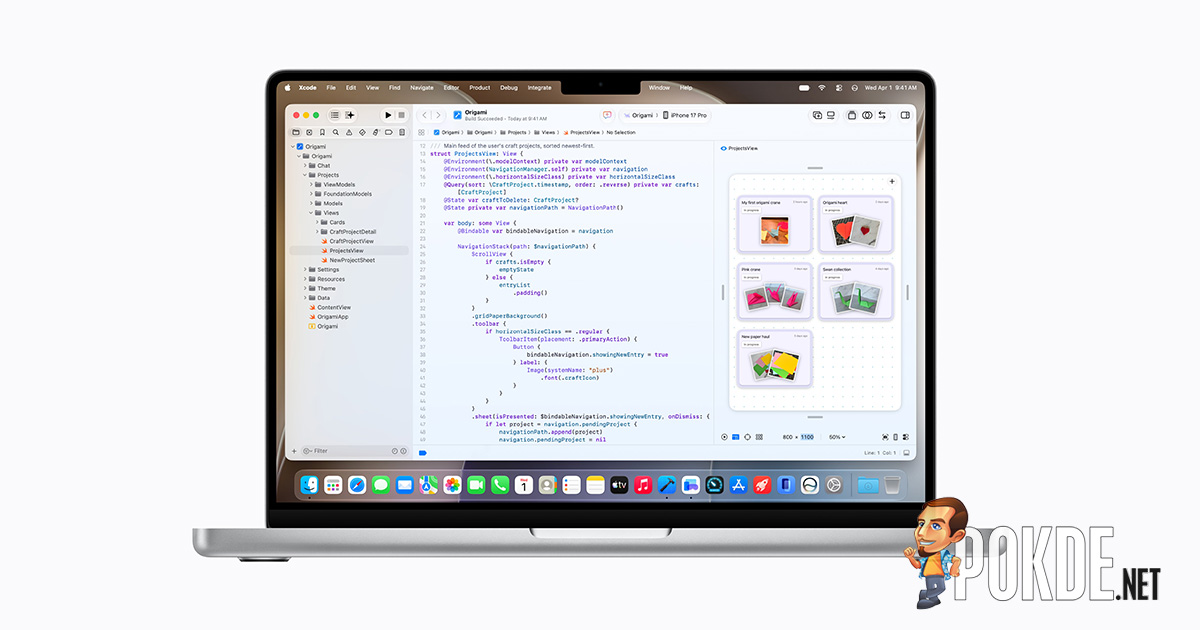
In WWDC26, Apple has introduced updates to its developer toolchain, including new intelligence frameworks, an expanded Foundation Models API, and Xcode 27 with agentic coding capabilities. At the same time, developer betas for iOS 27, iPadOS 27, macOS 27, watchOS 27, and visionOS 27 are also now available.
New AI Frameworks
The Foundation Models framework now functions as a unified Swift API supporting on-device models with image input, server-side model access, and custom skill development, built in collaboration with Google’s Gemini models. Developers enrolled in the App Store Small Business Program with fewer than 2 million total first-time downloads can access the next generation of Apple Foundation Models on Private Cloud Compute at no cloud API cost.
The framework also supports third-party models including Claude and Gemini through a new language model protocol, and introduces Dynamic Profiles for updating model behavior without app updates. A separate new framework, Core AI, is designed for running custom models on device, using an architecture optimized for Apple Silicon’s unified memory and Neural Engine to support full-scale local LLMs.
Xcode 27 & Agentic Coding Support Apple Introduces New AI Frameworks and Xcode 27 with Agentic Coding at WWDC26
New on Xcode 27 includes the integration of coding agents from Anthropic, Google, and OpenAI directly into the development workflow – conversations with said agents support interactive planning, multi-turn Q&A, and a canvas that renders Markdown alongside code changes and previews. Agents can also run autonomously by writing and executing tests, using Playgrounds for isolated testing, checking visual output via previews, and interacting with the simulator through a new Device Hub.
Xcode 27 also supports extensions via plug-ins using the Model Context Protocol (MCP), with GitHub and Figma among the first to offer integration. The application is now Apple Silicon-only, dropping support for Intel x86-based processors which allows the software to shrink 30% in size; it also now includes a customizable toolbar and a new theme system as well. Alongside that, Xcode Cloud is up to 2x faster and adds support for Metal and visionOS builds.
SwiftUI & Game Development Updates Apple Introduces New AI Frameworks and Xcode 27 with Agentic Coding at WWDC26
Apple’s SwiftUI has received performance updates, including more efficient state initialization and faster layout rendering, which requires no code changes from developers; new reorderable containers also reduce the need for custom layout code. The Spatial Preview framework allows 3D models from Mac apps to be viewed on Apple Vision Pro via streaming. Swift 6.4 introduces targeted warning suppression, simplified availability attributes, and improved compiler diagnostics.
On the game development side, Managed Background Assets now delivers localized asset packs based on a player’s detected language to cut down install sizes, while a new Steam Asset Converter assists in adapting PC games for Apple’s operating systems. Game Porting Toolkit 4 adds open source agent skills with Metal-specific guidance for Mac game development, while official Unity plug-ins from Apple now cover StoreKit and Background Assets, enabling native in-app purchase integration within Unity workflows. Reality Composer Pro 3 adds Live Previews combined with Mac Virtual Display for immediate visual feedback for developing spatial-based features.
Pokdepinion: Having coding agents that can run tests, check previews, and debug autonomously, all of which sounds like a big time-saver.