
Ericsson’s AI in RAN offers an alternative to Nokia’s tie-up with NVIDIA in the shape of a software subscription. Nokia’s approach relies on GPUs to act as a general-purpose compute fabric.
The vendor says the tech has been proven in more than 15 commercial network deployments and trials around the globe – see the quotations from operators below. Ericsson states it delivers up to 20% higher downlink throughput and up to 10% better spectral efficiency. It also supports up to twice as many high-volume users and offers coverage predictions that are 90–95% accurate, and is to up to 5x more precise about users’ positioning.
Joe Madden, Principal Analyst at Mobile Experts, says: “This could be the best ROI for mobile operators in years. With a software upgrade, operators can squeeze more capacity, better observability, and more accurate location-based services out of the 5G network they bought years ago.”
Since announcing its tie-up with NVIDIA last October and pivoting to reposition itself as an AI infrastructure company, Nokia’s share price has doubled, leaving Ericsson’s share price trailing – see below. So can Ericsson’s counter to NVIDIA/Nokia’s physical AI monetisation story succeed (not that there are any guarantees operators will buy into the GPU-in-the-RAN model)?
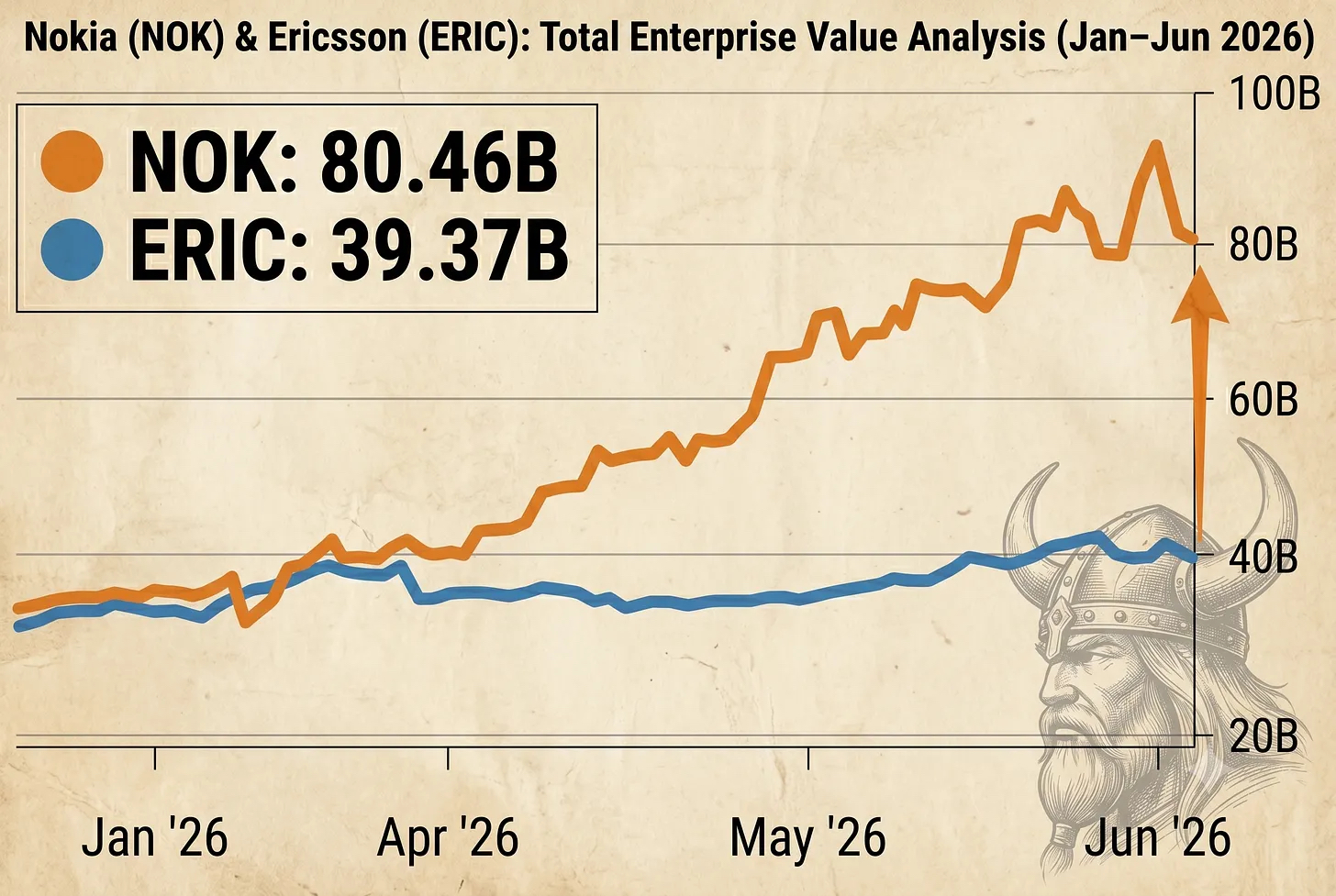
Source: Sebastian Barros, What in Valhalla is Going on With Nokia? 2X Value to 80B in 6 Months!, published 9 June 2026
Before we get going on the new AI in RAN part, Ericsson is keen to point out it has introduced AI functionality across its products since 4G, and in 2021 added AI‑ready acceleration in RAN Compute. More to the point, in February, it unveiled Neural Network Accelerators in its Massive MIMO radios, increasing AI inference capability by 10 times.
What is AI in RAN?
Ericsson’s new AI in RAN is a software subscription that “brings telco-grade AI models into basebands and radios to boost efficiency, performance, and energy savings. This commercially scalable offering gives communications service providers (CSPs) immediate benefits for 5G networks and supports the shift to AI-native RAN without requiring additional hardware.”
Ericsson AI in RAN introduces:
• Telco-grade AI models designed to run in real time within the RAN
• Continuous learning software powered by scalable, ‘high-quality’ data
• Agentic AI support for advanced RAN automation and network operations.
It works with Ericsson 5G Advanced across both purpose-built and Cloud RAN platforms to enable new AI-driven services. Some of the software features include AI-native Scheduler for Link Adaptation (see info on trial with T-Mobile US here), AI-powered Macro Positioning, AI-managed Beamforming, AI-powered Multi-layer Coordination, Performance Management Event Schema Files, and Augmented Observability for AI in RAN.
The first AI in RAN features are available in Q2 2026, with enhancements scheduled for later in the year.
What the operators say…
Teruyuki Oya, Senior Vice President & CNO at SoftBank Corp, comments, “Ericsson’s AI in RAN software marks an important step in bringing AI deeper into the radio access network. By enabling realtime optimization of radio performance, spectrum efficiency and user experience, it helps us turn AI innovation into practical value on live networks. We also see strong potential in how this foundation can support emerging AI-driven services, including Physical AI scenarios that depend on low-latency, highly reliable connectivity, and intelligent coordination between network and compute resources.”
Bruce Dean, Senior Vice President, Network Technology & Operations at Bell, is also in favour, “At Bell, we’re continuously evolving our network to meet growing demand for high-performance, AI-driven services. Integrating AI directly into the RAN is an important step in making networks more intelligent and efficient. Working with partners like Ericsson, we’re bringing these capabilities into our network to enhance performance, improve energy efficiency and deliver a better experience for our customers.”
Yu Takki, Head of Network Technology Office at SK Telecom, adds, “Through our collaboration with Ericsson, SK Telecom is advancing AI-RAN to enhance network performance and energy efficiency while supporting more intelligent and automated operations. By combining research, real-world validation and software innovation, we aim to strengthen our leadership in AI-powered network evolution and help lay the foundation for AI-native 6G.”
Mark Kennedy, CTO at Rogers, says, “As Canada’s best 5G+ network, we’re proud to work with Ericsson and bring the latest 5G technology to Canadians. AI in RAN will help optimize network performance for customers in real-time and reduce energy consumption.”
Last word to Ericsson
“Ericsson is redefining what’s possible in mobile networks by bringing powerful AI capabilities to service providers,” says Mårten Lerner, Head of Networks Strategy & Product Management at Ericsson. “With AI in RAN software, we are taking a major step toward AI-native networks, alongside the AI-ready radios we unveiled in February.”
He adds, “With AI in RAN, Ericsson is bringing AI into networks to elevate 5G performance and efficiency through energy-efficient AI inference at scale”.