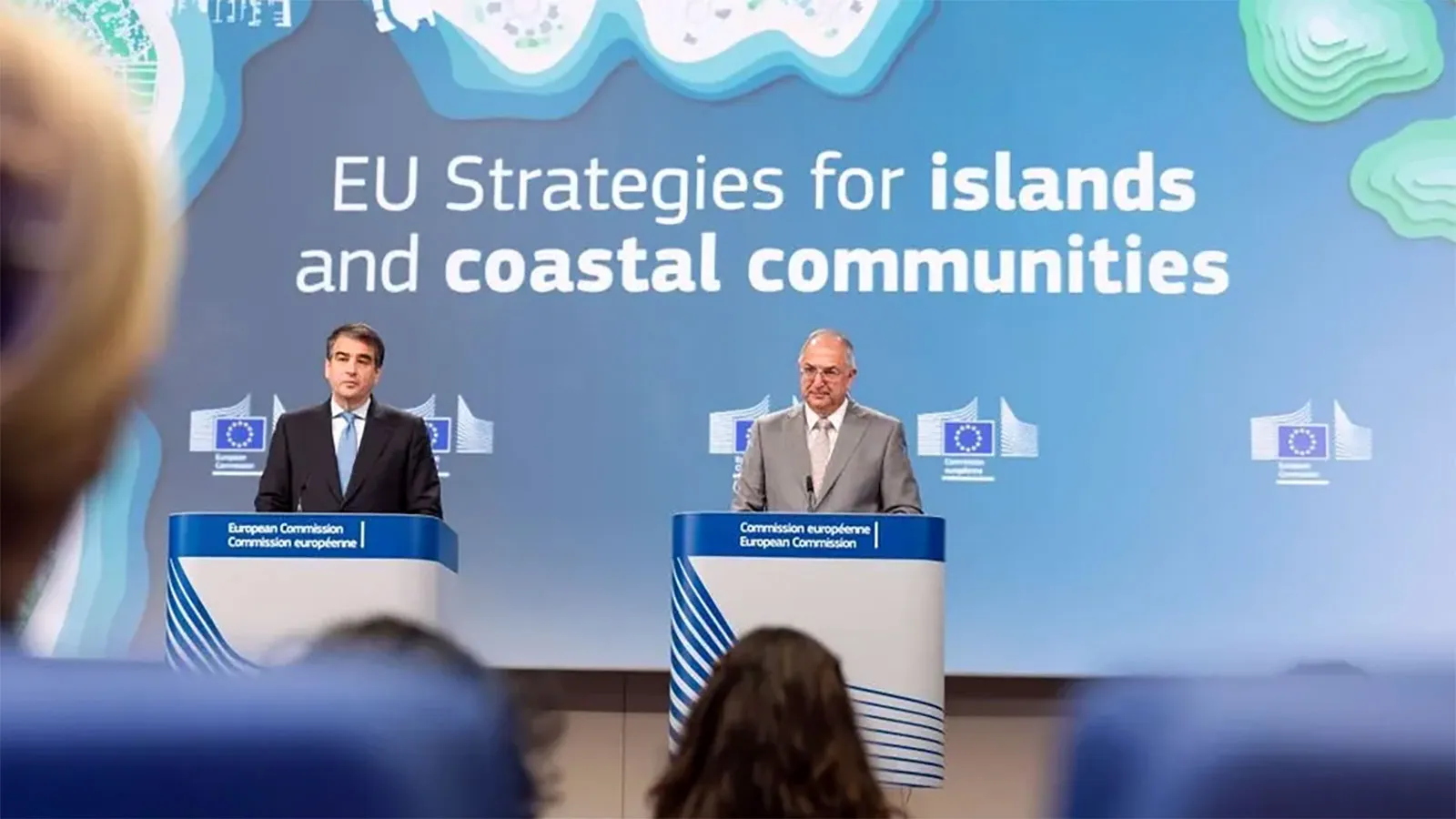
The European Commission has adopted two specific strategies for the islands and coastal communities of the European Union, with which it establishes for the first time a coordinated approach to address the needs of these territories, improve their capacity to respond to structural challenges, and leverage their economic, social, and environmental potential in the long term.
The initiatives affect 17 million people living on more than 4,000 inhabited islands spread across 16 member states and 95 million citizens residing along the 70,000 kilometers of EU coastline or in coastal areas of 22 member states. The Commission proposes an action framework that integrates economy, connectivity, energy, environment, demographics, public services, and security, with the aim of ensuring that the particularities of these territories are taken into account in future European policies.
The strategy for the islands recognizes that these territories face additional costs arising from insularity, connection difficulties, smaller market sizes, dependence on tourism and fossil fuels, pressure on housing, water scarcity, demographic loss, and limited access to essential services. The Commission points out that these factors affect both economic competitiveness and the quality of life of their inhabitants. The document recalls that islands are recognized in Article 174 of the Treaty on the Functioning of the European Union as regions with serious and permanent natural or demographic disadvantages.
The insular strategy is structured around four main areas of action. The first focuses on economic development, connectivity, competitiveness, and innovation, with measures aimed at diversifying local economies, promoting entrepreneurship, improving maritime, air, and digital connections, and supporting sectors such as sustainable tourism, blue economy, agriculture, fishing, and digitalization. The Commission will also analyze the cost of insularity and possible measures to reduce it, especially in transportation.
The second block addresses energy security, environmental protection, and climate resilience. The Commission plans to extend the Clean Energy for EU Islands initiative during the period 2027-2030, promote the exchange of good practices among member states, and create a voluntary platform of insular network operators to work on renewable-based energy systems. Greater attention is also proposed for the protection of sensitive marine ecosystems, water management, waste, and adaptation to phenomena such as coastal erosion, sea level rise, or droughts.
The third pillar targets communities, demographics, and quality of life. The Commission identifies priorities such as access to affordable housing, education, healthcare, digital connectivity, transportation, and public services. Islands often face aging populations, youth out-migration, and difficulties attracting qualified professionals. In this area, Brussels anticipates measures related to youth mobility, administrative simplification to facilitate sustainable housing, and support for public authorities in areas under residential pressure.
The fourth block is linked to security and crisis preparedness. The Commission believes that many islands have strategic value due to their geographic location, role in external border surveillance, protection of critical infrastructure, and maritime security. The document mentions the importance of ports, airports, submarine cables, energy networks, and communication systems, as well as the need to integrate insular specificities into national security, migration, and civil protection strategies.
The second strategy is dedicated to coastal communities and proposes three priorities: prosperity, resilience, and livability. The Commission starts from the diversity of these territories, which range from small fishing communities to large port and industrial cities. The objective is for European policies related to the sea, cohesion, energy, climate, research, transportation, and the environment to operate under a common framework that allows adapting responses to each local reality.
In terms of prosperity, Brussels positions sustainable blue economy as one of the key development axes for coastal areas. The document includes fishing, aquaculture, ports, maritime transport, shipbuilding, marine renewable energy, blue biotechnology, coastal tourism, and services associated with ocean observation. The Commission estimates the gross added value generated directly by the European blue economy at about €263 billion per year, although it warns that some sectors remain underfunded.
The strategy also includes new business models linked to fish tourism, local value chains, low trophic level aquaculture, blue bioeconomy, blue carbon credits, and services based on oceanic data. In this area, the OceanEye initiative will play a relevant role in improving ocean observation, assessing climate risks, detecting maritime security threats, and providing useful information for authorities, businesses, and local communities.
In the environmental realm, the Commission identifies coastal communities as territories particularly exposed to climate change, loss of marine and coastal biodiversity, pollution, erosion, flooding, saline intrusion, and ecosystem degradation. The document warns that, without mitigation and adaptation measures, annual damage from coastal flooding in the EU could rise from the current €1.25 billion to a range between €93 billion and €961 billion by the end of the century.
To enhance resilience, Brussels proposes to map investments for coastal adaptation alongside the European Investment Bank, expand risk assessments, develop technical capacities in local authorities, and extend the CoastWAVE initiative, aimed at alert systems and threat assessment in coastal communities. The Commission also plans to more intensively incorporate climate adaptation into maritime spatial planning through the future European Ocean Law.
The coastal strategy also includes measures on affordable housing, maritime culture, local heritage, and quality of life. The Commission acknowledges that some coastal areas face tourist pressure, seasonal economic activity, lack of housing for residents and essential workers, and youth out-migration. To address these situations, Brussels is preparing an Affordable Housing Law and a pan-European investment platform aimed at mobilizing financing for social and affordable housing.
Both strategies align with the European Ocean Pact, presented in 2025, and with European policies on cohesion, climate action, sustainable development, maritime security, and energy transition. Outermost regions are excluded from these proposals, as they will have a specific strategy due to their unique status under Article 349 of the Treaty on the Functioning of the European Union.
The Commission invites member states to incorporate specific measures for islands and coastal communities into their future national and regional plans, as well as to use territorial investment instruments that allow for the design of integrated actions. It also proposes a periodic dialogue with representatives of these territories, technical support, exchange of good practices, and greater local participation in the planning of European policies with maritime and coastal impact.