
Slovenia’s new conservative-led government on Thursday lifted an arms embargo on Israel and entry bans on Prime Minister Benjamin Netanyahu and two of his ministers.
Last year, Slovenia, then under liberal prime minister Robert Golob, imposed a series of measures against Israel over the war with Hamas in Gaza.
Several other EU members have done the same.
But the government of Prime Minister Janez Jansa, which took office last week, overturned the bans against Netanyahu and National Security Minister Itamar Ben Gvir and Finance Minister Bezalel Smotrich.
“This will restore the conditions for a normal political dialogue with Israel,” it said in a statement, adding the move would help “strengthen the role of the Republic of Slovenia in the efforts to achieve a lasting peace in the Middle East.”
Get The Times of Israel’s Daily Edition
by email and never miss our top stories
By signing up, you agree to the terms
The country is also letting the arms embargo expire, considering the decree “unnecessary” given existing national defense laws and EU arms export criteria, it said.
The government of Jansa — an admirer of US President Donald Trump — also lifted a ban on imports from Jewish settlements in the West Bank.
Foreign Minister Gideon Sa’ar welcomed Jansa’s “swift and just decision to lift the distorted anti-Israeli measures taken by Slovenia’s previous government,” calling him a “bold leader and a true friend of Israel.”
Last week, Israel announced it will open an embassy in Slovenia, marking what it hopes will be a new chapter in relations with the European country. The country’s embassy in Austrian capital Vienna has previously covered Israeli diplomatic interests in neighboring Slovenia.
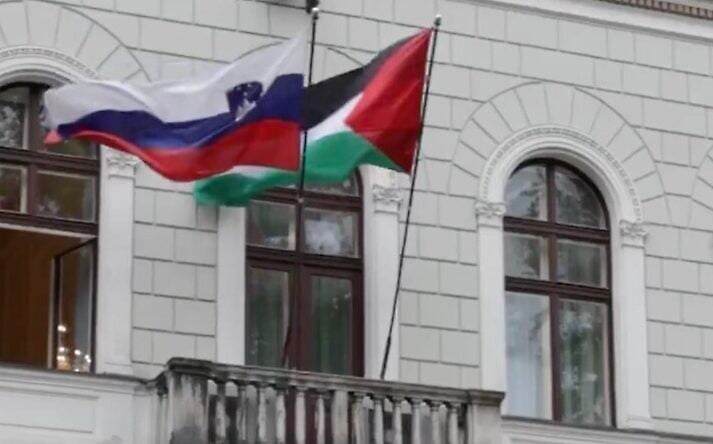
Screen capture from video of the Palestinian flag flying over the Slovenian Presidential Palace, June 5, 2026. (Nataša Pirc Musar/X)
Since taking office, Jansa’s government has also removed a Palestinian flag symbolically displayed on the government building since Slovenia recognized Palestinian statehood in 2024.
Ties between Israel and Slovenia had soured under the previous government of Golob, which also characterized Israel’s military offensive against the Gaza-ruling Hamsa terror group as “genocide.”
We can’t do this work alone.

The war with Iran has been draining for all of us in Israel. But when I heard about a high casualty incident – ballistic missile impacts in Arad and Dimona that left nearly 200 people wounded – I drank a cup of coffee, packed a bag, and headed south.
There, I spoke with Shilgit, the head of an after-school program for underprivileged youth. Standing outside her destroyed center, Shilgit said it was a miracle that no children were hurt and spoke about the community coming together in the hours since.
As a Times of Israel reporter, I’m committed to telling stories of resilience like Shilgit’s. But my colleagues and I can’t do this alone. If you value work like this, please consider joining our reader support group, The Times of Israel Community. Your financial support is essential to keep real human reporting like this going.
— Stav Levaton, military reporter
Already a member? Sign in to stop seeing this
You’re a dedicated reader

That’s why we started the Times of Israel – to provide discerning readers like you with must-read coverage of Israel and the Jewish world.
So now we have a request. Unlike other news outlets, we haven’t put up a paywall. But as the journalism we do is costly, we invite readers for whom The Times of Israel has become important to help support our work by joining The Times of Israel Community.
For as little as $6 a month you can help support our quality journalism while enjoying The Times of Israel AD-FREE, as well as accessing exclusive content available only to Times of Israel Community members.
Thank you,
David Horovitz, Founding Editor of The Times of Israel