
Problem
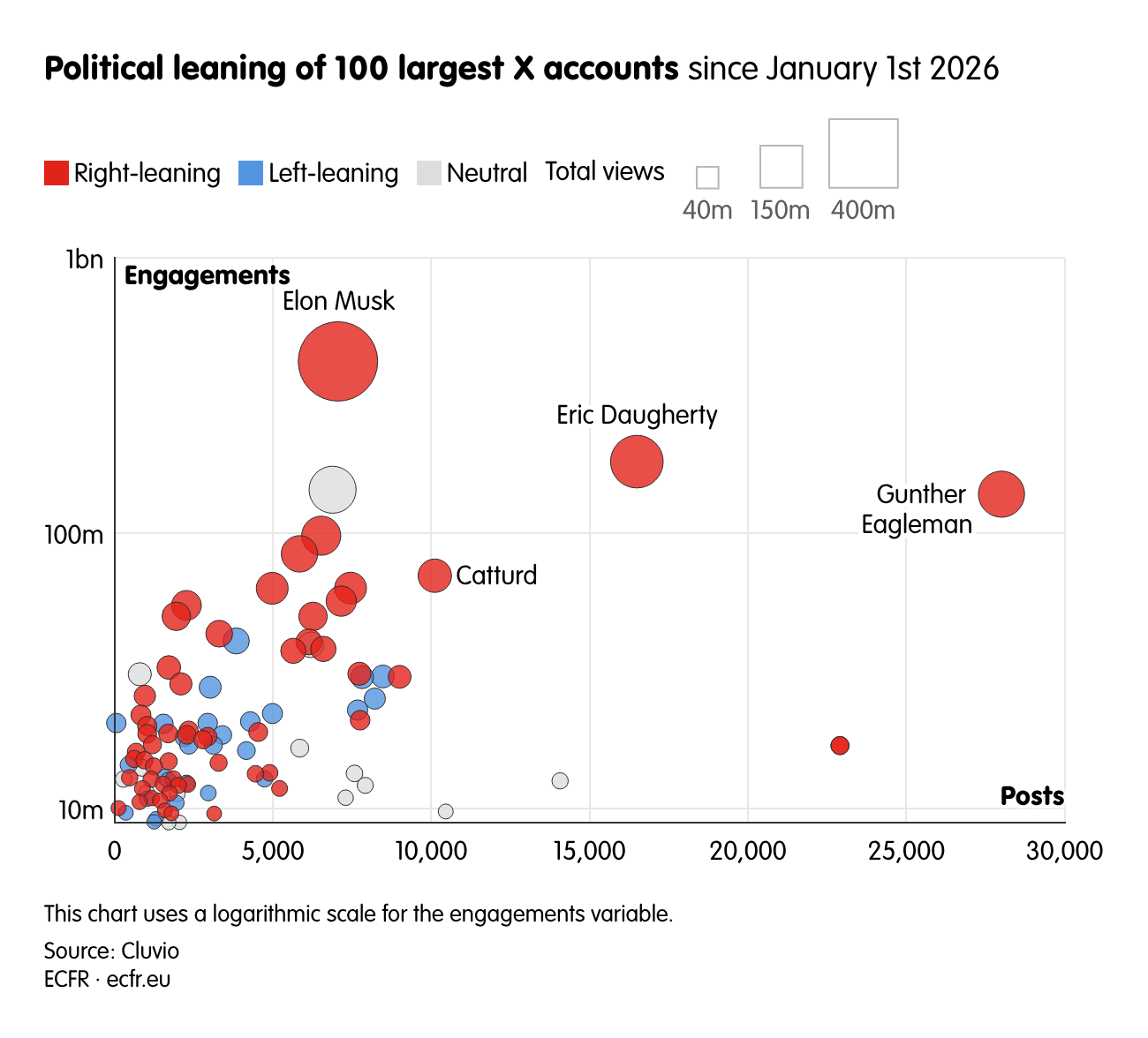
Elon Musk has escalated his campaign against Britain. He has called its prime minister a criminal, backed a far-right party, amplified fabricated statistics about quarter of a million girls raped by migrants to his 240 million followers—and now he has written “RAGE” in response to the murder of Henry Nowak. Musk is trying to destabilise democratic governments and empower the far right across Europe.
In the US, Musk reorganised X’s algorithm to amplify right-wing voices and suppress Democratic accounts. In Germany, he boosted the Alternative for Germany party ahead of the February 2025 federal election, and spread a fabricated quote about EU election interference that received 21 million views. In Spain, when prime minister Pedro Sánchez proposed age-gating social media, Musk called him a “dirty tyrant and traitor”. He averages nearly three media-attack posts per day.
Think of X this way: one person manufactures the only television set on the market, owns the only channel it broadcasts and uses both to advance his political agenda—which is to encourage viewers to riot in the streets.
Response
The EU’s Digital Markets Act and the Digital Services Act together provide the legal architecture for two complementary remedies. But they remain unused.
The first remedy is to introduce mandatory interoperability: requiring X to open up the connections, content and follower relationships its users have built—and which currently lock them in—to third-party providers on fair, reasonable and non-discriminatory terms, so people could move out of X and remain connected to their followers.
The second is mandatory algorithmic choice: requiring X to offer users genuine alternatives to Musk’s proprietary recommendation engine—allowing people more control over what they see, and ensuring political orientation is no longer determined by the preferences of the platform’s owner.
This would break Musk’s exclusive control over what X’s 557 million users see and in what order—allowing independent developers, fact-checkers and civil society groups to offer alternative ways of curating and moderating content on the same platform. A user could choose an algorithm that prioritises verified news over inflammatory content, or a moderation layer that filters out disinformation, all without leaving X or losing their audience.
The contrast with the US is instructive—and damning. In 2024, Washington enacted PAFACA, the Protecting Americans from Foreign Adversary Controlled Applications Act, which placed Chinese-owned TikTok’s algorithm under US ownership. Europe faces a more direct threat from X under Musk’s direction.
Alongside the two remedies above, a coordinated UK-EU response, grounded in existing law and implementing structural platform remedies rather merely content moderation, would only strengthen European Commission efforts and at the same time help Britain save its democracy.
Context
After the 2025 German federal election, Merz said Musk should face consequences for his meddling. But nothing happened, and the billionaire continues to weaponise his platform against European democracies. The European Commission has built substantial infrastructure to counter Russian disinformation. But it has shown a striking reluctance to apply the same framework to American-origin interference—even though Musk’s political interventions are more consequential than anything Russian information operations achieved in the same period. The asymmetry is indefensible.
This commentary was supported by funding from Luminate Projects Limited.
The European Council on Foreign Relations does not take collective positions. ECFR publications only represent the views of their individual authors.